CAVU Café: Royboy’s Prose & Cons, Page 6 of 17 The views expressed in CAVU Café: Royboy’s Prose & Cons blog are those solely of the writer and are not necessarily shared by the Aviation Suppliers Association or the Association’s staff, members, or Board of Directors. About Roy Resto Labor Shortage Mitigation StrategiesPosted By Roy Resto | October 01, 2021
Before getting started, I’d like to offer some advice to those already on the job market, or considering placing yourself on the market, or if your firm is in discreet discussions with an applicant: Obtain your training records from your previous or existing employer. It’s always a good idea to have copies of your training records, but more so in the dynamic employment market we find ourselves in today, especially since your furlough may come unannounced. My clients frequently hire ‘experienced’ employees and ask can the employee be waivered from qualifications or training requirements? The answer is yes, but most easily facilitated if the training or qualification you seek to waiver is demonstrably documented from the previous employer or other records. Also consider that:
Now onto our stated subject matter. As if the current labor shortage was not enough, consider this excerpt from the Boeing Pilot and Technician Outlook 2021-20401: “Long-term demand for newly qualified aviation personnel remains strong, as 612,000 new pilots, 626,000 new maintenance technicians and 886,000 new cabin crew members are needed to fly and maintain the global commercial fleet over the next 20 years.” This likely portends continuing, future challenging labor requirements across the entire aviation sector, but what about now? The topics to be discussed include the following:
USE OF HEADHUNTERS
Before reaching out to a recruiter make sure to have an up to date and accurate job description. If you’re ever considering using candidates from other countries (see below), Recruiters typically have HR expertise in this area. USE OF CONSULTANTSIn a shameless plug for persons like myself, consider the use of consultants under the following circumstances or for the following reasons:
USE OF WORKERS FROM OTHER COUNTRIESOne of my clients just hired a person from the middle east to fill a Chief Inspector position in the USA. I’ve worked with this person, and everyone seems delighted with his fit and performance. The pros and cons:
Disheartening postings I see frequently on Linked In, is where a firm is hiring for desirable positions but posts “Sponsorships not available”. Also, when a company is posting for desirable positions, but neglects to post “Sponsorships not available”, and many out-of-country candidates respond with hopeful submissions, only to be turned down. Don’t be afraid, even if you’re a small sized firm. Persons I have interviewed for this article strongly recommended using the services of an immigration attorney, as they have themselves. In the USA the most common visa used for these purposes is the H-1B. By the way, at the end of this article I have posted an Appendix as a primer on the process. USE OF INTERNSBy ‘Interns’ I mean students at local universities, colleges, or technical schools. Typically, they are used for short engagements, and likely on a part time basis. I’m particularly keen on this option since I have had mostly productive outcomes with these students. There are advantages for both sides:
Persons I interviewed for this article strongly recommended using an online service called Handshake for the purposes of reaching out to local institutions for interns: Nothing however can beat calls to your local education outlets for interns. Ask for HR or Recruiting. This is best for technical colleges where you may be seeking technicians for your repair station/AMO, for example. By the way, just some ‘Royboy’ counsel: I’ve seen too often that interns are given a dark corner and menial tasks and appear discouragingly disconnected from the mainstream activities of the firm. Include them on some of your meetings, ask them for their recommendations, take them out to lunch, and challenge them with interesting tasks; you may be surprised at the results. USE OF PERSONS OUTSIDE OF AVIATIONWe are fortunate in the aviation industry that so many people look at aircraft longingly and romantically and are fascinated by all things involving flight. In fact, most of us in aviation probably exhibited these same characteristics before joining the work force. For those reasons it’s not a bad idea to leverage that interest and take a risk on hiring persons outside of aviation to fill your positions. Consider:
Before doing this, give some consideration to your onboarding process. Minimally, create a carefully thought-out listing of all the major tasks and duties associated with performing the job. Then assign staff to systematically impart the training for each listed task. NON-TRADITIONAL LABOR SOURCESA current trend in the corporate world is to be conscientious of your firm’s ESG profile. Environmental, Social, and Governance (ESG) criteria are a set of standards for a company’s operations which socially conscious investors use to screen potential investments. Environmental criteria consider how a company performs as a steward of nature. Social criteria examine how it manages relationships with employees, suppliers, customers, and the communities where it operates. Governance deals with a company’s leadership, executive pay, audits, internal controls, and shareholder rights. For this article I really want to focus on the “S” of ESG, particularly your relations with your community. Do you really want to make a difference for a mutually beneficial outcome? Consider using people who have paid their debt to society and are transitioning from incarceration back to mainstream life. Usually when this suggestion is mentioned it’s followed by a long pregnant pause, and understandably so. Ask yourself these questions: Q: In instances where there has been theft in your company, was it perpetrated by a former prison inmate? A: No. Q: In instances where you have had to let go of employees for not showing up to work on time, or being chronically absent, were they former prison inmates? A: No. Q: That time you had to let that employee go due to poor performance, despite your best counseling and training efforts; where they former prison inmates? A: Umm…No. The point being that you’re already taking risks for anyone you hire. As with hiring persons from other countries, this course of action will require some effort. Persons I spoke with who work with transitioning inmates suggested the following:
A friend in the community who is a CEO for an aviation firm has hired such workers. One of those is now a VP in another company over several locations; a former felon who was given a chance. HIRE VETERANSMany of you hardly need any encouragement to follow this course of action. Yet others of you do not have this as a goal in your HR hiring plans. For those in the latter group, consider the following:
When we say ‘Veterans’, we really mean two categories of former military members:
For those already in the civilian work force, they’re likely to be treated as anyone else on the job market. If you have it in your ESG plan to hire vets, then when resumes/CVs come across your desk, consider giving grading points for vets, especially those already in the work force. This is particularly helpful since candidates who are already in the civilian work force often get their veteran status overlooked. Being able to hire veterans just transitioning out of active duty presents a unique opportunity to tap into a valuable resource. Consider that just in the USA, 200.000 transition out of the military each year3. There is a plethora of online services to facilitate your search. A good place to start is with RecruitMilitary3. AB INITIO AND APPRENTICESHIP PROGRAMS Ab inito, meaning from the beginning, is an industry term that describes airline-oriented flight training programs that take you from zero experience through commercial pilot. Many airlines use this model to train their candidates from scratch. This is typically facilitated by an employment agreement to work for the airline for a stated period and to pay back the investment in training. Note that this pilot training takes minimally 2 years. There are some career fields so difficult to find qualified candidates, that this becomes an attractive alternative. Ab initio implies that someone else is doing the training which you are underwriting. An example might be that your MRO needs welders which are in short supply. Why not send someone you’ve already vetted and interviewed, or perhaps an existing employee to school on your dime, under an employment contract as previously suggested? More ‘Royboy’ counsel: When doing so, consider that the person needs to make a living while in school! Pay them something reasonable so they can pay their bills. Other more in-depth programs will likely develop, such as Ab Initio for Technicians as Deutsche is doing4. Apprenticeship programs are another emerging pattern to ‘home grow’ your hard-to-find skilled employees and is an inhouse alternative to Ab Initio. Lufthansa Technik has several such programs with over 650 enrolled5. Over ‘n out Roy ‘Royboy’ Resto AIM Solutions Consulting/FAA-DAR www.AimSolutionsConsulting.com 1 https://www.boeing.com/commerc... 2 https://www.insperity.com/blog... 3 https://recruitmilitary.com/ 4 https://www.ainonline.com/avia... 5 https://www.avitrader.com/2021... APPENDIX: Sponsoring a foreign national: What you should know2What common types of visas are there? Visa categories cover a broad range of non-immigrant or temporary visas depending on the specific kind of work, but some of the most common are: 1) H-1B – Non-immigrant, employment-based visa for temporary workers Duration: Starts off for up to three years but can be extended for an additional three years with the option to extend to temporary status if the company is willing to sponsor the employee’s citizenship. 2) J-1 – For researchers, scholars or student/exchange visitors Duration: There are different types of J1 visas. The duration of each depends on the program. The work performed must be part of the participants approved program. For example, a short-term scholar program may be granted six months, while a professor or research scholar may have a duration of five years. 3) F-1 – For students Duration: The work visa will depend on form I-94 and I-20. Grants permission to work part time on campus (20 hours or less per week) and are eligible to apply for off-campus employment – OPT (see below) – in their field of study. 4) OPT – Optional practical training is temporary employment directly related to a F-1 student’s area of study Pre-completion OPT is limited to 20 hours per week while school is in session. Post-completion OPT students may work full time. Duration: Per authorization documents Typically these are for students in certain science, technology, engineering and math (STEM) fields, who may apply for a 24-month extension of OPT employment authorization following graduation if they meet certain conditions. 5) CPT – Curricular practical training or temporary authorized training Duration: As directed by program and authorization documents CPT is very similar to OPT, except CPT work can be either full-time or part-time, and a signed cooperative agreement or a letter from the employer is required. OPT and CPT can later be transferred by the employer if the employer wants to sponsor these visa holders for H-1B visas. 6) H-4 – For the spouse or dependents of an H-1B visa holder Duration: Generally, H-4 visas expire automatically if the associated H-1B expires or is not renewed. H-4 visa holders may work full time if the associated H-1B is valid. 7) L-1 – Transfer of a foreign employee to work in an U.S. office of the same employer. For those in management, executive or specialized knowledge positions. Duration: Starts off for three years and can be extendable to a maximum of five years L-1 visa holders cannot transfer to another employer. If they resign or get fired, they must leave the country. If employed in a managerial or executive position for one continuous year in the preceding three years (in the U.S. or outside the U.S.), you can apply for green card in EB1C category immediately. How do I sponsor a foreign national?Follow these seven steps to successfully identify, recruit, vet and sponsor a non-U.S. citizen: 1. Determine what position the hire will fill The type of job will have a bearing on how much red tape is involved and the type of visa required by the employee. First, decide what roles within the company you will fill with foreign nationals. While there are dozens of possible fields, the majority of visas are granted to applicants within six specific disciplines. Recent yearly data by the U.S. Customs and Immigration Services (USCIS) shows most of the approved H1-B petitions went to computer-related occupations by a more than 4-to-1 margin over the next highest occupations of architecture, engineering and surveying, education, administration and medicine/health. 2. Conduct recruiting process, background checks and verification of documentation Determine the proper immigration visa program (H-1B, L-1, etc.) for your recruiting needs. The most important question: Will the employee become a permanent resident or is this a temporary hire? Conduct the same rigorous recruiting process used to identify qualified domestic candidates. Allot additional time for your international recruitment efforts, as it may take longer to verify foreign college degrees and other documentation. This verification process can take weeks to months, depending on the country. An H-1B visa is the most common, often called a U.S. work visa. These are granted to eligible temporary workers with employer sponsorship. H-1B visa sponsorship cannot be offered until the candidate’s background check is complete. U.S. companies may hire any foreign national as long as they are already in the country and are eligible and authorized to work in the United States. Federal law requires all employees complete an I-9 form for legal identification. All foreign hires must also have a valid work visa from the U.S. Customs and Immigration Services. 3. Apply for a work visa Consult an immigration attorney. H-1B visas are very popular because they allow the holder to live and work in the U.S. while seeking permanent resident status. Historically, the quota has been filled quickly. 4. Obtain Department of Labor certification Before formally applying for a candidate’s visa with the U.S. Customs and Immigration Services (USCIS), your next step is obtaining a certification from the US Department of Labor. This is a complex process. In a nutshell, requesting certification means that the employer has made the case to the Dept. of Labor that all efforts to recruit a U.S. worker for the position have been exhausted and that the identified candidate meets the skills and qualifications required for the role. The certification required will depend on the type of business, but typically takes eight to 12 weeks. Contact USCIS to verify which certification will suit your needs. Part of this step is the submission of a Labor Condition Applications by the employer to the Department of Labor via Form 9035. The LCA details the conditions employers must meet in the process. 5. Comply with insurance requirements Since the passage of the Affordable Care Act (ACA) in 2010, there have been significant changes to the health care industry and some of those changes affect H-1B visa holders. Foreign nationals are not obligated to maintain coverage, but once they become a “resident alien,” as defined by federal laws, H1-B visa holders are subject to ACA laws. Insurance obligations are the responsibility of the employee, but companies may assist in the process or offer company insurance. 6. Meet salary and benefit requirements The salary for an H-1B employee cannot be less than the typical wage for the position or occupation. The employee must be given the same benefits as other employees in a similar position at the company. The employer, not the employee, is responsible for all costs associated with filing the application for an H-1B petition. The employer may not charge these costs to the employee or seek reimbursement from the employee. While some of the fees for H-1B applications are standard, such as the basic filing fee ($460) and fraud prevention and detection fee ($500), others are based on how many workers the filing company employs and can vary from hundreds to several thousand dollars. Typically, the cost to an employer will run between $2,500 and $7,000. 7. Cross your fingers The processing time for H-1B visas varies. NOW!: Distributors/MROs Need to Establish Contact with Emerging Technology CompaniesPosted By Roy Resto | August 02, 2021
Who among us has not experienced that feeling in our lifetime of having missed an early opportunity to get on board with something new? At this very moment that same feeling should be sending out alarms! We are on the cusp of a revolution in air transportation of cargo and passengers. Now is the time for Distributors and MROs to aggressively forge ties with the emerging firebrands of this movement, and to creatively develop new methods to support it while the distribution of spares and performance of maintenance is still in the formative stages. This revolution is characterized by the simultaneous development of emerging technology and operations, herein briefly summarized:
This new and emerging technology has of course, created many new acronyms. Among these: UAM: Urban Air Mobility UAS: Unmanned Aerial System UAV: Unmanned Air Vehicles UCAV: Unmanned Combat Air Vehicles VTOL: Vertical Takeoff and Landing- Helicopters are the traditional VTOLs. eVTOL: Electric Vertical Takeoff and Landing SC-VTOL: Small Category Vertical Takeoff and Landing Here is actionable intelligence: At the end of this article, after considerable effort, is a listing of companies in this new space which distributors and MROs should research for possible opportunities; throw that challenge to your business-development staff! In development: Design and certification of aircraft, creation of new operations procedures, integration of these new aircraft into the existing aircraft operations environment, and certification of pilots are all occurring at a frenzied pace with now daily press releases of firms seeking to impress investors, and regulators informing us of their efforts to instill a modicum of standardization and order for these processes. An interesting and creative hint of how some of this may manifest is in Joby Aviation’s deal with the U.S.’ largest parking garage operator allowing it to secure long-term rooftop leases for vertiport (UAM takeoff and landing) sites. The companies will focus initially on Los Angeles, Miami, New York and the San Francisco Bay Area. Converting the rooftops of underused parking garages into vertiports is seen as an early opportunity to expand the infrastructure for urban air mobility beyond the limited number of heliports now available3. Investment and Airline Involvement: Consider that in just the first months of 2021, investors contributed $4.5 Billion into the blossoming advanced air mobility industry. The goal is that commercial aerial ride-sharing will become a reality in 20242. Airlines have taken notice and with typical fanfare have placed significant orders with these upstart manufacturers as illustrated below1. 
And this just in, Japan Airlines is also jumping into the eVTOL market with their buys going to Volocopter5. Another headline as I write: “DHL to pilot use of large cargo drones in Europe.8 Developer Dronamics is establishing 39 droneports across the continent. DHL said Monday it could use up to 4,000 heavy-cargo drones operated by Dronamics for its logistics and parcel network in Europe.” “ Right now carriers are stuck buying the latest version of 30 or 50 year old twin engine airplanes. The History of technology suggests that, at some point, there will be radical disruption, and airlines want to be part of that when it happens.”1Certifying Artificial Intelligence (AI): The way to profitability: If Urban Air Mobility takes off in 2024 as planned, there is no doubt that the flights will be crewed by a pilot (take notice I’ve succumbed to the PC demand to use genderless references by using the term ‘crewed’ as opposed to that pesky legacy term, ‘manned’). In addition, since these initial aircraft will be small and carry a very limited amount of passengers, there are some who question the profitability of these initial operations. On the other hand, when these flights are able to be flown autonomously (read that pilotless), a new level of profitability will take hold. If so, Artificial Intelligence will be a key enabler of autonomous passenger flight4. Note that Machine Learning (ML) and AI are often equated with each other and mentioned in the same sentence. EASA has taken notice of all this and appears to be positioning itself to certify the first AI/ML software which would be key to facilitate autonomous operations. Research is underway to define this process6. This is all particularly interesting for two reasons:
Techno savvy: For those of us who want to dig a little deeper into the brave new world of electric propulsion, the following article nicely introduces us to the new techno-speak; it’s titled “What are the main challenges to using electric propulsion in commercial aviation?9” Royboy predicts:
BTW: A good source for UAM news is at this site: https://www.urbanairmobilitynews.com/ Here’s the listing of companies I researched and put together in alphabetical order for your biz-dev department: 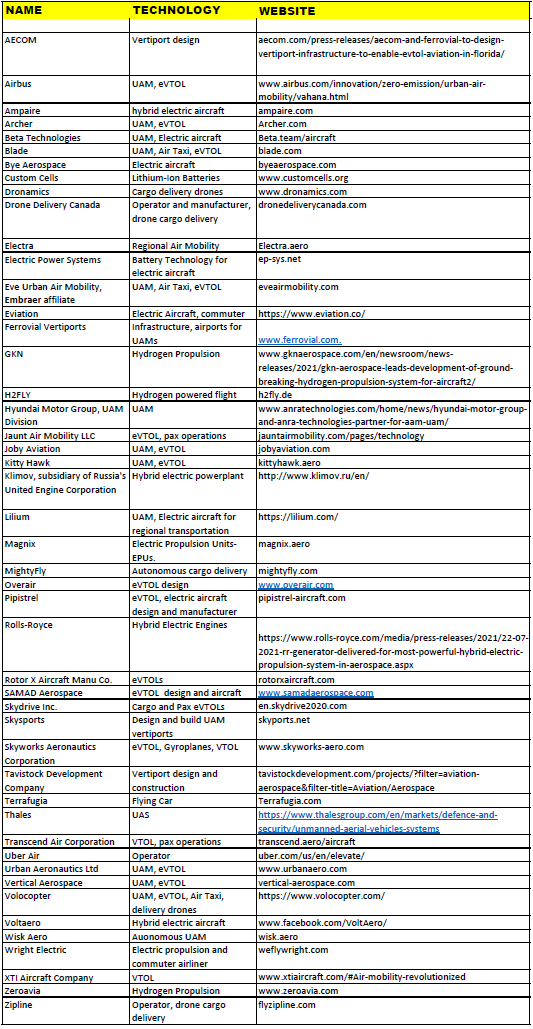 Make it happen! Roy ‘Royboy’ Resto AimSolutionsConsulting.com 1 What Do Airlines Want from eVTOLS?; Aviation Week & Space Technology, June 28-July 11, 2021, page 64. 2 Vertical Ambition; Aviation Week & Space Technology, June 28-July 11, 2021, page 66. 3 Joby Eyes Rooftop Vertiports; Aviation Week & Space Technology, June 28-July 11, 2021, page 70. 4 Certifying Artificial Intelligence Is The Key To Automating Air Mobility; Aviation Week & Space Technology, June 14-27, 2021, page 36. 6 https://www.easa.europa.eu/research-projects/machine-learning-application-approval 7 https://en.wikipedia.org/wiki/DO-178C 8 https://www.freightwaves.com/news/dhl-to-swarm-europe-with-4000-cargo-drones THE COLLIER TROPHYPosted By Roy Resto | August 02, 2021
There are lots of awards, trophies, and recognitions in aviation, but the Collier is among the most historically significant and longest running of them all. This is going to be a departure from the usual fare, but a fun one! I recently read a magazine piece on the finalists for this trophy (see below) for the recent year which triggered this article. Since 1910 the Trophy has been given annually for: "…the greatest achievement in aeronautics or astronautics in America, with respect to improving the performance, efficiency, and safety of air or space vehicles, the value of which has been thoroughly demonstrated by actual use during the preceding year" 1 . 
For both history buffs and astute observers of leading-edge aviation technology, following the Collier Trophy is rich. 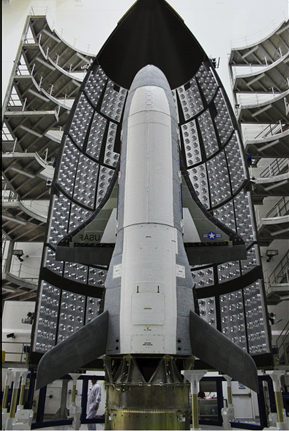
As of this writing in 2021, here are the finalists for the 2020 Trophy 3: The Bell V–280 Valor The Bell V–280 tilt-rotor aircraft has a 12,000-pound useful load and can deliver up to 12 troops from 500 to 800 nautical miles at 280 knots—more than twice the current range and speed—and with agility “greater than a traditional helicopter’s capabilities,” according to the manufacturer. Boeing Confident Travel Initiative Through the Boeing Confident Travel Initiative, health and safety remain high on the priority list during the resumption of air travel and the relaxing of coronavirus pandemic restrictions. Boeing and its industry partners including airlines, regulators, and other organizations are working through the initiative “to enhance health safeguards and develop new solutions.” Garmin Autoland The revolutionary Garmin Autoland system was certified for the Piper M600/SLS in 2020, making the aircraft the first “ever certified with a system that will land the airplane on its own should the pilot become incapacitated,” as AOPA reported. According to Garmin, the system can “automatically manage aircraft speed, engine performance and engine power so the aircraft can climb, descend or maintain altitude as needed during an Autoland activation. On approach to land, the system initiates a controlled descent to the airport.” 
Reliable Robotics Remotely Operated Aircraft System Reliable Robotics is working to bring autonomous technology to airplanes, and in 2020 the company announced achieving “historic firsts for global commercial aviation by completing successful test flights of remote-piloted passenger airplanes in United States airspace.” The first flight featured a Cessna 172 that operated autonomously from taxi to landing. Later, Reliable Robotics “demonstrated fully automated remote landing” of a larger aircraft, the Cessna 208 Caravan. SpaceX Falcon 9 and Dragon 2 Space-exploration technologies venture SpaceX’s reusable Falcon 9 rocket is “the world’s first orbital class reusable rocket,” designed and manufactured to safely and reliably transport “people and payloads into Earth orbit and beyond.” In 2020, SpaceX delivered NASA astronauts to and from the International Space Station “on American vehicles for the first time since 2011.” The next-generation Dragon 2 spacecraft is the successor to the reusable Dragon 1, and is capable of autonomously docking with the International Space Station. US Department of the Air Force Green Propellant Infusion Mission Team In 2020 NASA “validated a new type of propellant, or fuel, for spacecraft of all sizes,” as a substitute for toxic hydrazine, which requires handlers to wear protective suits and calls for special loading procedures. The validation occurred in just over a year of testing following launch on a SpaceX Falcon Heavy rocket for NASA's Green Propellant Infusion Mission. Tests of both the propellant and the propulsion system indicated that “both are practical options for future missions.” Yates Electrospace Corporation’s Silent Arrow The Silent Arrow one-ton-gross-weight disposable cargo drone demonstrated autonomous flight after being deployed from “U.S. Air Force C-130s and rotorcraft sling load operations,” according to the developer. The aircraft was designed to deliver critical equipment anywhere in the world for tactical aerospace and defense or civilian disaster-relief operations. The aircraft’s gross weight and three-quarter-ton payload capability are “500 times greater than typical quadcopter delivery drones and it can deliver lifesaving military, humanitarian supplies or vaccines autonomously and safely from up to 25,000 feet and a 40-mile standoff distance,” the developer said. CALL IT: It's just Royboy’s opinion that the Garmin entry should win, lets see... This article is being posted on 6/1/21, and the 2020 Collier winner will be announced tomorrow 6/2/21. Over ‘n out Roy ‘Royboy’ Resto linkedin.com/in/royresto AimSolutionsConsulting.com 1 https://naa.aero/awards/awards-and-trophies/collier-trophy 2 https://naa.aero/userfiles/files/documents/Press%20Releases/Collier%20Trophy%20for%202019.pdf THE IMPORTANCE OF AIRCRAFT PARTS RECORDSPosted By Roy Resto | March 30, 2021
Having worked for a major airline, the tragic memory of one of our aircraft crashing into the side of a mountain remains vivid. I was the senior QA member of management at the facility where this aircraft had all its major maintenance performed. I was off duty when the news broke. I called my on-duty staff and instructed them to sequester all the records for the aircraft in anticipation of the investigation review. As the sun rose the next day, the call came to hand these over. My thoughts immediately evolved to the quality of these records; were they accurate, where there any mistakes? In another case, a major airline’s aircraft crashed into the coastal Pacific Ocean. During the long investigation I did some consulting work for the airline directly related to the accident. Their records too, were carefully investigated. It is natural for investigators of records, upon seeing lapses in accuracy, thoroughness, or mistakes made, to conclude that such behaviors may extend to other things; if they can’t get this straight, what else are they messing up? From the moment you are born until your death, you are creating records, in this case your Birth and Death Certificates. In fact, on paper you don’t exist, or have really perished, until these records are presented upon demand. And so it is for aircraft. From the moment metal is being cut until its certificate of destruction or mutilation, there is a torrential slew of records being created. So…how good are your records? Quality Audits of Records: A significant amount of time is spent during an audit looking at records; training records, scrap records, CAR records, Management Reviews, self-audit records, etc., but this article will focus on parts records. During an audit I like to review at least two complete sets of records of parts already shipped. The records reviewed include all the documents sent to the customer with the part, and I also ask to see the customer’s PO or RO (Purchase Order, Repair Order). These records tend to be very rich in auditable material and are frequent sources of Non-Conformity Reports, NCRs. For example:
SPECIAL MENTION:
Standards and Regulations for Records: In aviation, nearly every standard and regulation will address record keeping. This applies to the entire spectrum of aviation firms such as manufacturers, distributors, repair station/AMOs, and operators. A small sampling follows:
Record Retention Period: The retention period by which you are required to have the records on file and accessible vary considerably by type of operation being performed, the Quality System you are accredited to, and any requirements your customer may impose. Because of this, these periods may vary from between 2-10 years. For those of you who may be burdened with paper records, a 10-year requirement is easily noted by the stacks of those banker boxes gathering dust in your warehouse. Make sure these boxes are carefully indexed for ease of retrieval. Back to my airline stories. In the case of my airline’s accident, the NTSB concluded that the accident was due to pilot error and technology challenges. The maintenance performed as evidenced in the records was not cited. Regarding the aircraft that crashed into the ocean, maintenance was heavily implicated, and all the records were meticulously reviewed; the source of the parts, tear-down reports, the maintenance performed, and logbooks among many others. Would you have felt comfortable if any of your records were in the lineup? Over ‘n out Roy “Royboy” Resto AimSolutionsConsulting.com THE IMPORTANCE OF BEING ON A ROSTERPosted By Roy Resto | February 01, 2021
You’ve been ‘listed’. That could be good or that can be bad! If you’re on a no-fly list, that’s bad, but if you’re on any of the following lists, consider yourself privileged. Whether you call it a Roster, Registry, or Listing of Authorizations, they all essentially mean the same thing: It’s a tabulation of names and the listing of tasks they are authorized to perform. Let’s amplify this, and by the way, regardless of what you call it, in this article I’ll use the generic term, Roster. In aviation, whether you are a manufacturer, operator (airline, Air Force, etc.), AMO/Repair Station, or accredited distributor, all have their versions of Rosters. Here’s a small sampling of some of the many types of programs requiring Rosters: Manufacturers:
Airlines:
AMO/Repair Stations:
ASA-100 Accredited Distributors:
Qualifications to be added to a Roster: Regardless of what type of entity your firm is, your system of manuals will contain a procedure which details the requirements which must be met in order for a person to be added to the Roster. For example, the ASA-100 Standard in paragraph 4.B. calls this “Authorization criteria.” Depending on the criticality of the task, the criteria by which one becomes qualified for the Roster may consist of, or a combination of, training, recurring training, experience, education, or credentials including licenses, permits, or education. The importance of being on a Roster: During my career I have had the privilege of being on many Rosters including RII, Return to Service for aircraft and components, MRBs, Conformities, and many more. If you have ever been on a Roster, detail it on your CV/Resume. Being on any Roster is a career milestone and should never be taken lightly no matter how mundane the task may feel. In this regard I’d especially like to reach out to our friends in the Accredited Distribution community. It is known that distributors don’t perform any actions regarding airworthiness or maintenance, and that their own certs are not airworthiness documents. I’ve often thought that this realization may contribute to some persons on the Roster trivializing their role. Nothing could be further from the truth. I’m constantly impressed with the quality of the non-conformities or discrepancies found by distributor inspectors regarding their visual inspections and review of documents. For some distributors, Royboy offers this counsel:
Of course, for small companies it must be recognized and accommodated that employees have to ‘wear multiple hats’. Understood and acknowledged, but be careful. Keeping the Roster Current: In this time of staff adjustments there are occurrences where the Roster is not being kept current. For some Rosters which are regulatorily required, the rosters must be updated within 5 days of the staff changes, for example FAR 145.161 (b). Regardless, it’s a reflection of your professionalism and attention to detail to keep these current. Roster variations: Some Rosters not only have the names and authorizations for the listed employees, but also contain additional information such as:
Support for employees on the Roster: For employees on any Roster, they must be given the authority and independence to perform their duties without fear of retribution or loss of their employment. Management’s support for such employees says a lot about the safety and quality culture of the firm. Over ‘n out Roy ‘Royboy’ Resto AimSolutionsConsulting.com 1 For more information see this previous article titled “MAX, ODAs, BABIES, AND BATHWATER”: https://www.aviationsuppliers.org/max-odas-babies-and-bathwater 2 For more information see this previous article titled “Cannibalizing, Robbing, and Swapping Aircraft Parts”. https://www.aviationsuppliers.org/Cannibalizing-Robbing-and-Swapping-Aircraft-Parts WILL THERE EVER BE A SINGLE SET OF GLOBALLY ACCEPTED CERTIFICATION STANDARDS?Posted December 01, 2020
I do a lot of work with Repair Stations/AMOs (Approved Maintenance Organization). For MROs (Maintenance Repair and Overhaul) which do business internationally, the customer’s national CAA (Civil Aviation Authorities) often require that maintenance performed on aircraft based there be performed by MROs certified to their nation’s regulations. Thus, it is common to see MROs with multiple certifications for all the nations they do business with. Each nation typically charges fees, and requires a dedicated Manual (AKA Expositions, Supplements, etc.) detailing how their regulations will be implemented by the MRO. Manufacturers of aircraft and engines similarly must endure multiple certifications as this headline demonstrates1: 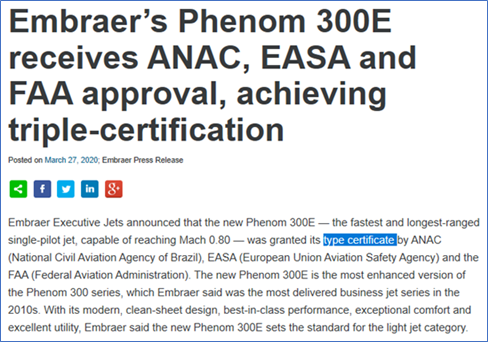 For airlines it is the same. You must get certificated in your host nation followed by whatever additional certifications are required to fly to international destinations. For MROs, Airlines, and Manufacturers involved in these maddeningly multiple certifications, all ask privately, when will there ever be a single set of globally accepted standards? The answer is, it’s complicated. Yes, it’s possible, and it will occur, but first some interesting realities to discuss. To start, let’s look at a few topics:
FEES: Ask anyone involved with these multiple certifications and they will hiss at the fees and costs being accrued to achieve the certifications they are being required to obtain. Add to this, these significant collateral costs:
CAAs will not likely divulge it publicly, but if we’re honest we must look at the possibility that the fees contribute to their sustainability, and thus are internally looked upon favorably, perpetuating the certification requirement. NATIONAL SOVEREIGNTY: A nation’s right to make their own laws is universally accepted and tied to the ideals of sovereignty; the nation is sovereign and will make any laws or regulations it deems to be in its best interest. And so it is with their aviation laws and regulations. The idea of subordinating or delegating one’s own domestic aviation laws and regulations to an international standard would predictably chaff against nationalistic sentiments. COMMONALITY: If you have ever been involved in implementing and maintaining multiple CAA certifications for your products or services, you’re immediately struck by the degree of commonality among them. CAA’s admirably and harmoniously implement rules and regulations which appear to be best practices globally. A good recent example is the various CAA’s requirement to implement Safety Management Systems (SMS), so multiple certifications will require you to implement SMS. Because of this, a reasonable, unbiased person would conclude that all of this represents irrational duplication of effort. RECIPROCITY: The current state of any global acceptance activity is entrenched in nation-to-nation statecraft, and that word endeared among generations of diplomats: reciprocity. In simple words, if your country accepts my requirements, I’ll accept yours. If you charge me fees, I’ll charge you fees. If you suspend or revoke my nations aviation companies, the same will happen to you. A common title used to identify reciprocal acceptance of nation-to-nation requirements is Bilateral Agreement. For example, the FAA maintains a publicly available listing2 for the US’s Agreements. Bilaterals are meticulously negotiated, take time, and have the potential to be influenced by politics. Because of this, it’s hardly the model which would usher-in globally accepted standards. GOING FORWARD: While some nations may exhibit hubris in claiming to have the best set of aviation regulations, due to the reality of international politics it is unlikely that any one nation would emerge to be the universally accepted global standard. So, what’s needed? Mutual recognition between the nation and the standard/regulation-setting organization. But who? To be globally accepted, you’d need an organization which is independent (not connected with any country), probably a non-profit, and which commands a degree of respect in the aviation community. Today we have two such organizations: ICAO (International Civil Aviation Organisation3) and IATA (International Air Transport Association4). But first a little history. HISTORICAL BASIS: For those of you who may take the time to read the fine print on many aviation documents, you’ll likely have noticed references to the Chicago Convention. For example, on the Incident/Accident Clearance Statement there is this entry: “A. none of the above-listed article(s), has been: 1. damaged during, or identified as the root cause of, an accident or an incident subject to mandatory reporting as described by Annex 13 to the Chicago Convention, …” By the way, for those of you curious about that commonly seen statement, an aviation accident is defined by the Convention on International Civil Aviation Annex 13 as an occurrence associated with the operation of an aircraft, which takes place from the time any person boards the aircraft with the intention of flight until all such persons have disembarked, and in which a) a person is fatally or seriously injured, b) the aircraft sustains significant damage or structural failure, or c) the aircraft goes missing or becomes completely inaccessible. Annex 13 defines an aviation incident as an occurrence, other than an accident, associated with the operation of an aircraft that affects or could affect the safety of operation. The Convention on International Civil Aviation, also known as the Chicago Convention, established the International Civil Aviation Organization (ICAO), a specialized agency of the UN charged with coordinating international air travel. The Convention establishes rules of airspace, aircraft registration and safety, security, sustainability, and details the rights of the signatories in relation to air travel. The Convention also contains provisions pertaining to taxation5. The Chicago Convention originally had 52 signatories in 1944. Today 191 nations have signed-on to recognize and operate by ICAO’s Convention on International Civil Aviation known as Doc 7300. History will recognize the Chicago Convention as among the first successful efforts to gain global unity and acceptance of aviation rules. It brought us closer to but did not provide relief from the multiple-certifications dilemma. KEEP YOUR EYES ON: Today nearly every major airline is part of a code-sharing alliance designed to make inter-airline global travel a seamless passenger experience. Examples include Sky Team, Star Alliance, and One World. For a given airline member, their respective CAA expects that the airline is able to assure that the connecting airline (particularly international airlines) has an acceptable degree of safety and quality. This had meant that airlines audited each other multiple, overlapping times (sound familiar?), with the aim of certifying safety and quality. Again, irrational duplication of effort…until IATA’s IOSA program (IATA Operational Safety Audit). “The IATA Operational Safety Audit (IOSA) Program is an internationally recognized and accepted evaluation system designed to assess the operational management and control systems of an airline. The IOSA audit creates a standard that is comparable on a world-wide basis, enabling and maximizing the joint use of audit reports. This has saved the industry over 6400 redundant audits and continues to lead to extensive cost-savings for IOSA participating airlines”8. As of the writing of this article, there are 437 airline operators listed in the IOSA registry. With IOSA we are getting closer to a working model of globally accepted standards. Ask any airline employee involved with IOSA audits and you’ll be met with a roll of the eyes regarding its toughness and level of preparedness needed to meet the auditors. Briefly, the over 600 pages of the IOSA Standards Manual covers airline:
How have the CAA’s accommodated IOSA? First consider this example6: 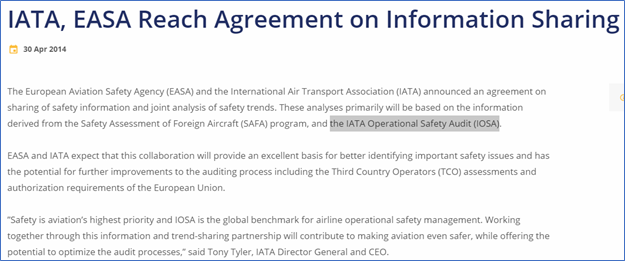 Second, how does a given CAA integrate its recognition of the standard? Consider this FAA excerpt from their FSIMS (Flight Standards Information Management System) manual7: “1.4.2 U.S. Air Carrier. The U.S. air carrier is responsible for all requirements associated with their Codeshare Safety Program to include the qualifications of the foreign air carrier(s) with whom they wish to conduct codeshare operations. All requirements must be satisfactorily completed prior to the DOT’s authorization of the codeshare. a) International Air Transport Association (IATA) Operational Safety Audit (IOSA). Before a codeshare is authorized, the U.S. air carrier must have accomplished, or had through a third party, an IOSA of the foreign air carrier.” Repeatedly the IOSA Standard requires that the host nation’s civil aviation regulations be consulted. And there you have it. A standard that recognizes the CAA’s regulations, and CAAs which recognize the standard; mutual recognition and accommodation. WE’RE NOT THERE… YET Clearly, mutual recognition and accommodation does not equate to the desired end-state which is globally accepted certification. If IOSA ever becomes such a certification standard, it would only apply to airlines. That would leave out Repair Station/AMOs, and Manufacturers. Nonetheless, observers of history will note that IOSA was indeed a harbinger of how it can be done. Over ‘n out Roy ‘Royboy’ Resto www.AimSolutionsConsulting.com 1 https://embraer.com/global/en/... 2 https://www.faa.gov/aircraft/a... 5 https://en.wikipedia.org/wiki/... 6 https://www.easa.europa.eu/new... 7 https://fsims.faa.gov/PICDetai... 8 https://www.iata.org/en/programs/safety/audit/iosa/ |