CAVU Café: Royboy’s Prose & Cons, Page 9 of 17 The views expressed in CAVU Café: Royboy’s Prose & Cons blog are those solely of the writer and are not necessarily shared by the Aviation Suppliers Association or the Association’s staff, members, or Board of Directors. About Roy Resto MROs OPENING UP AFTERMARKET DISTRIBUTORSHIPSPosted By Roy Resto | October 01, 2018
A growing trend I’ve observed in my consulting and auditing activities involves Maintenance Repair and Overhaul MROs) organisations opening up affiliated aftermarket distributorships. For example, an MRO opens up a separate but affiliated firm, and gets that distributor firm to be accredited to the ASA-100. From all appearances there seems to be many benefits for the MRO with this arrangement, and these will be reviewed. This trend also extends to OEMs, Airlines, and tear-down/disassembly facilities starting their own affiliated aftermarket distributorships, but in this article I’ll stick to MROs. Also, for a certainty, there is also the same reverse trend wherein distributors open up affiliated MROs. The following will be addressed:
EXISTING AND EMERGING BUSINESS PRACTICES: The following are what appears to be emerging uses of distributorships to support MRO Operations:
For successful MRO-distributor relationships, the following are apparent:
If not obvious, advantages of having your own separate but affiliated distributorship, which may tickle your imagination include:
RECOMMENDATIONS REGARDING STRUCTURE AND STARTUP
Over ‘n out Roy ‘Royboy’ Resto www.AimSolutionsConsulting.com FACTS, FIGURES, AND FORECASTSPosted By Roy Resto | August 01, 2018
I love reading about facts, figures, and forecasts, or as my military friends would say, F3. I come across quite a few of these and thought you’d enjoy reading them in summary form. Each entry is properly cited. I’ll do these for you once or twice a year. Airbus forecasts nearly 37,400 new aircraft valued at US$5.8 Trillion required over 20 years.1
ATR Forecast Demand for new turboprops to exceed 3,000 over next 20 years.2
Raw Deals. 3
The number of aircraft owned by the US Military: 4
Lines of code in Military and Commercial aircraft: 5
Monies spent by the US Agriculture Department in 2017 fighting wildfires (including firefighting aircraft):6
For my fellow Avionics geeks: Number of accidental false alerts generated by ELTs (Emergency Locator Transmitter) in all of 2017:7, 17
The US Air Force recently retired the history-setting Predator UAS, Unmanned Aerial System or RPA, Remotely Piloted Aircraft (Drone to outsiders). This is the Drone that made Drones a household name in the military and changed ISR, Intelligence, Surveillance and Reconnaissance, forever. Here are some interesting stats: 8, 9
Last year in 2017, the NTSB, National Transportation Safety Board, analyzed: 10
2018 Commercial Aircraft Stats: 11
3D Printing stats: 12
Suspect Counterfeit and Non-Conforming parts in the global electronic parts supply chain: 12
The number of Aerospace companies globally, listed in OASIS (Online Aerospace Supplier Information System) as accredited to ISO/AS/EN standards: 13
Various stats from Oliver Wyman: 14
Various stats from ICF: 15
Many of you who are personally certificated or credentialed by the government to perform your aviation duties are aware of NASA’s Aviation Safety Reporting System. ASRS captures confidential reports, analyzes the resulting aviation safety data, and disseminates vital information to the aviation community. Persons who voluntarily report incidents are given a degree of immunity from enforcement actions against their certificates or credentials. The success of this program in protecting individuals (Pilots, Technicians, Dispatchers, Controllers, Cabin Crew, others) and as a means of gathering safety information has led to various Civil Aviation Authorities around the world instituting similar programs. According to ASRS: 16
Space Cadet:
Crazy Busy Airport/Fly-in. Put this on your bucket list. Attend an EAA air show fly-in (called Airventure) at Oshkosh, WI. You have never seen anything like it; a hoot. Regarding air traffic control: 20
Global Defense Spending Rising: 21
Flight delays in Europe due to Air Traffic Management issues: 22
Over ‘n out Roy ‘Royboy’ Resto AIM Solutions Consulting www.AimSolutionsConsulting.com 1 Airbus Global Market Forecast 2018-2037.2 https://www.avitrader.com/2018/07/03/atr-forecasts-demand-for-new-turboprops-to-exceed-3000-over-next-20-years/3 Up Front, Kevin Michaels; Aviation Week & Space Technology; May 21-June3, 2018; Page 12.4 How the Pentagon Tries to Stay Ahead of Cyberattacks, Jen DiMascio; Aviation Week & Space Technology; June 18-July 1, 2018; Page 49.5 Synopsys Advertisement; Aviation Week & Space Technology; June 18-July 1, 2018; Page 26 Fires Fuel Renewal, Graham Warwick and James Drew; Aviation Week & Space Technology; February 26-March 11, 2018; Page 44.7 SARSAT Beacon Accidental Activation Prevention Initiative; Avionics News; June 2018;Page 9.8https://en.wikipedia.org/wiki/General_Atomics_MQ-1_Predator9 Elegy for the Predator, Brian W. Everstine; Air Force Magazine; July 2018; Page 1910 More data Infuses NTSB’s Proven Approach, Bill Carey; Aviation Week & Space Technology; April 9-22, 2018; Page 68.11 Orders and Deliveries; Flight International; 5-11 June, 2018; Page 27.12 http://www.erai.com/ERAI_Blog/3139/__2017_ERAI_Reported_Parts_Analysis13 Update on Transition Timeline, Walter Sam O’Connor; Presentation during the 2018 ASA Conference to the QA Committee.14 AVIATION LABOR SHORTAGE FORECAST, Neil McConachie; June 26, 2018; Presentation at the 2018 ASA Conference.15 THE MRO MARKET & KEY TRENDS, Richard Brown; ASA Annual Conference26 June 2018.16 NASA Aviation Safety Reporting System (ASRS), Linda J Connell; https://ntrs.nasa.gov/archive/nasa/casi.ntrs.nasa.gov/20170010289.pdf17https://content.govdelivery.com/attachments/USAFAA/2018/07/18/file_attachments/1041070/InFO18007.pdf18 Viewpoint: Space Congestion Threatens To ‘Darken Skies’, Bill Beyer and Nicholas Nelson; National Defense; July 2018; Page 35.19 By the Numbers; National Defense; July 2018; Page 5.20 http://www.boldmethod.com/blog/lists/2018/07/ten-things-you-should-know-about-the-busiest-control-tower-in-the-world/21 Boom Times, Michael Bruno; Aviation Week & Space Technology; July 16-29, 2018; Page 77.22https://www.aerotime.aero/aerotime.team/21607-iata-calls-for-urgent-action-to-tackle-european-atc-delays?utm_source=newsletter&utm_medium=email&utm_campaign=sas_faces_crewing_issues_says_theyre_blown_out_of_proportion_aerotime&utm_term=2018-07-31DO YOU VALUE YOUR INTERNAL/SELF AUDITS?Posted By Roy Resto | June 01, 2018
Like many of you, I’m a ‘morning person’ meaning I go to sleep early and rise early to start my day. When challenged with a big project, my preference is to wake up early and get to work to put in that long day. When it’s time to go home, I leave on time even though I may have worked extended hours by coming in very early. In discussions with persons of similar dispositions, it seems we all have one common gripe; very few people notice our extra effort. For example, we routinely may come in hours-early to get it done, but leave on time…the extra effort not noticed, therefor not acknowledged. That might be ok if it weren’t for the fact that the person who came in on time but stayed an hour over is given credit by management for being a ‘company person’ and being dedicated. Managers who engage this behavior are likely to alienate the early risers; lesson learned – take notice of, and value your early birds. They are in fact likely among your most productive employees. Another company asset whose value is frequently overlooked is the Internal or Self Audit. In my career I have taken notice of what seems to be 3 models of the practitioners of this recurring requirement:
Which one are you? Whatever your feelings regarding this task, know that you are not alone. A short list of the standards requiring internal self-audits would include:
Internal self-audits came into prominence following the Japan/Dr.
Deming quality revolution where there was a shift from reliance on Quality
Control to Quality Assurance, among many other changes. One of the ways of
gaining the ‘Assurance’ in ‘QA’ is by the performance of this task. Simply put,
these audits are a means of internal
surveillance; are your quality systems working as they should? Without
question there is strong and consistent correlation between your internal audit
findings and external audit findings; an inverse correlation. Firms with
strong and aggressive internal audits tend to have fewer external findings and
vice a versa. External being those performed by regulators, customers, and
accrediting organizations. Zero Findings during internal audits: Think about it, for firms with zero internal audit findings, they’re really saying ‘we’re perfect’; Really? When you think you have that perfect system, please call me; no one has figured out how to have a perfect system yet. Consistent zero findings could be caused by:
The external auditor’s perspective: When an external auditor sees that there is an aggressive audit program with meaningful findings, its sets the external auditor at ease because it reflects that the auditee is on their game; they are adequately surveilling themselves. The fact that you may have many internal audit findings will not reflect poorly on your operation; quite the opposite. Speaking
just for myself, when I see that the internal audits have zero findings, I
increase the sampling size of the audited areas and know I will have to spend
more time with the audit. If I have significant or numerous findings, I can put
in the audit report that performance of the internal audit can be improved-upon,
given the number or scope of the external audit findings. In other words, the
internal audit does not appear to have the level of effectiveness needed to intercept
and prevent quality issues from occurring. Management Support: In the ISO/EN/AS world, internal audit findings are shared with upper management, typically during the required management reviews. The data from this and other sources in the quality system are designed to drive continuous improvement in the operation. But what if you’re not ISO/EN/AS certified? Among those firms who are not ISO/EN/AS accredited, there appears to be great variation among upper management and the value placed by them on this process. In some cases, outside of the QA Office, the results of the internal audits are not known by upper management. Some defenders of this might counter that there is no requirement to do so…and they would be right, but what a wasted opportunity to benefit your organisation! Books, textbooks, and many courses address auditing techniques, so it is not the purpose of this article to restate those many works. There is no question that in the world of aviation, aggressive meaningful internal audits have contributed to heightened levels of safety and compliance; it is one of many tools used in quality to affect safety and continuous improvement. How sharp is your tool? PS: Morning people really like premium coffee… Over ‘n out Roy ‘Royboy’ Resto AimSolutionsConsulting.com Cannibalizing, Robbing, and Swapping Aircraft PartsPosted By Roy Resto | April 02, 2018
I’d like to add a new choice of terms to our ever evolving aviation lexicon. When an aircraft reaches the end of its life and it’s being parted out, we’re not removing the parts- we’re harvesting the parts from the legacy asset. A word that has managed to survive the trendy, revisionist makeovers is ‘cannibalize’, as in cannibalizing aircraft parts. Used interchangeably is the equally, potentially offensive word, ‘robbed’ aircraft parts. My, oh my, I want to retreat to a safe place and curl into a fetal position at the use of such utterances. We certainly need kinder-gentler expressions! But guess what? They’re here to stay. Get over it. So…what are we talking about? A likely scenario: An aircraft is at the gate for the first flight of the day and passengers are loading. By the way, at any given airline, the bank of first flights is closely monitored in real time by many different organizations, and the percentage of flights making it out of the chocks on time is a key performance metric; this, since any delay or cancellation is going to have a cascading effect on the subsequent flights of the day. For the first flight of the day, the flight crew has to perform lengthier aircraft systems checks, and during these checks our air crew observes a fail during a bite test (Built-In-Test-Equipment). The air crew consults its MEL (Minimum Equipment List) and confirms the failure can’t be deferred; it must be fixed. The aircrew calls its Maintenance Operations Control center (MOC), who dispatches technicians to the aircraft. The techs note that the Fault Isolation Manual (FIM) requires the replacement of an LRU (Line Replaceable Unit). The problem is there is zero stock; and the parts-pooling partners are similarly zero stock; drats! These savvy technicians know however, that an identical aircraft is parked on the ramp awaiting lengthy repairs due to a bird strike. The techs call MOC for authorization to take the part off the idle asset, and use it on the now-waiting aircraft full of passengers. Twenty minute later the techs are on the flight deck signing off the offending write-up with the aircrew, and minutes later the tug spews its first puff of smoke as the aircraft backs out of the gate. In many an airline’s GMM or GPM (General Maintenance Manual or General Procedures Manual; in the USAF the equivalent is Air Force Instruction 21-101, Aircraft and Equipment Maintenance Management), this procedure is referred to as cannibalizing or robbing the part. To be sure, there are probably, other more kinder-and-gentler titles of the procedure, but these are the prevalent ones. In the USAF, the same action is also called cannibalizing, and only certain Maintenance Management persons are certified to authorize such an action on the scene. I had this certification. Without doubt, cannibalizing or robbing must always be an option of last resort; all efforts must be expended to locate the part first from normal supply channels. It is no surprise then, that cannibalization rates in the airlines or military are a closely monitored metric since it reflects on the effectiveness of the inventory control system. Higher cannibalization rates tend to be accepted through clenched teeth for parts that are out of production. Higher rates may also be the natural consequence of operators who deliberately choose to be under-spared for certain assets to conserve cash. Up to this point, the process to rob that part sounds easy…but it’s not. Consider the following:
o Is it a part that has scheduled overhaul or other maintenance requirements? If so, the airline’s tracking system must be amended to show the current installed-position of the part. o Is the part an LLP, Life Limited Part? My experience is that these parts are rarely robbed since nearly all require extensive disassembly in order to facilitate the removal and installation. Nonetheless, it remains a possibility and must be carefully considered for remaining time or cycles and to be tracked as concerns its current installed position. How about swapping? Swapping exists for one reason: To facilitate the troubleshooting process. For example, an aircraft has a write-up, but experience has shown that several LRUs (Line Replaceable Units) are equally capable of causing the fault. Any experienced technician will tell you that there has never been written a perfect Troubleshooting Logic Tree or FIM. Swapping parts that are the same part number to see if the fault is eliminated, or follows to the other swapped position, is really a great troubleshooting tool to confirm the source of the fault. This also helps reduce those pesky No-Fault-Found (NFF) charges. There are two scenarios for swapping: 1. Swapping in the same aircraft tail number: Due to redundant aircraft systems, it is not unusual to find the same part number LRU installed for a Right or Left system, or in some cases a left, center, and right system, or system 1, 2, 3, or colored systems. It’s been my experience that technicians often perform this type of troubleshooting without the necessity of informing anyone or filling out any tags or other documentation. The conscientious technician always will return the parts to their original positions once the troubleshooting process has concluded. In some cases the airline may have a hard rule that any such activity is strictly documented in accordance with their manuals, and for good reasons. 2. Swapping between aircraft of different tail numbers. In some cases, this is the preferred or only option for swapping during troubleshooting. In this circumstance there are usually strict controls on documenting the actions taken. If you know of any kinder-gentler, mood-ameliorating terms in use to describe these actions don’t hesitate to post a comment. Over ‘n out Roy “Royboy” Resto BLOCKCHAIN IN AVIATION?Posted By Roy Resto | February 01, 2018
Can I order a Big Mac with bitcoin? Not yet, but bitcoin (cryptocurrency) excites many, and is based entirely on blockchain. But is blockchain ready for prime-time in aviation? Use of popular words is observed to cycle through articles, literature, and social media with some regularity. For example, use of the terms ‘core competency’ and ‘paradigm’ seem to be waning. On the other hand, use of the word ‘disruptive’ seems to be peaking. Initially, use of this word demanded our attention; a herald of a new order of things, but alas, marketers have been attaching this adjective to too many products and ideas, and many simply are not worthy of the term, thus the effectiveness of the word has been diluted. Predictably an idea we often see described as ‘disruptive’ is blockchain technology. Will it truly be ‘disruptive’, and further, what may be its implications on aviation, if at all? WHAT’s BLOCKCHAIN? In the excerpt below, the italics are my own for emphasis ”A blockchain, originally block chain, is a continuously growing list of records, called blocks, which are linked and secured using cryptography. Each block typically contains a hash pointer as a link to a previous block, a timestamp and transaction data. By design, blockchains are inherently resistant to modification of the data. It is an open, distributed ledger that can record transactions between two parties efficiently and in a verifiable and permanent way. For use as a distributed ledger, a blockchain is typically managed by a peer-to-peer network collectively adhering to a protocol for validating new blocks. Once recorded, the data in any given block cannot be altered retroactively without the alteration of all subsequent blocks, which requires collusion of the network majority. Blockchains are secure by design and are an example of a distributed computing system with high Byzantine fault tolerance. Decentralized consensus has therefore been achieved with a blockchain. This makes blockchains potentially suitable for the recording of events, medical records, and other records management activities, such as identity management, transaction processing, documenting provenance, food traceability or voting. The first blockchain was conceptualized in 2008 by an anonymous person or group known as Satoshi Nakamoto and implemented in 2009 as a core component of bitcoin where it serves as the public ledger for all transactions. The invention of the blockchain for bitcoin made it the first digital currency to solve the double spending problem without the need of a trusted authority or central server. The bitcoin design has been the inspiration for other applications.”1 BLOCKCHAIN IN AVIATION? Aviation is dependent on strict record keeping. Much of today’s record keeping procedures are required by regulation and yet others by de-facto industry practice. The continuum of aviation records typically starts in manufacturing during/before metal is cut, software written, or assembly tools laser measured, and extends the entire life cycle to the end with a record of being scrapped. For all of us in the aftermarket, we are intensely attuned to the issue of impeccable records. There is after all, clear correlation between the value of the parts (assets, articles) and the quality of its records. We tend to be particularly sensitive to these records:
The known problem of these records is that they tend to take many forms: Paper, digital, Logbooks, and Scanned PDFs, and that there is no single repository of these records. Often the records are archived; a polite way of really saying it’s in the black hole of hundreds of those legal cardboard boxes in the warehouse…good luck with that… So…can blockchain be the answer? According to some; yes. According to Mr. Bas De Vos: “…what if all of these participants submitted a transcript of the transactions into a purpose-specific, distributed ledger — like blockchain — which only authorized participants would have access to? The manufacturer would initially start the blockchain for the asset and each participant would add the relevant blocks to it. The distributor would let the chain’s participants know that the asset was transported from point A to point B, while the operator would register the number of flight hours that the asset has undergone. Using blockchain for this asset management scenario would give you a 100 percent verifiable, traceable, and trustworthy history of the asset’s lifecycle in real-time.”2 And according to AeroTime Staff: “…blockchain technology has the power to transform the asset management value chain—and the firms that adopt it early will reap the rewards. Commercial aircraft assets are definitely an untapped market, with a visible lack of standardization. A blockchain solution could potentially replace the network of disparate systems, Justinas Gilys, COO at AviaAM Leasing believes. “A blockchain registry would, first of all, provide a high degree of transparency,” Gilys told AeroTime. Transparency brought by a secure ledger would increase the efficiency of transactions for all the parties involved, Justinas Gilys of AviaAM Leasing believes. “A secure blockchain solution would help to effectively secure the interests of both aircraft owners and financiers.” Unlike traditional databases, blockchain-based registries are consistent, immutable and secure from outside tampering.”3 Sounds pretty promising, but to be sure, there are detractors. For example: “ ‘The thing is that this technology is way over-hyped and filled with over-positive expectations,“ Beliunas told AeroTime. As I’ve been arguing this for quite a while, many leaders and executives see it as a magic word and a solution to all of their pain points. And this is most definitely not the case. What they should be doing is their research trying to identify their specific use cases and tailored solutions instead of jumping straight on the bandwagon. But lessons will be learned, one way or another.’ “3 There are also existing avenues within the industry attempting to address the aforementioned records problems. Among these:
I distinctly remember years ago in my avionics and flying ventures of a new system called MLS: Microwave Landing System. It was supposed to allow curved instrument approaches and multiple approaches among its many benefits. In fact the USAF for example went through considerable expense to install the required hardware on many aircraft while the FAA was installing the systems at a few airports. Then out of left field came GPS. MLS was forgotten, and today GPS-based instrument approaches are common place. GPS was disruptive before disruption was hip. Will blockchain be to RFID what GPS was to MLS? GOING FORWARD In an article Titled “Microsoft Azure Supporting Blockchain Test by AFI KLM E&M, Ramco,”4 it appears that “Microsoft has developed a solid infrastructure on its Azure Cloud platform for a variety of implementations of Blockchain and is now working with AFI KLM E&M and Ramco Systems on a test of Blockchain for providing back-to-birth records of aviation parts.” The bold italics are mine, and wow, fasten your seatbelts. I hope that global Civil Aviation Authorities are paying attention. Regulations and guidance regarding electronic recording keeping may have to be updated to accommodate this new platform. Over ‘n out Roy ‘Royboy’ Resto 1 https://en.wikipedia.org/wiki/Blockchain 2 http://www.aviationpros.com/article/12363451/using-blockchain-to-reinforce-aviation-asset-management 3 https://aerotime.aero/en/civil/20680-3-ways-blockchain-technology-is-disrupting-aviation MASTERS OF LOGISTICS: USTRANSCOM & THE CIVIL RESERVE AIR FLEETPosted December 04, 2017
Think you know logistics? How would you handle the specialized global logistics needs of a world super power and economic behemoth; their humanitarian, government, and military logistics needs? Those needs are indeed gargantuan in scope, but USTRANSCOM makes it happen 24/7/365, and they make it look routine. Consider the following occurring every day: 3
Considering a single piece of freight could weigh from a few ounces to 100 tons, that's a huge challenge. The US Transportation Command is the biggest Logistics operation you've never heard of. How do they do it?  After 32 years in the Air Force I had participated in many USTRANCOM missions. They are the behind-the-scenes enabler that choreographs complicated logistics challenges. Without the rapid response, force delivery systems of USTRANSCOM, the military would be a local force; unable to project power. Indeed, according to General McDew, Commander of USTRANSCOM, in a recent speech to staff: "Your ability to deliver an immediate force tonight and a decisive force when needed is a unique capability and significant strategic advantage..."1 (my italics for emphasis). 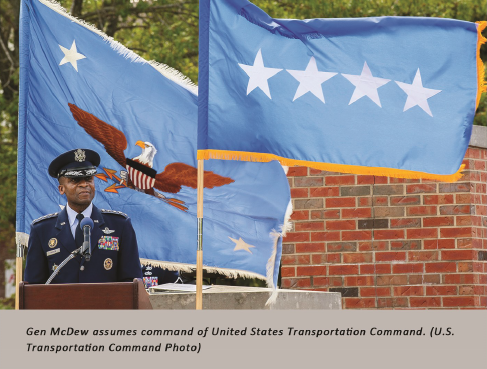 USTRANSCOM's total wartime capability consists of a diverse force: 45,945 active duty; 73,058 Reserve and Guard, and 19,104 civilian personnel. USTRANSCOM's force of Soldiers, Sailors, Airmen, Marines, Coast Guardsmen, DOD civilians and commercial partners accomplishes a wide array of logistics missions. With its people, trucks, trains, railcars, aircraft, ships, information systems and infrastructure, as well as through their commercial partners providing 1,203 aircraft and 379 vessels in the Civil Reserve Air Fleet (CRAF) and Voluntary Intermodal Sealift Agreement (VISA), respectively, USTRANSCOM provides the U.S. with the most responsive strategic mobility capability the world has ever seen. 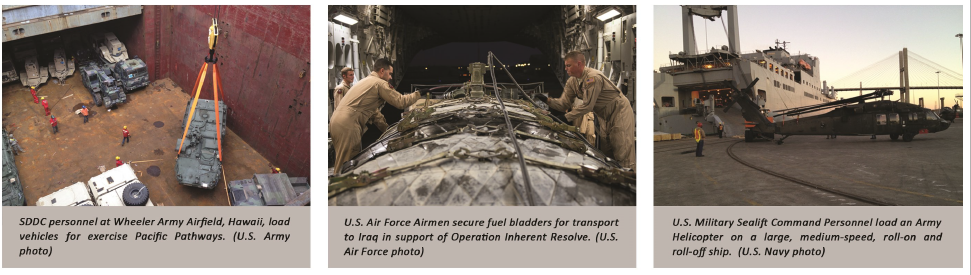 CIVIL RESERVE AIR FLEET Airlines have a long history of contributing to the needs of their nation, and in the US this is reflected in Civil Reserve Air Fleet, CRAF. Having worked at a major airline, I distinctly recall our participation in this program and hosting audits by the DoD as described below. Having been deployed overseas many times with the Air Force, I clearly remember seeing all those civilian tails mixed in with the military aircraft at locations off-limits to typical civilian flights. Many of you have likely contributed to the needs of airlines supporting such operations. Here are some details2 about the CRAF: As of April 2017, 24 carriers and 434 aircraft are enrolled in CRAF. This includes 397 aircraft in the international segment (267 in the long-range international section and 130 in the short- range international section). There are 37 aircraft assigned to the national domestic services segment. These numbers are subject to change on a monthly basis. The airlines contractually pledge aircraft to the various segments of CRAF, ready for activation when needed. To provide incentives for civil carriers to commit aircraft to the CRAF program and to assure the United States of adequate airlift reserves, the government makes peacetime DOD airlift business available to civilian airlines that offer aircraft to the CRAF. DOD offers business through the Charter Airlift Services in support of the Civil Reserve Air Fleet contract administered by USTRANSCOM. To participate in the international segments of CRAF, carriers must maintain a minimum commitment of 40 percent of its CRAF capable passenger and/or cargo fleet. Aircraft committed must be U.S.-registered and carriers must commit and maintain at least four complete crews for each committed aircraft. Safety is the paramount concern, and numerous procedures are in effect to ensure that the air carriers with which DOD contracts afford the highest level of safety to DOD passengers. Prior to receiving a contract, all carriers must demonstrate that they have provided substantially equivalent and comparable commercial service for one year before submitting their offer to fly for the Defense Department. All carriers must be fully certified Federal Aviation Administration carriers and meet the stringent standards of FAA regulations pertaining to commercial airlines (FAR Part 121). Additionally, a DOD survey team composed of experienced pilots and skilled maintenance personnel performs an on-site inspection of the carriers. This team conducts a comprehensive inspection that includes the carrier's aircraft, training facilities, crew qualifications, maintenance procedures and quality control practices. Following the on-site inspection, the Commercial Airlift Review Board approves the carrier to provide charter airlift services before receiving a contract. The DOD Commercial Airlift Division monitors the carrier's safety record, operations and maintenance status, contract performance, financial condition and management initiatives, summarizing significant trends in a comprehensive review every six months. In addition to this in-depth review, there are several other surveillance initiatives. These include safety preflight inspections of commercial aircraft by DOD designated inspectors and periodic cockpit observations on operational flights by highly experienced pilots from AMC's (Air Mobility Command) DOD Commercial Airlift Division. This Division maintains close coordination with the FAA for the sharing of safety information on all DOD approved carriers. The following air carriers are current members of the Civil Reserve Air Fleet program (subject to change monthly). International Segment - Long Range
International Segment - Short Range
National Domestic Services Segment
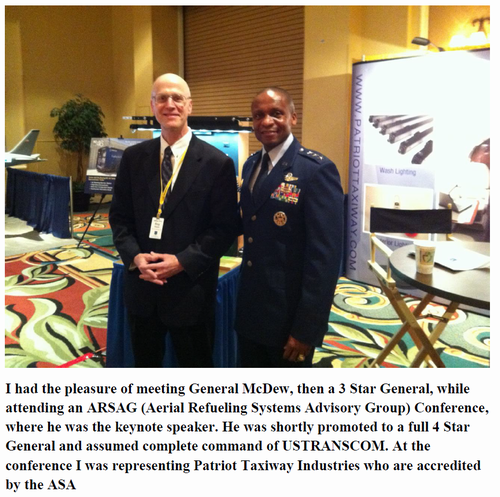 I know there are many ASA members and accreditees who participate in government/DoD programs. That logistics world (as distinguished by the civilian world) is ruled by a myriad of unique Orders, Instructions, Manuals, FAR's (Federal Acquisition Regulations) and DFARs (Defense FARs). You've likely participated in USTRANSCOM programs and were not aware of it. Make it happen. Over 'n out Roy Resto AIMSolutionsConsulting.com 1 United States Transportation Command Strategy; A Plan for Our Future 3 Email to Resto from Michael P. Kleiman, Commander's Action Group, U.S. Transportation Command; dated 11/7/17. |