CAVU Café: Royboy’s Prose & Cons, Page 12 of 17 The views expressed in CAVU Café: Royboy’s Prose & Cons blog are those solely of the writer and are not necessarily shared by the Aviation Suppliers Association or the Association’s staff, members, or Board of Directors. About Roy Resto OEM ANTI-COMPETETIVE, MONOPOLISTIC PRACTICES IN THE AFTERMARKETPosted By Roy Resto | December 03, 2015
OEM ANTI-COMPETITIVE, MONOPOLISTIC PRACTICES IN THE AFTERMARKET? By Roy Resto
What’s going on in the aftermarket? I read an article in the Wall Street Journal titled “Promised Monopoly Crackdown Fizzles.”1 The article highlighted the US Government’s acknowledgement that there needs to be more enforcement of laws against monopolistic practices. The aviation industry was not mentioned in the article, yet it triggered some thoughts: are there any such practices in the aviation industry? To the point: Nearly every part flying on an aircraft is from an OEM supplier that has been awarded exclusive, sole-source rights. Are there classic monopolistic practices at play here? The competition to settle that award was decided before the aircraft or engine went into full production; so there was competition, initially. Further detracting from the inference that these OEM’s are engaged in any sort of monopolistic practices in their manufacturing operations is the very nature of the Type-Certification process. It is meant to be vigorous and thorough in order to ensure the highest levels of safety. The process is so demanding that, although we card-carrying capitalists intuitively chaff at any hint of monopolies, we can be forgiven if we don’t apply the monopolistic standard here, in the interest of safety. Such vigor in the certification process necessarily implies high investment costs in research, development, and tooling. Of course the OEM’s have a fundamental right to recoup their investment costs and to protect their intellectual property. That is for manufacturing, but what about the aftermarket? The manufacturing arena (you’re building it to fill a ‘hole’ on the aircraft/engine production line), and the aftermarket arena (spares, logistics, maintenance, repair, and overhaul) are two separate and distinct environments, each with their own set of players, business models, and regulatory challenges. Is it possible that in the aftermarket, OEM behaviors are contributing to a rising feeling that anti-competitive practices are in play? The European Commission (EC) is investigating just that prospect. The EC, as published in an Aviation Week & Space Technology article titled “Under Review: EC investigates ‘alleged anti-competitive behavior’ in commercial aircraft maintenance”2, confirmed that it is taking a close look at the competitive atmosphere amongst MRO services in the European Union, as first reported in the Financial Times. More specifically, it is looking into alleged anti-competitive behavior. The article starts by sharing that “At industry trade shows, airlines perennially gripe about original equipment manufacturers (OEM) holding too much sway over the commercial aftermarket – and pricing their products accordingly”. An example which seems to quantify such assertions came from the International Air Transport Association (IATA) which stated that “…MRO represents 10-13% of airline costs, and those costs are rising beyond inflation despite efforts to rein them in.” Not holding back on articulating what is certainly reflective of their constituency, IATA Director General and CEO Tony Tyler said “Unfortunately, certain OEM Business practices drive up costs by blocking entry into the market for (MRO) services.” Further, “IATA is examining commercial, legal, and economic options where we may be able to contribute to efforts to rein in runaway aftermarket-related costs.” Pretty strong stuff indeed. If the gloves have come off in regards to calling out alleged OEM behaviors, then perhaps we should be more specific about what the practices seem to be, which are contributing to the perceived anti-competitive assessments. How about these and their variations: • Blocking independent repair station’s access to the OEM’s Maintenance, Repair, and Overhaul Data (AKA as Component Maintenance Manuals, Maintenance Manuals, and ICA’s – Instructions for Continued Airworthiness). How possiblycan these independent MRO’s compete without reasonable access to such data? I’d say ‘reasonable’ might include practically priced subscriptions, but outright denials?
• Maintenance Manuals whose instructions say to return the product to the OEM or their designated Repair Station affiliate. In other words, there are no available maintenance instructions available for operators or independent repair stations.
• Finding ways to charge below-list prices for piece parts to the OEM’s MRO affiliate, but the higher list prices to independents.
• A parallel to that last bullet is that the OEM entices the operator with long-term (5 years) contracts with built-in, below-list pricing for parts, and caps on price increases despite any larger inflation increases. How possibly can independent MRO’s and distributors compete against that?
• Enlisting the help of an aftermarket confederate to buy all the spares (those in Overhauled, Repaired, or Reparable condition) in the aftermarket, and then take those off the aftermarket entirely. If you’re an operator and need a spare, then guess what? You have to buy a new part from…the OEM. By the way, what does the OEM do with those off-the-market spares? They give their OEM MRO affiliate exclusive access to them, further eroding the competitiveness of independents and aftermarket distributors. And oh-yes, guess what happened to the market price of any spares? In the ether…
• A distributor who engages in parting-out activities recently shared a frustration: it seems his parting out activity had introduced additional spares into the market which in turn brought down the average price of those spares. Guess what the OEM did? They cut him off from doing any business with them.
By the way, regarding those maintenance manuals, in an article titled “State-Level Proprietary Rights Do Not Trump Aviation Safety”3, we’re told that “…we established that the FAA has rules that require design approval applicants to create ICAs. Those rules establish minimum standards for what needs to be in the ICAs. And those ICA’s are required to be shared with certain parties, like properly rated repair stations.” So…where’s the enforcement of that? Is it just the Airlines and independent Repair Stations affected by this? With a certainty, there is a trickle-down collateral effect upon the aftermarket distributor and broker community as well. A famous line from a Godfather movie said “Don’t take it personally, it’s just business.” But are these activities just business, really? I suspect the EC investigation is going to open the door to increasing scrutiny as to whether any lines have been crossed. On the other hand, make no mistake, our free market systems will respond to these OEM activities, actions which should not be underestimated. A few things that come to mind: • As with IATA, expect segments of the industry to enlist their respective trade associations to pursue possible legal actions, editorialize the purported unfair OEM practices, and pressure legislators to enact ‘corrections’.
• Calls for reforms in the certification process to somehow increase competition among OEM’s. After all, in the aftermarket, they currently do enjoy monopoly status; competition would have a wonderful ameliorating effect on operator costs.
• Calls to increase PMA activity.
• Increasing parting-out activity.
• Calls for the FAA to enforce the rules making manuals available.
• An increase in independent MROs seeking to develop their own Process Specifications in cases where the OEM is not making available the MRO data, or has not written any.
An economist would insist that the best solution is to increase competition among the OEM’s and let the market decide… Let’s see where all this goes. As always, you’re invited to leave a comment. Roy ‘Royboy” Resto www.AimSolutionsConsulting.com
1 Promised Monopoly Crackdown Fizzles; The Wall Street Journal; November 9, 2015; Page A4. 2 Under Review: EC investigates ‘alleged anti-competitive behavior’ in commercial aircraft maintenance; Aviation Week & Space Technology; October 26-November 8, 2015; Page 30 3 State-Level Proprietary Rights Do Not Trump Aviation Safety; Aviation Maintenance; October/November 2015; Page 48. NON INCIDENT/ACCIDENT STATEMENT (NIS) and INCIDENT/ACCIDENT CLEARANCE STATEMENTS (ICS)Posted By Roy Resto | October 15, 2015
What potentially, do all of the following have in common, which may occur in flight or while taxiing? A Pax dies of natural causes, lightning strikes, hale damage, bird strikes, FOD damage, hard landings, tail strikes, or bent metal caused by impacts with ground equipment or other aircraft. Answer: Depending on varying broad definitions, these, and many other scenarios all have the potential to be categorized as accidents or incidents. In fact it has been my experience that given a mature aircraft, it would be difficult to find any serial number that has not experienced some sort of accident or incident. Perhaps it’s that realization which causes purchasers of aircraft, engines, and components to continue to ask for Non Incident/accident Statement (NIS) or Incident/accident Clearance Statements (ICS). Before I get into NIS/ICS’s I’m
wont to address the neglected issue of the rather portly pachyderm reposing in
the parlor. We need to clearly establish that NIS/ICS’s are not regulatorily required! So why the continuing requirement as
if it added some sort of value to the transaction? Assuming the transaction
requires the asset be in airworthy condition, you will get the applicable
documentation attesting to such airworthiness. Any past history of accidents
or incidents does not detract an iota from the stated status of airworthiness!
And ‘so-what’ if that part flew on a military platform? Are all the now
civilian airworthiness documents in order? I continue to shake my head at
practices that add cost but not value, and this is one of them. ME: “So Joe, why
your need for an NIS?” JOE: “Royboy, because
it’s a requirement.” ME: “Really? Why, what
reg’ is that?” JOE: “Hmm, I’ll have
to get back to you on that” ME: “So… why?” JOE: “Because it’s
on my checklist.” ME: “Why?” JOE: “Because it’s
in my manual to do so.” ME: “Why?” JOE: “Because we
have always done it that way.” And there you have it: the root
cause within 5 ‘whys’. Alas, I suspect many of you
will agree with the aforementioned, but posit that the practice is too
entrenched, and that the right people don’t get it…which will bring me back to
NIS and ICS’s. At the last ASA conference, during
the QA Committee meeting, Tom Kolesar gave an introduction to a project that
the Aviation Working Group has accomplished. According to their web site, AWG is
a “not-for-profit legal
entity comprised of major aviation manufacturers, leasing companies and
financial institutions that contribute to the development of policies, laws,
and regulations that facilitate advanced international aviation financing and
leasing”. It seems they have put forth a
neat, standardized set of ICS’s. Some feedback I’m getting from various sources
seems to indicate the ‘form’ is gaining popularity. Friends, I’m all for
standardization. By the way, AWG has coined the
term ICS to replace NIS. Aiding in the AWG’s rollout of
the ICS, it seems that IATA, the International Air Transport Association, has
embraced the ICS, typically in a Document titled “Guidance Material and Best Practices for Aircraft Leases.” According to the AWG’s
Guidelines document for the ICS, “The purpose of this incident/accident
clearance statement is to remove the focus from whether or not an
aircraft/engine/part has been subjected to an accident or incident and instead
declare that the aircraft/engine/part has been deemed acceptable for continued
use.” Bravo. There are two formats; one for
Aircraft and one for Engines. The one for Engines can be formatted for
components. Interestingly, the Guidelines suggest that if desired, the language
can be added to the traditional ATA Spec 106. Neat. Although you can google the
documents, I’m going to post below the fundamental elements of the ICS for your
perusal: To Whom It May Concern: Engine serial number
[insert ESN], details of which are specified below, has been operated by
[insert company name] during the period from [insert delivery date] to [insert
redelivery date]. Configuration details as
of date of this statement; Description Type/Part No. Serial
No. TSN CSN I hereby certify that, to the best of my knowledge, during the period stated above: 1. Neither the engine, nor any part installed have been a. damaged during, or identified as the root cause of, a reportable incident or accident as defined
by Annex 13 to the Chicago Convention, or b. subjected to severe stress or heat (such as in a major engine failure, accident, or fire) or has been submersed in salt water, unless its airworthiness status was re-established by an approved maintenance organisation in accordance with the instructions of the type certificate holder and/or OEM of the part, and supported by an authorized airworthiness release certificate. 2. No part has been
installed on the engine which was obtained from a military source or was
previously fitted to a state aircraft as deemed by Article 3 of the Chicago
Convention. Again, this can be modified for
use on components. Lastly, I’d like to address
another neglected issue; that is, the use of the words “…to the best of my
knowledge.” I have heard some make disparaging remarks about the choice of
these words as if it diluted the sincerity or validity of the attestation: it
does not. I prefer to think that the person is being honest, and that
between the lines the meaning is: …at the
moment I signed this, presented with all the information available at the time,
I attest that… It’s my opinion that in order
to bring a modicum of stability and clarity to the issue of Non Incident
Statements, we should encourage the use of the AWG’s ICS. Over ‘n out Roy “Royboy” Resto www.AimSolutionsConsulting.com STANDARD PARTS: THE UNCOMMON OVERVIEWPosted By Roy Resto | June 02, 2015
You bump into a friend you have not spoken with in a while. The friend asks “so…are you still with Jane?” What should be a simple yes or no answer turns into a slightly awkward and delayed answer from you; “it’s complicated”. Use of the “it’s complicated” strategy means that in order to be truthful with your friend, a quick answer will not do, and that the choice to give any additional details is optional (due to time limits or level of trust), and further, that if you don’t give any additional details it would be socially acceptable to move on. Of course, in the absence of additional details, your friend’s imagination would immediately and quietly embark upon a fit of creativity, which may find expression in the presence of other friends, maybe. So, what about standard parts? I would like to give a common, simple answer, but guess what? It’s complicated. I’m wont to write this blog because in my consulting business I continue to run across confusion and misinformation about this topic in the industry, especially a lack of practical advice (herein bolded for ease of locating it), so I hope to impart some here. I’m going to cover the following topics: · Definition · Trace for standard parts · Lesser known standard parts · Standard parts that are only standard within the purview of the OEM · Documentation for standard parts DEFINTION: From FAA AC 20-62E titled “Eligibility, Quality, and Identification of Aeronautical Replacement Parts”: · Standard Part. Is a part manufactured in complete compliance with an established U.S. Government or industry-accepted specification, which includes design, manufacturing, and uniform identification requirements. The specification must include all information necessary to produce and conform to the part. The specification must be published so that any party may manufacture the part. Examples include, but are not limited to, National Aerospace Standard (NAS), Air Force/Navy (AN) Aeronautical Standard, Society of Automotive Engineers (SAE), Aerospace Standard (AS), Military Standard (MS), etc. From EASA AMC M.A.501 (c): · Standard parts are:(a) parts manufactured in complete compliance with an established industry, Agency, competent authority or other Government specification which includes design, manufacturing, test and acceptance criteria, and uniform identification requirements. The specification should include all information necessary to produce and verify conformity of the part. It should be published so that any party may manufacture the part. Examples of specifications are National Aerospace Standards (NAS), Army-Navy Aeronautical Standard (AN), Society of Automotive Engineers (SAE), SAE Sematec, Joint Electron Device Engineering Council, Joint Electron Tube Engineering Council, and American National Standards Institute (ANSI), EN Specifications etc… In these and other definitions I’d like to point out the important common denominator which is the standard part was manufactured in compliance with a Government, or industry accepted specification. For example, commonly cited part numbers such as may start with NAS, MS, or AN, are parts whose blueprints (specifications) were crafted by the Government. Before going any further, here’s my first bit of practical advice: Write down this web site and put it in your favorites: http://quicksearch.dla.mil/. Go there. On the Document ID line, type in a common standard washer AN960 and Submit. The result will have a link to the actual drawing (and whoopee, it’s free), and you’ll notice a note saying it’s been S/S (superceded) by NAS1149. In fact the link to the AN960 drawing will also take you to the official cancellation notice (a quick flutter of the eyebrows please). Neat huh? We wish it were all so simple, right? The problem arises with those pesky other standard part numbers that do not begin with NAS, MS, or AN, and indeed there are many. For example, you may be on the market for a certain part number, and a supplier informs you that the part number is a standard part number, really? This is the first illustration of the complicated issue. I have seen too many suppliers purport to have standard parts but can’t prove it in light of the aforementioned definitions. More practical advice: Ask to see the blueprint or specification for the part. If you are shown a typical manufacturer’s print with those tiny notes in the legend that say its proprietary, or any other equivalent language indicating its IP (Intellectual Property), then it’s not a standard part, period. But, you ask, Royboy, why would anyone want to claim a part is standard? TRACE FOR STANDARD PARTS: For new-condition aircraft parts you want to be able to
demonstrate you have trace documentation to the PAH/DAH (Production Approval
Holder or Design Approval Holder), in other words, trace to someone who
typically possesses a TC, PMA, or TSOA. An exception to this requirement is
that standard parts generally do not require trace to a PAH/DAH; you can obtain
them from any source as long as you are provided the documentation I’ll review
in the last section. So, here’s a practical
example of how this comes into play: You’re on the market for a new-condition,
certain part. A supplier informs you she has the part. You dutifully ask if
they are a PAH/DAH? The reply: ‘that is not necessary, this is a standard
part’. At this point your head bends down towards the table to be supported at
the forehead by one of the palms of your hands as you realize things just got
complicated. If the supplier cannot produce proof that the part is indeed
standard (as is the case for many such suppliers), your head is now seen to
bend down towards the table with the forehead supported by two palms; body language for a troublesome position indeed. Move on
to another supplier. Royboy’s practical
advice: If no supplier can prove it’s a standard part, go up the Next
Higher Assembly (NHA) chain until you get the PAH/DAH and order the part from
them.
…standard parts generally do not require trace to a PAH/DAH LESSER KNOWN STANDARD PARTS: A friend recently approached me who is on the market for an aircraft light bulb, part number 767. She said that a supplier told her the part was a standard part. It took some research, but my friends in the aircraft lighting industry told me to look at SAE Aerospace ARP881 titled “Lamps for Aircraft Lighting” and guess what? There it is. Many other part numbers are listed. First we need to recall that both definitions I cited earlier included examples of Government or Industry accepted specifications. SAE is but one of those industry groups, and ARP881 is a perfect example. If you go to SAE’s web site and search on ‘Aerospace Lighting’, you’re going to get a lot of results. The challenge is that each standard has a price, so I can’t tell you that all those search results at the SAE web site will yield a listing of part numbers as did the ARP881. If any one of you has that information, please share it as a comment on this blog. Of course there’s more. I have a pretty good avionics background so I know the electronics industry has a lot of standard part numbers. For example, 2N2222 is a common transistor (anything starting with 2N is a transistor), and anything that starts with a 1N is a diode. RL is similarly used for resistors. By the way, more practical advice; go back to the Assistdocs.com web site. In the “Word in Title” line, type in 2N2222, enter Submit. Uh-huh, more neat info. An ‘A’ awaits any college student willing to spend the time to research all those government and standards organizations to create an exhaustive list of standard part numbers cross referenced to the respective standard. Oh, yes, be sure to share it with Royboy STANDARD PARTS THAT ARE ONLY STANDARD WITHIN THE PURVIEW OF THE OEM: How about part numbers that start with BAC, ABS, or NSA? Are those standard parts as we established earlier? The answer is a stern no! BAC part numbers are only ‘standard’ within the purview of Boeing aircraft, and ABS and NSA within the purview of Airbus. Their drawings are IP, and so were not made by a government or industry group. As you can see, the problem is the industry loosely uses the term ‘standard part’ for both BAC/NSA/ABS, and AN/MS/NAS parts, but as you now know, there are critical distinctions between the two. Failure to make that distinction has resulted in reports of Suspected Unapproved Parts. Let’s amplify this with some simple practical advice: When purchasing new BAC, NSA, or ABS parts ask the question: Is the supplier a PAH/DAH (do they have for example, PMA or TSOA for the parts? If the answer is no, get the parts from Boeing or Airbus, period. Just because a manufacturer is on some Boeing approved supplier list does not entitle them to sell BAC parts directly to end users (unless they have PMA or TSOA), and in fact such selling (AKA Direct Shipping) is a clear, reportable SUP. ‘Nuff said.
As you can see, the problem is the industry loosely uses the term ‘standard part’ for both BAC/NSA/ABS, and AN/MS/NAS parts, but as you now know, there are critical distinctions between the two DOCUMENTATION FOR STANDARD PARTS: For all standard parts, the expected documentation is some sort of Certificate of Conformity. BTW, see my blog titled ‘C of C’s, BEWARE THE DIFFERENCES’ at http://www.aviationsuppliers.org/index.asp?bid=222&BlogEntryID=172&FormID=300 Airbus recently sent out a message that it will start to issue EASA Form 1’s for its NSA and ABS standard parts, very welcomed.
Over ‘n out Roy ‘Royboy’ Resto Economics and Influences on the Surplus Aftermarket, Part IIPosted By Roy Resto | April 13, 2015
As
the title infers, this is part II. If you have not read Part I, please look
back at the previous blog by the same title. The data which triggered my thought process was this graph, created by our friends at ICF International: 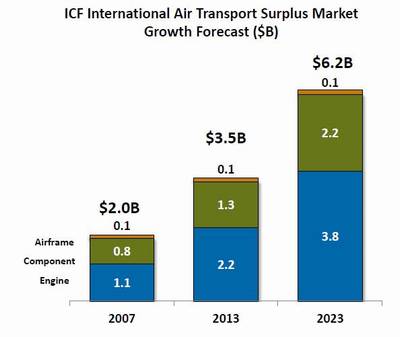
Let’s understand the basis for this data; from ICF: “Alternatives to new OEM parts are therefore a big deal. PMA parts are the best known, yet have achieved a modest 2% market share after decades of effort. A less glamorous, but fast-growing alternative is surplus parts, which have emerged as the key threat to the OEM service parts revenue stream. My firm has studied the surplus parts market extensively and estimates annual consumption is $3.5 billion – about six times as large as PMA parts and a 12% market share. Moreover, the use of surplus parts is poised to grow significantly over the next decade. ICF’s nominal scenario is for surplus parts usage to reach $6.2 billion by 2023 (constant dollars) – a 5.6% annual growth rate.”1 So, according to this forecast, there will be 5.6% annual growth through 2023, to a $6.2 billion Surplus Market. What data is available to support this?
Let’s take a look at Boeing forecast data: 
Source: Boeing Current Market Outlook 2014-2033 I like this chart because it’s simple, yet reflects critical data:
Now let’s look at the forecast for the total number of aircraft:  Source: Boeing Current Market Outlook 2014-2033 You don’t need to be a ‘Poindexter’ to understand that more aircraft equates to a bigger Surplus Market. This data suggests that the total number of aircraft will more than double in twenty years – astounding! Yep, this data too supports the Surplus Market Forecast.
Next, the forecast of the number of aircraft being retired per year: 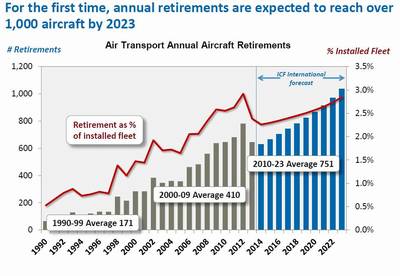
Source: ICFI: The Surplus Parts Market, Richard Brown, Washington DC, 16 June 2014 A significant contributor to the amount of parts on the surplus market is the annual amount of aircraft retirements; the amount of parts is directly proportional to the aircraft being retired. According to the graph above, by 2023 the amount of aircraft being retired per year will surpass 1000, and this data too strongly supports the Surplus forecast. Before we get too enamored by the forecast of 1000 retirements per year, the significant relationship that exists between the price of fuel and aircraft retirements should not be overlooked as illustrated: 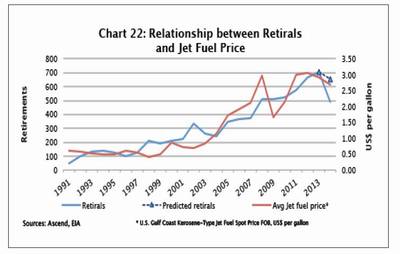
Source: Aircraft Retirement and Storage Trends, Economic Life Analysis Reprised and Expanded, Dick Forsberg, March, 2015, Avolon The data implies a direct relationship between the price of fuel and aircraft retirements. This relationship should be intuitive since older aircraft tend to be less fuel efficient and when fuel prices are high there’s a corresponding rise in retirements. As of this writing however, fuel prices have come down significantly. This may have a moderating effect on the Surplus Parts market forecast. Royboy’s opinion is that current low fuel prices are a temporary aberration. Note also that according to the cited Avolon data, there is a 1.5 year average lag between changes in fuel prices and resultant corresponding changes in retirements. In economics parlance, that makes fuel prices a Leading Economic Indicator regarding aircraft retirements.
I’d like to re-post the following information from Part 1 of this blog: 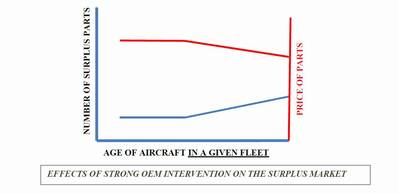 CHARACTERISTICS:
I re-posted this information because of its potential to effect the Surplus Parts market forecast. To use words employed by ICF, the last two bullets regarding PMA and Tear-Downs are aftermarket ‘Countermeasures’. I like that term since it is widely used in the field of Electronic Warfare, my original Air Force career field. CONCLUSIONS AND OBSERVATIONS:
PS: Leave us a comment on the ASA blog site.
Over ‘n out
Roy “Royboy” Resto www.AimSolutionsConsulting.com
Economics and Influences on the Surplus Aftermarket, Part 1Posted By Roy Resto | February 23, 2015
In college many of you took Micro and Macro Economics. You likely remember that those classes were characterized by the numbing number of graphs; recall those Supply-Demand curves? I liked those graphs. To a certain extent they were intuitive, and you could derive a great deal of information from them. I hope to do that with this blog. I have not seen these graphs before, so I’m having geeky fun expressing latent talents for academia.
Recently, our friends at ICF International published economic data represented in the following chart: 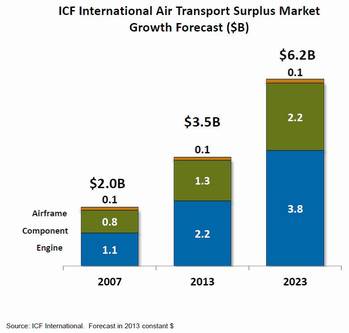 The release of this data triggered a few articles in industry magazines which offered analysis of the market and the represented data. It occurred to me that the fundamental economic drivers on the surplus aftermarket have not been adequately articulated in the past. Only when these fundamentals are understood, can we judge the quality of analysis and opinion. So, in this Part 1 I hope to articulate those fundamentals, and then with the next blog, Part 2, I’ll combine the fundamentals with current analysis. I hope you’ll find the last two graphs particularly interesting:
If I have done my job right, these will all seem simple and intuitive. For all of these, you will recall your college professors repeatedly saying “All things being equal”, and so it is here, these are generalizations. 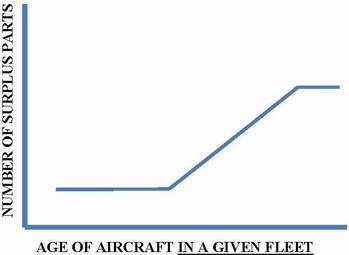 
Easy right? Let’s build
upon this. 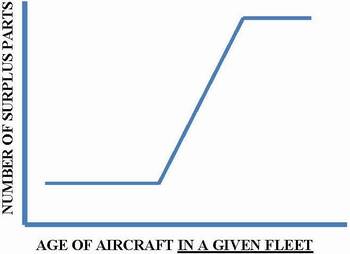 
Next: 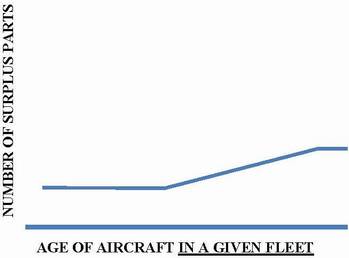 
How about a combined global aircraft types? 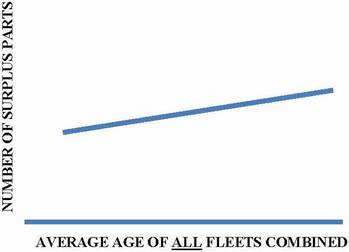 
Here’s an interesting but predictable phenomenon: 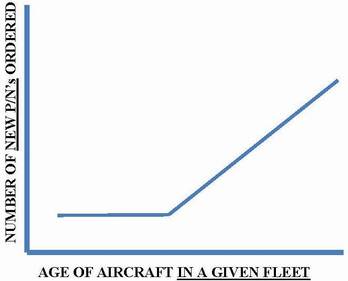 
Let’s
crank these a little bit: 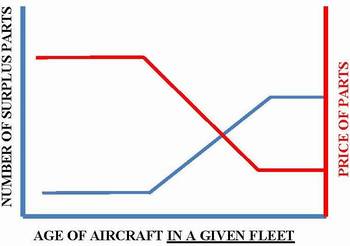 
Now we can break this down: 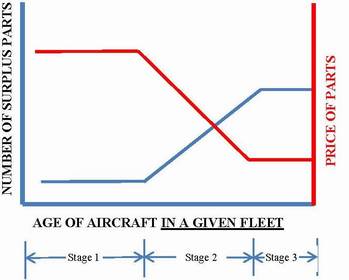 
The following phenomenon is emerging and worthy of commentary: 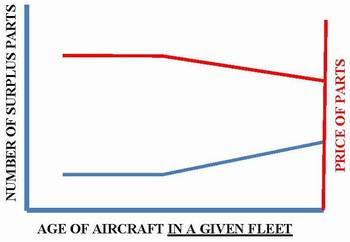 
University students looking
for thesis material may want to take these graphs and do the research to
quantify the graphs. In the next blog I hope to merge the theory presented here
with the forecasts earlier introduced. Over'n Out - Roy "Royboy" Resto - www.AimSolutionsConsulting.Com... class="MsoNormal" style="mso-margin-top-alt:auto;mso-margin-bottom-alt:auto; line-height:normal"> APPROVED SUPPLIER/VENDOR LISTS; THE ISSUESPosted By Roy Resto | December 03, 2014
Ok, time to stir the pot a bit. I know there is a silent majority of people out there who roll their eyes while simultaneously pressing their lips at the mention of Approved Supplier Lists; they look at it as a necessary evil; a constant source of findings on internal and external audits; a down-right thorn in the side! On the other hand, many of those same people, when presented the opportunity to get on a major customer’s Approved Supplier List, are heard to herald their unflinching dedication to all aspects of quality, and are seen to conspicuously post their quality pedigrees on their virtual sleeves. We love getting recognized by those major customers with neat trophies or certificates of recognition for on-time or other measured performance, don’t we? No problem with that, right? So, why the ambivalence? Depending on which regulation or standard you fall under, the requirements regarding the elements of your Approved Supplier/Vendor List may vary, but they all have common threads: Who are you getting your parts or services from?; How are they qualified to get on your list? Nearly all findings by internal or external auditors are due to non-compliance with what was said in the firm’s own manual. Here’s a sampling:
Other problems include:
Speak of
‘work-around’, another one used frequently in the industry is what I’ll call
the ‘Hidden Supplier’. Many firms have active programs to reduce or place a cap
on the number of suppliers they use, hence a reduced or capped Approved
Suppliers List. This is somewhat understandable since after all, you have to
manage all those firms on your list. Suppose you need a part, and the only
supplier is not on your Approved, capped Suppliers List. No problem, just issue
the PO to someone on the list, and by phone ask them to get the part from the
firm not on the list, hence the hidden supplier. You get the part from an
approved supplier (who got it from someone else), and everyone is happy, right?
The problem is, both the approved supplier and
hidden supplier got a price markup; two instead of one. This is one of the
reasons why these caps or reduced-supplier-base initiatives seem to come and
go. And how about the data talking to you regarding the Quality History of your suppliers? Too often unfavorable data just sits there, dormant. Maybe it makes its way into an internal report. But how about sharing your information with the offending party; the supplier? The most common excuse is that the supplier is a big name, and you’re just a small fish; that they won’t listen you. Really? Have you even tried? If the extent of such communication is that you issue a ‘speeding ticket’ (a CAR or SCAR), then perhaps I understand why you don’t get any response. Pick up the phone, establish a colleague-to-colleague dialog with the person at the supplier; have your data and examples ready. Most of time you’ll see results and a genuine interest, and usually, thanks. Try it. Then there are the firms that take their system for Approved Suppliers beyond merely meeting the base-line requirement of the standard or regulation; they want to actively meet the spirit and intent of the requirements. Attributes of such firms might include the following:
For those
minimalists satisfied with just meeting the standard, I hope you’ll challenge
yourself to utilize the requirement as an opportunity to better serve your firm,
and to develop meaningful relationships with the suppliers you’ve teamed with. Leave a comment on this blog – your stories, observations, or best practices.
Over ‘n out Roy Resto www.AimSolutionsConsulting.com |