CAVU Café: Royboy’s Prose & Cons, Page 7 of 17 The views expressed in CAVU Café: Royboy’s Prose & Cons blog are those solely of the writer and are not necessarily shared by the Aviation Suppliers Association or the Association’s staff, members, or Board of Directors. About Roy Resto WHEN WILL THE FAA AND GLOBAL CAAs START TO ASSIST INDEPENDENT MROS IN OBTAINING MANUALS FROM THE OEMS?Posted By Roy Resto | October 01, 2020
We need to have a frank talk about a continuing pattern of injustice and seemingly anti-competitive behavior in the aftermarket. I’ll start. Due to the current covid crisis, and perhaps to the delight of OEMs (herein manufacturers who are Production Approval Holders, PAH, or have Production Organisation Approvals, POA) who in recent years have made major forays into the aftermarket, there are many small independent MROs staggering on the brink of business failure. Aside from covid, are there any other factors which may be contributing to the inability of these small independent MROs to compete fairly, thus exacerbating the viral effects? Unquestionably, unreservedly yes, and the factor is that despite being qualified MROs, these independent businesses are being denied reasonable access to the OEM’s maintenance manuals. Manuals, in this context being the data needed to repair and overhaul parts, variously called ICAs-Instructions for Continued Airworthiness, CMMs-Component Maintenance Manuals, Overhaul Manuals, etc. Without these you can’t add the applicable part numbers to your Capabilities List, restricting your growth and ability to compete. This is not the first time I’m addressing these issues. I greatly encourage you to read these articles:
Notwithstanding the nascent, substitute-PMA (Parts Manufacturing Approval) industry, OEMs repose as monopolies for the manufacturing of aircraft parts, and in the interest of safety the industry tolerates the monopoly. In the past these OEMs generally looked upon the MRO market as outside of their core competencies, but in recent years have sought to grab market share and bring it inhouse. Normally we would characterize this as ‘business is business’ but there’s disturbing, quiet evidence of OEMs imperiously seeking to extend their monopolies into the aftermarket. One of the ways they’re leveraging their status is by denying manuals to AMO (Approved Maintenance Organisation)/Repair Stations who are otherwise qualified to perform the work and should be given reasonable access to the documents1. It’s the classic David vs. Goliath scenario. Is anything being done?
If you’re a member of a non-profit trade association, I greatly encourage you to continue to ask them for actions seeking relief of this restraint of trade issue. How about the global Civil Aviation Authorities? Since the FAA is among the global leaders amid CAAs, let’s focus on them. If one of my MRO clients who is qualified and properly certificated to work on certain articles is being denied reasonable access to manuals by the OEM, can they call their FSDO (Flight Standards District Office) and ask for help in obtaining access? Unfortunately, there does not appear to be any procedural mechanism for this. Among the many things the FAA is empowered to do, it’s in their charter for the “…promotion of civil aviation…”3. I could not think of a more deserving cause the FAA should champion than this issue which would greatly contribute to the promotion of civil aviation; it would promote competition and moderate costs, all to the great benefit of operators and the MRO community. If so, and once again we’re frank, why hasn’t this already taken place? Perhaps:
FSDOs have no compulsion in escalating to a certificate action for MROs regarding the availability of approved data. The FAA on the manufacturing side must be willing to do the same against offending PAH-OEMs unwilling to share the data with independent MROs. In this article I’ve used the term ‘reasonable access’ to the manuals. Before you figuratively wag your finger at me and state that the OEM data is intellectual property, of course it is, and if desired the OEM should be able to charge a reasonable fee to recover their investment and/or a subscription fee for the data and SBs; understood. Just don’t cut me off entirely. I’d like to conclude with a story. During the 1990s ‘bogus parts’ hysteria, it came to light that one of the practices contributing to the phenomenon was the issue of ‘direct shipping’. It had become disturbingly common practice for non-PAH manufacturers to, instead of shipping their products to the proper PAH for eventual sale to the end users, the non-PAH manufacturers were bypassing the quality systems of the PAHs and sending product directly to the end users. The FAA boldly stood up and put the industry on notice that this would no longer be tolerated and today the FAA AC 21-29 clearly states that this is cause for a Suspected Unapproved Part. Bravo! Let’s see the same boldness and leadership on this issue…They would be heroes! Over ‘n out Roy ‘Royboy’ Resto linkedin.com/in/royresto www.AimSolutionsConsulting.com 1 https://www.aviationsuppliers.... EASA’s EMERGING GLOBAL LEADERSHIPPosted By Roy Resto | August 03, 2020
Back when the European Union was just forming, I distinctly recall the old days of the toothless JAA (Joint Aviation Authorities), and then in recognition of such tooth lessness, the transition to the more formidable EASA (European Aviation Safety Agency). My earliest impressions of the new EASA were twofold; one, that they were intent on not following anyone’s existing model of how to administrate aviation (read that: we’re not going to follow the FAA’s model), and two, a nearly homogenous aura among the administrators of unassailable authority; we’re here to establish our authority and tell you how it will be done, period. And why not? From the beginning EASA inherited daunting challenges not exhibited anywhere else in the world. Imagine trying to become an administrator of 32 member states, each with their own independent, entrenched, civil aviation authority, and significantly, varying degrees of political and economic influence. Challenging indeed. The resulting working model for this unique set of challenges is that the European Parliament, representing these varying member states, must first approve of all Regulations (aviation), which then becomes a mandate for EASA to follow and enforce. That is why you always see EASA processes and procedures prefixed by the respective, enabling EU Regulation. For example:
EASA’s initial activities expectedly consisted mostly of organizing itself and establishing basic aviation services such as aircraft, pilot/engineer, and organization certifications. These efforts have now reached a reasonable level of maturity and stability, and EASA seems to have come of age and established its own identity. Part of that identity, and the reason for this article, appears to be a willingness to innovate and accomplish ‘first-time-by-anyone’ achievements. While there are many, in this article I wanted to focus on these as examples, in bold. POSTING OF STOLEN AIRCRAFT PARTS ON THE EASA UNAPPROVED PARTS WEB SITE. The issue of stolen aircraft parts first came to my attention when I worked at a major airline. Two things occurred:
For the longest time it has been recognized that stolen aircraft parts necessarily contribute to Unapproved Parts Activity; perhaps forged documents, altered data plates and the like. An early article I wrote focused on this issue2. Early attempts to create a database of stolen parts were not successful. Recently however, EASA has started to list reports of stolen parts on their Suspected Unapproved Parts page3, bravo. It's my opinion that the problem of stolen aircraft parts is greatly under-reported for many reasons including:
Regardless, EASA has the first real attempt to put these parts in the public domain and they are to be commended. By the way, I strongly recommend you go to the EASA SUPS home page and sign up to receive their notifications. FIRST TYPE CERTIFICATION OF A FULLY ELECTRIC PLANE. As a FAA DAR I was once asked to certify an aircraft with an electric engine, but the FAA issued strict guidance against such issuances, so I had to deny the application; that was quite a few years ago. Since then, in a historical first, EASA has issued the first TC4. Here’s an excerpt of the press release: “COLOGNE, June 10, 2020 - The European Union Aviation Safety Agency announced the certification of an electric airplane, the Pipistrel Velis Electro, the first type certification world-wide of a fully electric aircraft and an important milestone in the quest for environmentally sustainable aviation. “This is an exciting breakthrough,” said EASA Executive Director Patrick Ky. “This is the first electric aircraft EASA has certified but it will certainly not be the last, as the aviation industry pursues new technologies to reduce noise and emissions and to improve the sustainability of aviation.”” While this aircraft is a small two-seater aimed at the flight training market, it no doubt established the model which will be used to Type Certificate larger electric aircraft, and there is a plethora of such aircraft in advanced design stages. Pretty cool. DIGITAL CERTIFICATES As reported in the ASA’s Web Log5, EASA is moving to issuing certain certificates digitally. In other words, they will no longer systematically print and dispatch wet signed versions of the certificates. The certificate applicant receives a high resolution, printable version of the certificate with the look and feel of the paper version, and anyone interested will be able to cross check the validity of the cert by going to the EASA website of such listings6. I highly recommend you add the link (number 6 below) to your favorites. It contains further links to many listings in one place, which we geeks in the past have found difficult to find. I find this interesting for a couple of reasons:
EASA ADOPTS NEW RULES ON CERTIFICATION AND OPERATIONS OF DRONES The segment of aviation and aeronautics with the highest rate of growth is that of UAS (Unmanned Aerial Systems), or by the more common parlance, drones. The on-going collaborations between industry and regulators to address the challenges of regulating UAS operations and certification of operators and aircraft is dizzying in scope and details. Given the population density of Europe and the well-publicized incidents of drone/aircraft encounters and airports being closed due to unauthorised drone activity, EASA has taken an aggressive leadership role. Most recently it released a proposal for standards for light UAS (600 kg or less, or 1,322 pounds)8. With such a high weight, this will undoubtably cover nearly all UAS operations such as package delivery. Once implemented and refined it will likely lead to a more formal Certification Specification. Earlier EASA had also released a rule on operations of drones which will become effective December of 20209. According to EASA Commissioner for Transport Violeta Bulc: "The EU will now have the most advanced rules worldwide. This will pave the way for safe, secure, and green drone flights. It also provides the much-needed clarity for the business sector and for drone innovators Europe-wide." For all these reasons we should applaud EASAs willingness to innovate and implement new ways of regulation and oversight for our ever-evolving marketplace. PS: What do you think? Leave a comment! Over ‘n out Roy ‘Royboy’ Resto AimSolutionsConsulting.com 1 https://www.easa.europa.eu/the-agency/faqs/agency 2 https://www.aviationsuppliers.org/STOLEN-AIRCRAFT-PARTS---By-Roy-Resto 3 https://www.easa.europa.eu/domains/aircraft-products/suspected-unapproved-parts 6 https://www.easa.europa.eu/document-library/approvals 9 https://ec.europa.eu/transport/modes/air/news/2019-05-24-rules-operating-drones_en THE BASICS OF DOING BUSINESS WITH THE GOVERNMENT/MILITARYPosted By Roy Resto | June 01, 2020
As any Investment Adviser would counsel, a recommended strategy is that you diversify your portfolio. In the last decade there has been a noticeable change in the landscape of the aircraft parts aftermarket. One of the evolutions involves the scope of work performed by distributors. In the past, firms whose only model was to broker, search and resell parts seem to have, in many cases, gone away. On the other hand, those who survived the economic turmoil following 2008, and which continue to survive despite the OEMs expansion into the aftermarket, appear to have done so due to their deliberate business plans to diversify. A short list of options to diversify would include:
Why? Consider this:
Due to its huge economy, the USA spends the most in raw numbers, but it is customary and a better measure to cite Defense Spending as a percentage of the nation’s Gross Domestic Product, GDP. By that measure, the USA ranks around #19 at over 3 percent, with Saudi Arabia at the top, spending 8.78 percent. Since the USA spends the most, this blog will focus on some basic things you need to do to qualify for entry into this marketplace. In this article we’ll give quick overviews of:
Before going down this road, here’s some counsel from Royboy-
CAGE CODES: Commercial And Government Entity. A CAGE code is a five-character alpha-numeric identifier assigned to entities located in the United States and its’ territories. The DLA (Defense Logistics Agency) CAGE Program Office is the only activity authorized for assignment or update of a CAGE code. An NCAGE is assigned to firms outside the USA and is a NATO CAGE code. The CAGE code is used to support a variety of procurement and acquisition processes throughout the U.S. Government and yes, it is required. It will be assigned during your SAM registration, see below. You can search CAGE codes at this web site: https://cage.dla.mil/search A virtual cigar to the first person to post the name of the firm belonging to 6TC01 in the comments section of the blog at the end. DUNS NUMBER: If you don’t already have one, get this first; you’ll need it for the SAM Registration Process. The Data Universal Numbering System, DUNS Number is a unique nine-digit identification number provided by D&B (Dun and Bradstreet). DUNS Number assignment is FREE for all businesses required to register with the U.S. Government for contracts or grants. Start here: https://fedgov.dnb.com/webform/ NAICS CODES: A NAICS Codes is simply a six-digit code which represents and describes the industry you’re in. A NAICS (pronounced NAKES) Code is a classification within the North American Industry Classification System. The NAICS System was developed for use by Federal Statistical Agencies for the collection, analysis and publication of statistical data related to the US Economy. It was adopted in 1997 to replace the Standard Industrial Classification (SIC) system in cooperation with the statistical agencies of Canada and Mexico. These codes don’t always exactly match what you do, so the trick is to find the ones which most closely match. It’s common for firms to list themselves with several NAICS codes to make sure all the possible topics are covered. For example, in my consulting business I list three codes, 541618, 541611, 541990. Look here for a search: https://www.census.gov/eos/www/naics/
The significance of these codes for use lies in searching for opportunities as well as making it known what you do. You’ll need to establish the ones applicable to your firm for the SAM Registration Process. The government posts opportunities for you in the form of Solicitations. Each Solicitation is meant to target firms with the applicable NAICS code, so you can search for Solicitation opportunities by the codes. More on Solicitations shortly. FARs, FEDERAL ACQUISITION REGULATIONS A former boss once asked me fill out a lengthy questionnaire since I was the FAR expert of the firm. I looked closely at the cited FARs and shook my head, wait, there is no FAR 52! My boss had seen the FAR citations and assumed it meant Federal Aviation Regulations; it did not. This was my initial foray into the exciting world of Acquisition Regulations. These FARs direct with whom, and how the government performs acquisition of goods and services with suppliers. It’s important that you have a working knowledge of these for two reasons:
If your goods and services are destined for Department of Defense use, it is likely that your Clauses will include DFARs, Defense Federal Acquisition Regulations. Whereas Federal Aviation Regulations are found within Title 14 (Aeronautics and Space) of the CFRs, (Code of Federal Regulations), Federal Acquisition Regulations and DFARs are found in Title 48 (Federal Acquisition Regulations System) of the CFRs. Here’s a link to title 48: NATIONAL STOCK NUMBERS (NSN): Some of you may have worked for airlines who have their own internal system of part numbers called Company Part Numbers. These are always in a standard format, for example a part with a CPN of CON7023 may mean a Controller, and in the listing for CON7023 is the OEM’s part numbers. There are many advantages to this arrangement, for example, CON7023 may list more that one part number as acceptable for use. National Stock Numbers, NSNs, are the government’s Company Part Numbers. Every OEM part number will have an assigned NSN. NSN’s are all structured the same. Here’s a training excerpt: 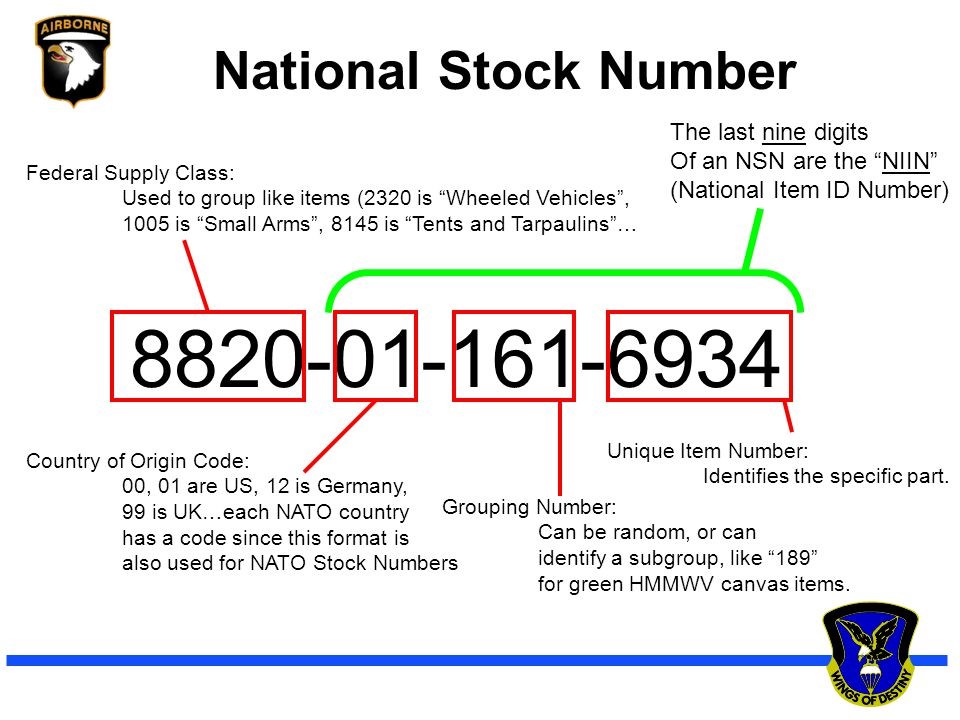 The first 4 digits are particularly helpful because it tells you what type of part it is. For example, every aircraft wheel and brake system component will start with 1630. In the commercial world it’s kind of like knowing the ATA Chapter; if you know the ATA Chapter, you know the system the part is installed on. Google ‘Federal Supply Class’. PSC CODES In any NSN the first four characters are traditionally called the Federal Supply Class or Codes. Those codes are also referred to as Product Service Codes. Product Service Codes are used by the United States government to describe the products, services, and research and development purchased by the government. Government procurement specialists and government contractors alike require a solid understanding of these codes in order to produce quality partnerships between buyers and suppliers. The significance of these codes for use lies in searching for opportunities as well as making it known what you do. You should establish the ones applicable to your firm for the SAM Registration Process. A helpful website to identify PSC codes is at https://psctool.us/ Go there and search on “Aircraft Parts”. The search results are about 180. Pick the ones that represent what products or services you sell. A small example from this search might be: 1560 – Airframe Structural Components 1630 – Aircraft Wheels and Brakes P200 – Aircraft Salvage (AFRA members may use this one) J016 - Maintenance, repair and rebuilding of equipment: aircraft components and accessories (For repair stations/AMOs) SAM, SYSTEM FOR AWARD MANAGEMENT, REGISTRATION: Now that you have your DUNs number, NAICs Codes, and PSC Codes, you’re ready to start the most important process required to do business with the government or military: your SAM Registration; a lengthy process. Here’s a snapshot of the home page: 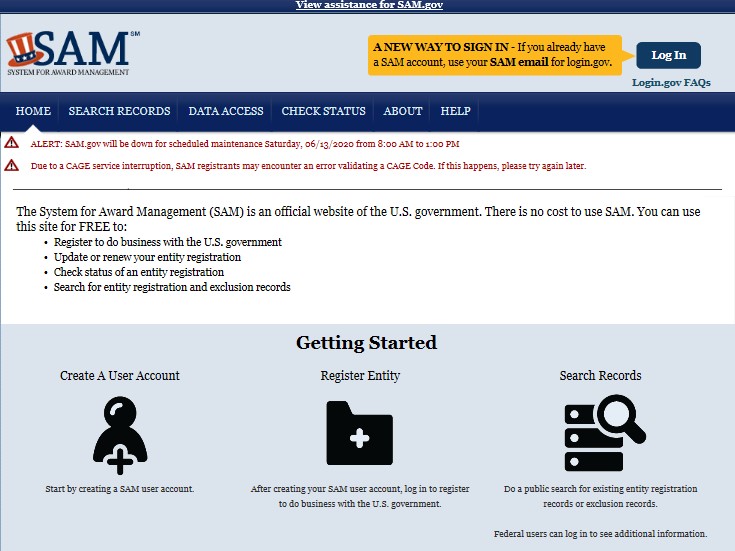 The government recently switched the login procedure to a common process reflected in the Login.gov website. Previously each government website platform had its own login functionality requiring you have multiple passwords for each .gov website. This new method introduces a welcomed standardization and commonality. Your initial setup may seem tedious, but be patient, it’s a good thing! Follow the steps. Take the time to familiarize yourself with the many tabs on this site, there’s a plethora of helpful, downloadable information. It’s beyond the intent of this article to duplicate those instructions and explanations. SEARCHING FOR SOLICITATIONS: At this point, if you’ve completed your SAM registration, congratulations! Your next step should be to start looking for opportunities. Previously, the platform to search for these opportunities was FBO or Federal Business Opportunities, commonly referred to as FedBizOps. This system recently migrated to https://beta.sam.gov. To start, conduct your initial searches of solicitations that are targeting your NAICs and PSC codes. You can save your searches and have them forwarded to your email daily. For those of you used to simple commercial RFQs with just price and qty, you’re in for a shock. The first time you look at a solicitation, you’re going to be overwhelmed with the depth of information and requirements in order to participate and bid. If you intend to submit a bid, the instructions must be followed impeccably. If you’re not awarded the bid, it’s still possible for you to participate. The government will announce the winner, and it common to reach out to them and ask to be subcontractor supplier. HELP: There are several free help agencies to assist you. If you have read this article and are convinced you want to enter this market, Royboy strongly recommends you have a cup of coffee and a chat with your state’s PTAC Rep, Procurement Technical Assistance Center. They will coach you. Here’s a link to get started: https://www.dla.mil/SmallBusiness/PTAP/ Another free source of help is the Small Business Administration, SBA. Here’s a link to their Federal Contracting assistance: https://www.sba.gov/federal-contracting MARKETING: If you are already are in the commercial market, you likely have a budget established for marketing, for example attending trade shows, advertising, booth displays, customer visits, etc. You need to do the same if you intend to enter the government/DoD arena. BEWARE THE “.COM” WEBSITES VS “.GOV”: When you register with SAM you will be asked if you want your registration to be ‘searchable’. I recommend yes since it gives your firm a degree of visibility. Firms seeking to partner for particular work can then find you. The flip side of this is that you will likely see your inbox frequented with emails cloaked in official sounding titles for services, most of which you will not need. If you grow weary of these, a simple test is whether it came from a ‘.gov’, ‘.mil’, ‘.US’, or ‘.com’. You can ignore most of the ‘.com’. LEVERAGING YOUR MINORITY OR OTHER SPECIAL STATUS The government has a great number of Solicitations which are loosely called ‘Set Asides’. For example, this means the work will be awarded to firms listed as minority owned firms. I’m both a Veteran and a Service Disabled Veteran Owned Small Business. Some set-asides are for such firms. I greatly encourage, and you should leverage, any such status. All of these are typically tied to the majority owner of the firm. During the SAM registration process you’ll be asked to make all such declarations. Note that some declarations may require that you be independently certified as such. The SBA, Small Business Administration is a great source of help in this area. See HELP section of this article. Best wishes, and over ‘n out! Roy ‘Royboy’ Resto AimSolutionsConsulting.com DRONE PRONEPosted By Roy Resto | April 01, 2020
Before getting started, we need to establish that insiders do not call these pilotless flying devices ‘drones’. Universally, commercial, government, and military operators call these either Unmanned Aircraft Systems (UAS) or Unmanned Aerial Vehicles (UAV). Recreational users continue to perpetuate the use of the drone moniker and it seems to have stuck in the public’s mind. This article will include:
OVERVIEW AND INTRODUCTION: How significant is UAS activity? Consider these statistics:
By whatever measure, we’re all aware of its explosive growth, and new creative uses emerge constantly. To their great credit, the FAA quickly stepped up to the many calls to bring control and structure for the many types of UAS operations. Roughly, the FAA categorizes all UAS operations into one of the following segments:
For each segment the FAA offers clear guidance. For more information on each segment, start at their main page for UAS operators at https://www.faa.gov/uas/ Of course, the UAS phenomena is global and National Aviation Authorities world-wide have similarly stepped up their regulatory activities. For example, EASA has implemented a program for their geographical areas and this link outlines their progress, timelines, and documents: https://www.easa.europa.eu/drones-regulatory-framework-timeline In the US, if you’re considering doing anything with a UAS and getting a fee for your service, it’s considered a Commercial Operation and you must become a certificated UAS pilot in accordance with the relatively new FAA Regulation 14 CFR Part 107 titled ‘Operation and Certification of Small Unmanned Aircraft Systems’. By ‘small’, the FAA means 55 pounds (25 kg) or less which is broadly inclusive of nearly all non-military UASs. I decided to get my Certificate last year. If you’re an aircraft pilot and are current, the process is easier, which was the path I took. All UAS pilots must become familiar with the FAR and the limitations of UAS flight. There is a plethora of aps, aids, checklists, and on-line assistance for conducting safe operations. For example, the free phone ap B4UFLY is popular. With it you can check your exact location to see if you are within, or in the vicinity of airport airspace which of course you must not fly into unless clearly coordinated with the FAA. Another popular free ap for situational awareness is Flightradar24, which gives you a picture of active aircraft at your location. I recently met Peter Menet and interviewed him for this article. Peter is a former Army Blackhawk pilot and is now the President and CEO of Menet Aero. A neat web site and video are at https://www.menetaero.com/ 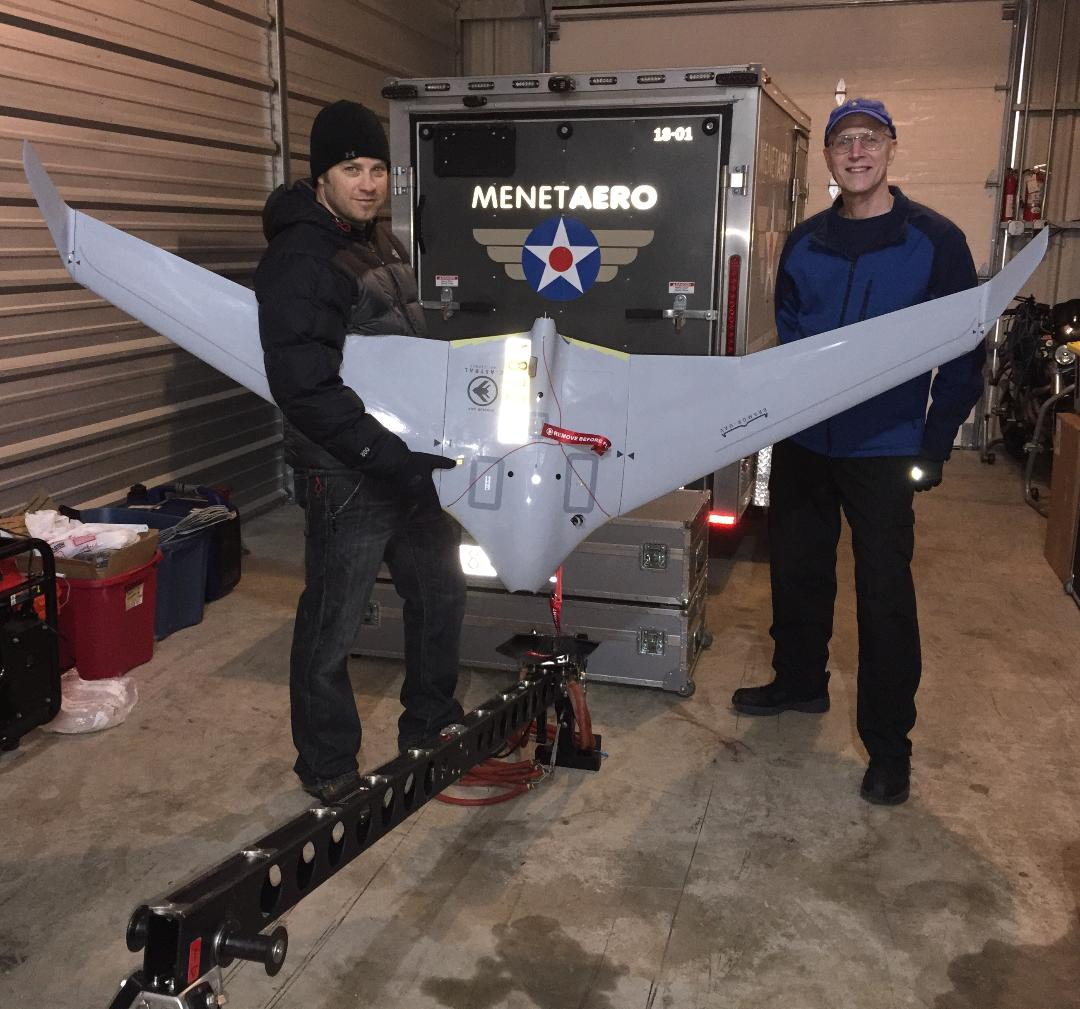 The UAS in this picture is manufactured by C-ASTRAL Aerospace Ltd in Slovenia. At the base of the picture is the launcher, and the UAS has an internal parachute for recovery. Both the UAS and its Launcher quickly come apart and are stored and transported in the two silver cases directly behind Peter. Menet Aero recently successfully participated in a US Special Operations Command evaluation of UASs, and this model type was flown. See link: https://www.c-astral.com/en/unmanned-systems Not visible in the picture are this UAS’s gimbaled optical and infrared sensors; these are in the nose but are here retracted into the body for protection and storage. OPERATIONS AND REGULATIONS: Menet Aero has participated in many projects, but one of notoriety is assisting the Department of Interior (DOI) to fight forest fires. The DOI is tasked with coordinating all activities involved in fighting forest fires, and there are many. During a typical big forest fire there may be multiple aircraft types participating including UASs, helicopters, and aircraft. It is routine that a TFR (Temporary Flight Restriction) be established in the area. A TFR is a strict warning for non-participating aircraft to stay away; this includes sightseers, news choppers, and amateur drones from interfering. For example, wherever the President is, a TFR is in effect. In fighting forest fires, flying operations will usually involve maneuvers that would typically be considered violations of regulations; for example, flying height above ground, flying within the TFR, and aircraft separation. In order to legally accommodate such operations, the DOI applies for and receives an SGI or Special Government Interest through which, waivers can be issued regarding those regulations. Menet Aero is able to provide real-time visual and infrared tracking and mapping of the fires so the DOI can best direct the firefighting efforts. Speak of regulations, of course there are many regarding UAS operations. A handy summary of these is available at: https://www.faa.gov/uas/media/Part_107_Summary.pdf As with any regulation, a waiver can be applied for, and if granted you’ll be issued a Certificate of Waiver or COA for Certificate of waiver Authorization. In fact, these are quite common for UAS operations. For example, Menet Aero has one (among many) for being able to fly UASs at night which is otherwise prohibited. Being a responsible UAS operator is all about situational awareness. Here’s an example of what situational awareness could entail. 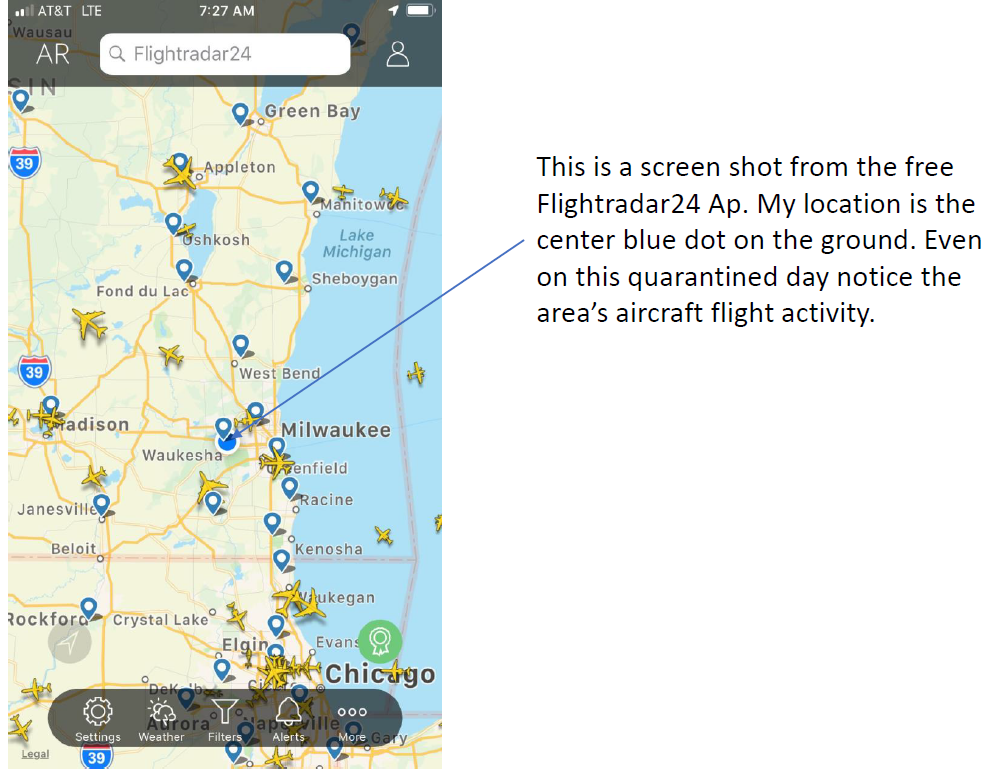 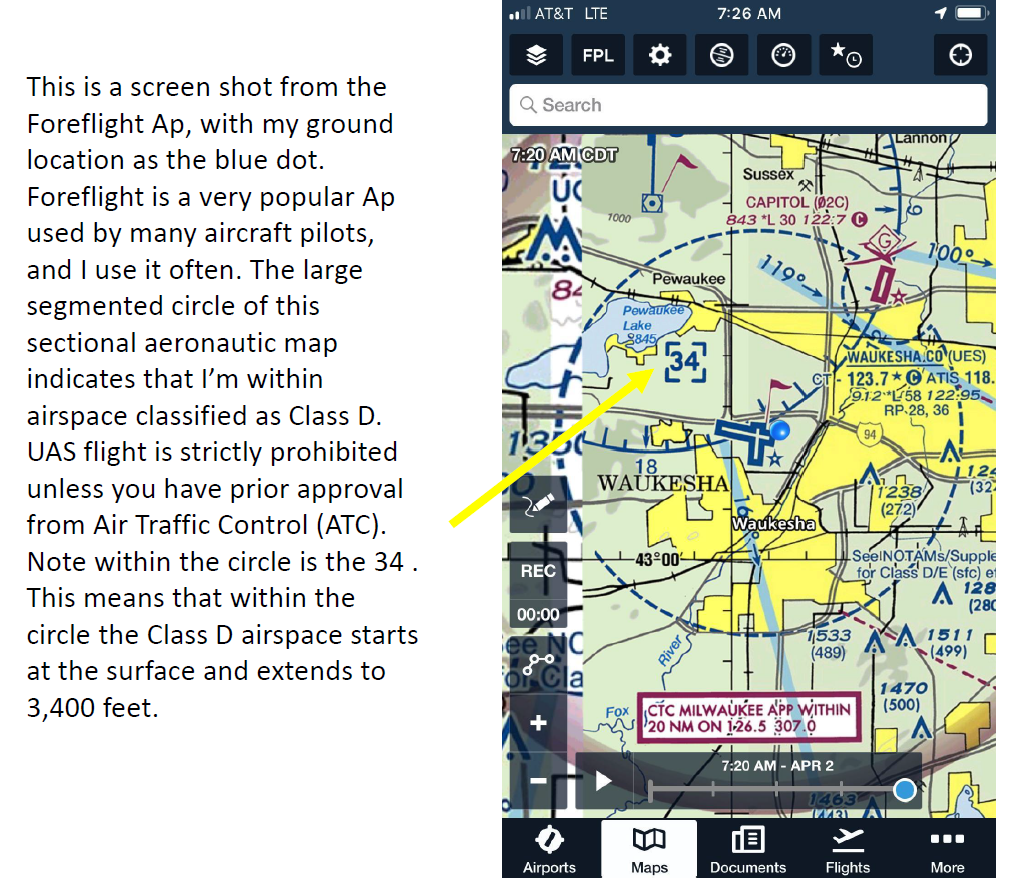 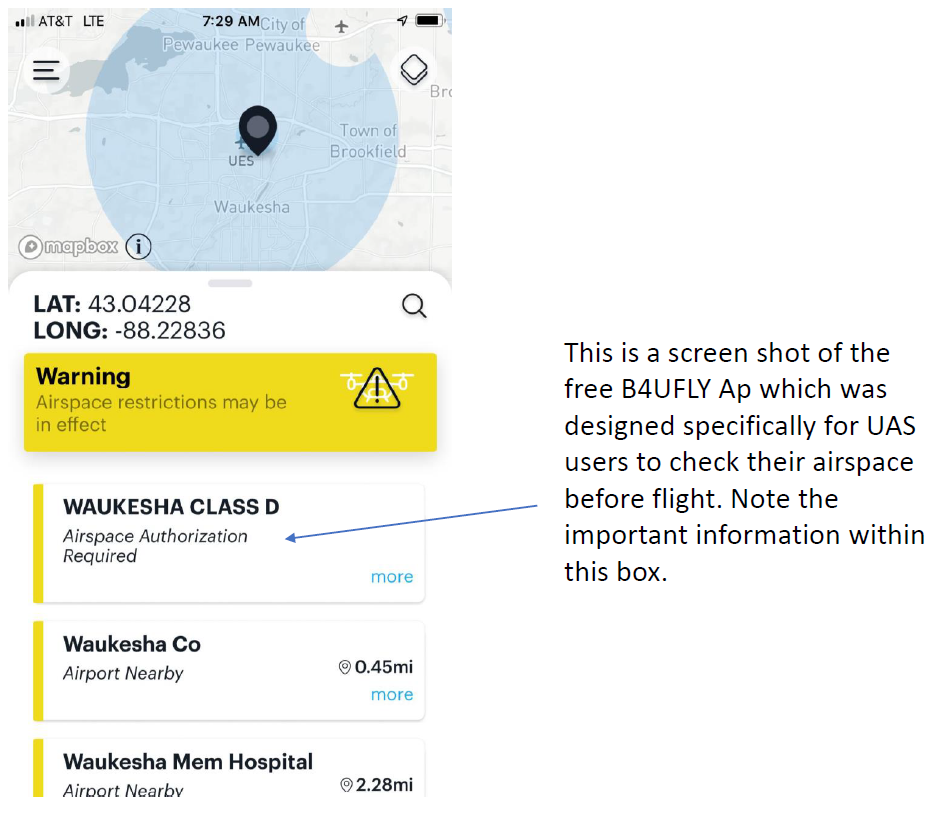
MAINTENANCE: Maintenance in the UAS world community is not as prescribed or regulated as in the aircraft world. The UAS must have a good pre-flight inspection as any pilot would do, but if there is maintenance to be performed, it will be by owner’s tinkering or ‘shade-tree’ fixing. Many manufacturers recommend replacing parts or returning it to the factory. As imagined, most required maintenance is because of hard landing episodes. The more expensive the UAS, the more likely that there will be maintenance instructions. For the UAS in the picture with Peter above, he keeps a maintenance logbook. Entities such as the Department of Interior who may vet his firm before handing out a contract, would be interested in seeing the UASs are getting the attention and maintenance required to keep them reliably operational, and would ask to see the logbook, but it is not a regulatory requirement at this time. PARTS: Nearly all spare parts are purchased directly from the factory. SALES/DISTRIBUTION: As is typical, sales and distribution are tied to geographic location and given exclusive sales rights for the assigned area. THE FUTURE: The UAS industry is bullish and optimistic. For example, Menet Aero sees itself as broadly being able to contribute to these industries with its services:
The ideas on how to use UASs are coming on as fast as new manufacturers and platforms. Drone delivery of freight and consumer packages, pilotless delivery of people, electric propulsion, pre-programed flight, autonomous flight aided by AI, advances in electronics, optics, and miniaturization…all and more are contributing dizzying rates of progress and blurring the neat lines we think exist in our aeronautics world. I was recently flying an aircraft, and the controller advised me before takeoff that there were reports of birds in the vicinity. In fact, this has been an ongoing issue at this airport, and I have seen the use of trucks to chase them off, noise devices, and natural predators to ease the problem. The pesky birds are still around the airport. How about if someone used a noisy, belligerent looking UAS to slowly fly preprogramed tracks at the airport to chase them off? Hey Peter, you got this? UAS CERTIFICATION A frequent question is that of certification of the UASs which, unlike for UAS Pilots, is still unanswered. Should they be Type Certificated which would bring an expected level of standardization, reliability, and safety? It’s Royboy’s opinion that the answer may lay in an existing, albeit new method of aircraft certification. FAA FAR 21 already allows for aircraft certification for aircraft manufactured to a Consensus Standard (for example 21.190 (c)(2)). Consensus Standards are a set of standards hosted and maintained by independent neutral organizations such as the ASTM (American Society for Testing and Materials), who establishes and maintains Standards for a variety of industries. The initial set of aircraft standards was developed with the participation of more than 200 multinational interested stakeholders and was accepted by the FAA in 20053. This is a new departure from the legacy certification model whereby the FAA stipulates each degree of aircraft design. In its place, instead of stating the aircraft conforms to all FARs, the statement is made that it conforms to the FAA Accepted Consensus Standard and is therefor eligible for an Airworthiness Certificate. All that’s needed is for the UAS industry to use that model and develop its own set of Consensus Standards. Neat huh? It’s also likely FAA DARs like myself will be able to issue the UAS Airworthiness Certificate (my eyebrows are seen to be fluttering). Special thanks to Peter Menet of Menet Aero. Over ‘n out Roy ‘Royboy’ Resto AimSolutionsConsulting.com 1 https://www.businessinsider.com/drone-industry-analysis-market-trends-growth-forecasts 2 Aviation Week & Space Technology, January 13-26, 2020; Remote ID Proposal for Drones; Page 26. MAX, ODAs, BABIES, AND BATHWATERPosted By Roy Resto | February 03, 2020
MAX, ODAs, BABIES, AND BATHWATER By Roy Resto My spleen seeks comfort in being vented, so this is going to be one of those articles. Regarding Max, let’s be clear; the issue will be fixed, the lessons learned, and the aircraft will return to be the economic best-selling performer it was meant to be. Period. I have always been impressed with our industry’s capacity to get to the root cause of any problem devoid of emotional, political, or institutional influences, for example in accident investigations. But not this time. I don’t ever recall seeing an accident investigation so clouded by politics, institutional posturing (unions, government groups) trade organisations, self-declared talking-head experts, and amateur news editorializing, as with the Max. Every current and former employee except the janitors have found expert expression in every media platform; wow. Perhaps it’s symptomatic of today’s hyper-sensitive society, I don’t know, but it’s clear that all these powerful external influences appear to have had great influence in sidetracking the essential work of root cause analysis and corrective action, sometimes in circus-like atmospheres. One of the sidetrack issues appears to be the pontificating going on regarding ODAs, Organizational Designation Authorization. In the history of aviation, ODAs are a relatively recent addition to the FAA’s system of delegating whereby individuals and organizations are authorized to perform duties on behalf of the FAA which they would otherwise perform themselves. Such entities are thus ‘designated’ by the FAA and generally referred to as Designees. For example, DARs and DERs are designees. This system finds its most basic authority in Federal Aviation Regulation 183, and for ODAs, 183 Subpart D which states in part that ODAs can “…perform specified functions on behalf of the Administrator related to engineering, manufacturing, operations, airworthiness, or maintenance.” Boeing, like so many other Type Certificate holders has an ODA, and the Max was certified under that system. But before we go on to the ODA topic, lets objectively look at our own sidebar, ADs; yes, Airworthiness Directives. Every country’s respective civil aviation authority (CAA) with responsibility for oversight of the Type Certificated products manufactured in their jurisdiction issues ADs. Type Certificates are only issued to Aircraft, Engines, and Propellers. Every Type Certificated product I’m aware of has had multiple ADs issued to them; Airbus, Boeing, Embraer, Bombardier, Cessna, GE, CFM, Pratt & Whitney, and Lockheed, and on and on. There are hundreds upon hundreds of ADs. According to FAA Federal Aviation Regulation 39: “This part prescribes airworthiness directives that apply to aircraft, aircraft engines, propellers, or appliances when:
Sadly, many ADs have been issued after loss of life. The overwhelming majority of Type Certificates have and will continue to be issued by the CAAs, without the use of ODAs. If there are so many ADs against those TC products, does that mean that somehow the CAA-TC system is broken since there are so many apparent safety issues which may have been overlooked in the design stage; that this system needs to be replaced? We don’t hear that talk, and rightly so. On the other hand, it appears that in the charged atmosphere of Congressional hearings, the concept of ODAs has come under severe criticism, for example: “A lot of Members of Congress have opined on the efficacy of the FAA’s Organization Designation Authorization—from “foxes in the hen house” to “coziness” to “conflicts of interest” to “ceding its mission” to “the power of the paycheck” to “complacency.”” 1 A Chicago Tribune article titled “Commentary: Get Boeing and the FAA out of the air safety inspection process”, quotes Sen. Richard Blumenthal, D-Conn. “There’s no question the current system is broken, and it needs reform urgently and immediately” 3 Another article opined that “Those familiar with the evidentiary standards of the US Congress, perception frequently outweighs facts and thus it is quite possible that ODA will be legislatively terminated only years after Congress specifically authorized this delegation.” 2 So…should the Congress cease all delegations and bring that work back in-house to the FAA? Not so fast: “…then-acting FAA Administrator Daniel Elwell said some delegation was essential. Taking back all the tasks associated with certifying new airplanes would require an additional $1.8 billion and a 10,000-person increase in its staff, Elwell said during a Senate hearing in March.” 2 Given the unlikelihood of that funding, have there been any other suggestions? How about 3rd party certification; not the FAA, and not the manufacturer? It turns out there has been some precedence for this idea. In the process of researching this article some fascinating history came to light. It turns out that between 1921 and 1925, Underwriters Laboratories (UL) did just that and here’s a sample certificate: 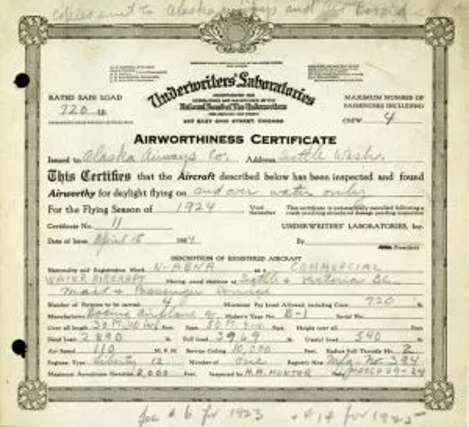 Could a third party like UL be used to independently take over the certification process and have the manufacturer pay for it? “There is no reason why an organization like the FAA should have to hire PhDs and have enough technical people to keep up with Boeing,” said Sandy Murdock, a former deputy administrator of the FAA. “We should have Underwriters Labs do the work and have Boeing pay for it.” 2 But alas, UL apparently was not enthusiastic about the idea; no surprise here. So, we come full circle. The FAA is unlikely to get the funding which would be needed to bring the work in-house, and it’s similarly unlikely that a third-party organization would rise to the gargantuan task of certification. What to do? It’s clear; forget the political posturing and let the aviation professionals investigate and independently arrive at the real, root cause issues that need the attention. Could the ODA have done better? If yes identify the issues and take the steps to fix it and prevent reoccurrence. For accidents of this proportion, there is seldom a single causal issue. ODA: fix it; requiring SMS for manufacturers: do it; airlines improving pilot training?: get it done; better software review?: enhance it; etc. If we’re going to have an honest discussion of Delegation, we need to acknowledge two things:
If all the ADs issued against TC products (issued without ODAs) has rightly, not resulted in actions to eliminate the CAA system, perhaps that level of objectivity should be fairly applied in this instance; don’t throw out the baby with the bath water…just sayin'…. Finally, a last parting sarcastic observation: Some famous persons have been quoted as saying “Don’t waste a Crisis” commonly applied to economic or diplomatic crises that can be exploited to advance political agendas. Corporately, I have observed years of CEOs in the aviation community who, when faced with their own managerial issues have found solace in external crisis’ that can conveniently be applied as the causal reasons for their firm’s doldrums. The Max has thus found expression in Annual reports and Board Rooms as the latest whipping boy. Next up: When that gets exhausted the corona virus will blamed for every malaise. There, I said it and I meant it, and my spleen is now in its proper place. Over ‘n Out Roy ‘Royboy’ Resto AimSolutionsConsulting.com royresto@aol.com 1 A Proposal To Respond To The ODA Perception Mess—B737 Max8–2019 #6 http://jdasolutions.aero/blog/proposal-respond-oda-perception-mess-b737-max8/ 2 UL As An Historical Model For Replacing ODA If Congress Stops That Authority-Comments On The Negroni Commentary 3 Commentary: Get Boeing and the FAA out of the air safety inspection process RECEIVING AND SHIPPING INSPECTIONSPosted By Roy Resto | December 02, 2019
In the Aviation/Aerospace industry, Manufacturers, Airlines, AMO/Repair Stations, and Distributors all conduct Receiving and Shipping Inspections of their aircraft parts. I have experience with all of these, so I thought I’d share some critical observations. First a little sarcastic humor from the distributor community:
Perhaps I was a little too liberal in my use of the word ‘humor’ in characterizing those quotes, but indeed these behaviors exist and are seldom spoken of in the open. We’ll come back to this later in the Chain of Command/Org Chart paragraph. THE ASA’s NEW ON-LINE TRAINING COURSES Before I get started, I want to draw your attention to the ASA’s new on-line training courses. Keep this link in your favorites or bookmarked, since new courses will continue to be added or updated. I also mention it since it’s our intention to post some courses about Receiving and Shipping Inspections. This article is a warmup for those courses. https://www.aviationsuppliers.org/Online-Training DIFFERENCES BETWEEN RECEIVING AND SHIPPING INSPECTION Fundamentally, most of the functions performed during receiving and shipping are the same. For example, entries in the ERP system, documentation review, and visual inspection. The simple essential difference between the two are illustrated below: 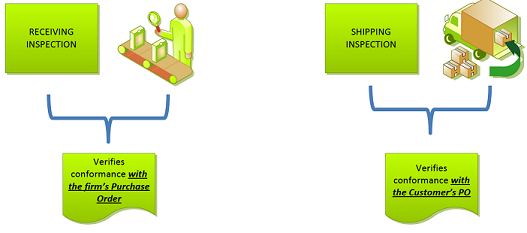 We’ll address these in the Documentation section, but next let’s examine visual and documentation inspections. VISUAL INSPECTION OF THE PART As recently as the early 1990’s there existed great emphasis on performing a thorough visual inspection of the part. Along came ‘Bogus Parts’, SUPs, and Trace requirements, and there was a pronounced shift to the importance of documentation. Since then there has been a noticeable atrophy in visual inspection skills. Excuses include that the inspector is not a certified maintenance technician or mechanic, and therefore should not be expected to perform an acceptable level of visual inspections. I’ve also seen where some inspectors are shy or fearful about removing the caps from ESD parts to inspect the pins, even though they have a functional ESD station! Do you need to be a certified maintenance technician or mechanic to spot these? 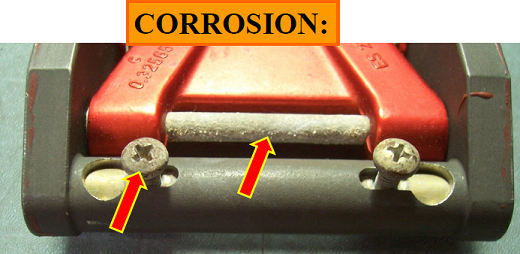 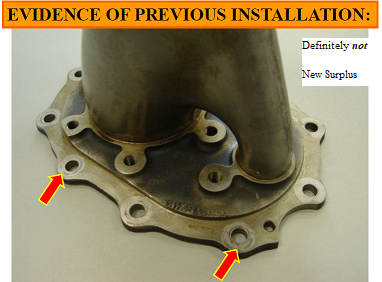 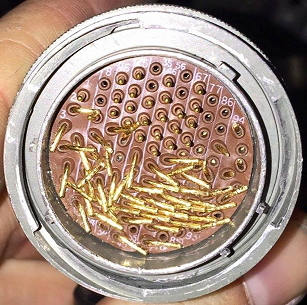 DOCUMENTATION INSPECTION It’s my opinion that it takes about three years before being fully confident in the skills of a new inspector in reviewing documentation, particularly in the aftermarket. Much less qualification time is involved if all you’re doing is receiving new (as in factory new) parts, so for the purpose of this article I’ll stick to the more troublesome aftermarket scenarios. By the way, as a side discussion, permit me to engage in a bit of whingeing regarding that pesky term ‘Factory New’, or FN. We continue to see the occasional use of this term even though it is nowhere defined by an authoritative source. If it just came off the assembly line to you, no one will debate that it’s Factory New. On the other hand, if it came you to off the assembly line and you’ve had it in stock for 5 years, is it still FN? In my opinion the issue can be settled with the answer to one question; is it still under the manufacturer’s warranty? If yes, it is still FN. Back to our topic. Regarding documentation, there is a fundamental rule Royboy continually harps on: Documentation regarding the condition of the part and documentation regarding trace are separate and distinct! For example, you may have a beautiful EASA Form 1 for an Overhauled Part, but the company listed on the Form 1 is the AMO who performed the overhaul. The Trace in nearly all cases is to another entity. The exception being when you purchased the part from the AMO who also overhauled it (145 trace), or you have an 8130-3 from the manufacturer (PAH/DAH/POA trace) for a new part. 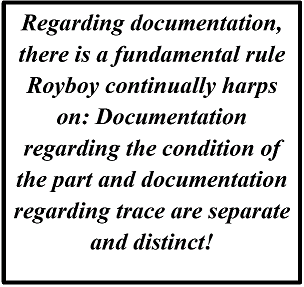 Problematic issues with documentation in the aftermarket include the following:
TERMS AND CONDITIONS; A NEGLECTED PART OF DOCUMENTATION INSPECTIONS Business Law 101: You enter into an agreement to buy or sell through the instrument of a Purchase Order; is the PO a contract? YES! Are the T&Cs a part of the contract? YES! The language on T&Cs varies widely from single sentences to as much as 5 pages, or links to the 5 pages as contained on a website (I’m sure those are all carefully read). I’ve seen much too often that the only portion of the POs being reviewed are for qty, price, and part number. These are all critical but what about those T&Cs? On Receiving Inspections, you are checking that your own T&Cs were met. On Shipping Inspections, that the customer’s T&Cs were met. Customer T&Cs that are commonly overlooked include the following:
I once saw a unique airline T&C which stated that only parts repaired or overhauled by one of their approved suppliers listed on their link to the list were acceptable. I asked was this checked and the answer was no. They stated that the customer had already accepted this and other shipments so they assumed it was ok. I hear that frequently as if it’s acceptable to continually deviate from customer T&Cs since they continue to accept the parts. This is followed by my question; would it be ok if we both called the customer to verify this practice? The question is usually followed by a pregnant pause… Regarding the inspection of the customer’s T&Cs: There are two models:
2. Upon receipt of the PO, any special requirements were flowed down into the firm’s ERP system and show up in pick tickets and/or subsequent POs to purchase or repair the parts. Issues include: A final observation regarding those bothersome T&Cs: Some firms enter into agreements or contracts with their customers. It is commonplace for the customer to list their T&Cs in those agreements you are signing. A challenge for you is how are you flowing down those otherwise unseen T&Cs to your staff and shipping department? This is a source of frequent weaknesses. CHAIN OF COMMAND AND ORGANISATION CHART In the design of organisations in aviation, it is customary practice to have the quality organisation have its own ‘branch’, separate and not reporting to the organisation it performs its quality duties for. The theory is that this should assure the independence of the quality function to not be unduly influenced by their internal ‘customers’. Safety is always enhanced by a robust and independent quality department. Royboy’s observed rule of thumb: The larger the firm, the more independence QA has. In worst case scenarios the inspectors in receiving and shipping are puppets of the sales or the production department; There, I said it and I meant it. Which model exists at your firm? Royboy’s parting tongue-in-cheek sarcasm and observations:
Over ‘n out Roy ‘Royboy’ Resto AimSolutionsConsulting.com |