CAVU Café: Royboy’s Prose & Cons, Page 5 of 17 The views expressed in CAVU Café: Royboy’s Prose & Cons blog are those solely of the writer and are not necessarily shared by the Aviation Suppliers Association or the Association’s staff, members, or Board of Directors. About Roy Resto Certifications For Avionics TechniciansPosted By Jeanne Meade | October 02, 2022
Many of you buy and sell avionics parts and/or have Repair Stations/Approved Maintenance Organisations. As such I’d like to share with you the options that exist globally regarding the credentials which avionics technicians may bring to your attention during the hiring process, including the relatively new NCATT (National Center for Aircraft Technician Training) Certification. Before starting, since this article is addressing a global topic, we need to point out that generally, the terms Technician, Mechanic, and Engineer will all mean the same thing; their use varies geographically. BACKGROUND As with any evolving field of interest, when advancements produce increased levels of complexity, an expected progression would be new fields of expertise, and so it has been for avionics (Aviation Electronics). During and after WW II, aircraft electronic systems became increasingly complex, particularly in the fields of communication and navigation. Technicians who demonstrated talents in these systems were singled out for their aptitude. Despite this recognition, certifications for aircraft maintenance technicians remained stubbornly centered around airframe and powerplant qualifications, with avionics training coming under the airframe category. So, where are we today with certification for avionics technicians? Currently the dominant patterns for maintenance technician certification are the ICAO, EASA, and FAA models. ICAO In past articles I’ve shared my hope that in the future the world would go to a single set of globally recognized and accepted aviation regulations. This desire stems from the dizzying number of duplicative certifications a company might require doing business globally. When this happens, it is likely that ICAO will be the organisation which establishes the standards everyone follows. This is likely because ICAO is not anchored to any nation-state, and therefor does not carry any political or geographic ‘baggage’ which might otherwise arouse the sensitivities of any nations. So, who is ICAO? The International Civil Aviation Organisation (ICAO) is a specialized agency of the United Nations and is funded and directed by 193 national governments to support their diplomacy and cooperation in air transport. ICAO is always quick to point out that they are not a global regulator but that “The stipulations ICAO standards contain never supersede the primacy of national regulatory requirements.1” This is an important distinction; a country’s civil aviation authority maintains its jurisdictional sovereignty over its nation’s aviation operations while implementing globally accepted ICAO standards. It’s this distinction which makes conceivable the promise of ICAO being the global model. ICAO’s standards are contained in 19 Annexes, and Annex 1 is titled “Personnel Licensing” and contains a section 4.2, Aircraft maintenance (technician/engineer/mechanic). This section further refers to ICAO Training Manual Doc 7192, and its Part D-1 which specifically addresses Aircraft Maintenance (Technician/Engineer/Mechanic), and includes Avionics, Radio, Autoflight, and Instruments. The ICAO standards, although valuable as a global influencer, do not require that Aircraft Maintenance Engineers have a specific license for Avionics. EASA The European Aviation Safety Agency has its part 66 regulation which deals with the licensing of Aircraft Maintenance Engineering personal. This licensing falls into 3 categories: CATEGORY A Category A1 – Certifying Mechanic Piston Engine powered Fixed-wing Aircrafts. Category A2 – Certifying Mechanic Turbine Engine powered Fixed-wing Aircraft. Category A3 – Certifying Mechanic Piston Engine powered Helicopter. Category A4 – Certifying Mechanic Turbine Engine Powered Helicopters. CATEGORY B B1.1 – Certifying Technician Piston Engine powered Fixed wing Aircrafts B1.2 – Certifying Technician Turbine Engine powered Fixed wing Aircraft. B1.3 – Certifying Technician Piston Engine powered Helicopter. B1.4 – Certifying Technician Turbine Engine powered Helicopters B2 – Certifying Technician Avionics B3 – Certifying Technician Ultra Light Aircraft. CATEGORY C Category C – Certifying Engineer. Significantly, note that which I have bolded, the B2. To the best of my knowledge this represents the first instance of a Civil Aviation Authority certifying the Avionics specialty. Many countries have copied the EASA model for licensure of AMEs. FAA The Federal Aviation Administration regulation for mechanics falls under Part 65, Certification, Airmen other then Flight Crew Members, and its subpart D addresses Mechanics. Mechanics can have an Airframe and/or Powerplant certificate (A&P). There is no certificate available from the FAA for avionics. Note however that regarding the privileges and limitations of mechanics, FAR 65.81(a) states that
My italics. Note the A&P limitations on instruments. So, how does FAR 1 define instruments?
That definition curiously includes topics which many of us would include as avionics. The go-around for this limitation has always been to obtain a Repairman Certificate for those systems. Repairman Certificates are not quite ‘Certifications’ such as an A&P, however, since they are only active with the employer you are with, and upon your departure must be surrendered. The pesky question in the US then, is how have employers recognized any level of license to equate with avionics/electronics knowledge for hiring purposes? The FCC, Federal Communications Commission has licensing options for those engaging in operations on the radio frequencies, for example, radio station operators, TV stations, and amateur operators (AKA Hams). Engineers which work on and can sign off on work performed for radio station and TV station transmitters must have a General Radio-Telephone Operators license, commonly called a GRO. In the past this was called the First-Class FCC license. The GRO test is a difficult test whereby you must know electronic circuits of all kinds, a plethora of electronics formulas, and FCC regulations. The GRO has the option to have additional endorsements, and one of those is a ship radar endorsement. Although not aviation specific, the GRO was for decades, and continues to be, an acceptable measure that the possessor knows their electronics, which applies to avionics. In fact, many job descriptions for avionics technicians included the desired GRO license, and the radar endorsement was very good to have. For example, many repair stations and airlines hired avionics technicians based on their having the FCC GRO. I should know, in addition to my A&P and I have the GRO with the radar endorsement and was hired into a major airline as an avionics technician based on this credential. Nonetheless, there is the continued and correct perception that the FCC GRO is not aviation specific, and there does not appear to be any FAA efforts to address this or to have any certifications of avionics technicians. In recognition of this, NCATT, the National Center for Aerospace & Transportation Technologies, created the Aircraft Electronics Technician (AET) certification. ASTM NCATT In 2014 the standards setting organization ASTM absorbed the aviation technician certification products that the National Center for Aerospace and Transportation Technologies developed. The NCATT 61-page study guide2 for the Aircraft Electronics Technician details an impressive list of topics the student will be tested on. There are 90 questions and the passing grade is 73%. In addition to these core requirements, there available several endorsements in the following areas:
Each endorsement has its own 50 questions with a passing grade of 70% Significantly, the Aircraft Electronics Association (AEA) endorses this program, and the FAA, in response to an October 2018 petition from the AEA, formally recognized ASTM’s National Center for Aerospace and Transportation Technologies (NCATT) Aircraft Electronics Technician (AET) certification as equivalent to formal training when showing eligibility for earning a repairman certificate3. Keep in mind however, that like the FCC GRO, the AET certificate does not empower you to perform Return to Service actions; you still need an FAA Airframe or Repairman certificate. This contrasts with the EASA model (B2) which does permit this. Over ‘n out Roy ‘Royboy’ Resto AimSolutionsConsulting.com 1 https://www.icao.int/about-icao/Pages/default.aspx 2 https://www.spacetec.us/wp-content/uploads/2019/03/AET-Study-Guide-v5-12.pdf NOTEWORTHY, Ed 2Posted By Jeanne Meade | August 01, 2022
Noteworthy is a compilation of interesting news items presented in summary form. In this issue:
IBA outlines continued buoyancy of the freighter aircraft marketplace The Boeing 737-800 freighter fleet has almost doubled in size to 113 from 59 a year ago, demonstrating its sustained appeal as an aircraft of optimal size and value for conversion. Despite its increasing legacy status, the Boeing 767-300 freighter fleet has also continued to grow from 127 to 156, driven by the plentiful availability of feedstock aircraft from retiring passenger fleets. Despite their much smaller baseline numbers, data from IBA’s InsightIQ platform demonstrates a clear growth in the Airbus converted freighter fleets. The A321 freighter fleet has doubled from four to eight aircraft over the past year, while the size of A330 (-200 and -300) fleet has also increased from 10 to 16. The growth in demand for all of these aircraft types is illustrated by the increasing number of conversion centres for each, with at least nine facilities becoming active for the A321, six for the A330 (with IAI still to announce) and 15 for the Boeing 737-800. The number of conversion lines for the Boeing 777-300ER is also growing as demand increases. IAA, which initially unveiled its conversion programme for the aircraft in 2019 with a single line, has approved two others. Further conversions programmes have now been rolled out by NIAR WERX and Mammoth Freighters. Over the past twelve months, IBA estimates that the market values of most freighter types have remained stable with only a slight drop, especially in younger model aircraft. The value of a 2006 build Boeing 737-800BCF has dropped by just 3.7% to US$21.23 million, and the value of a 2001 build A321-200PTF has declined by 6.3% to US$22.79 million. The only major exception are the Boeing 737 ‘Classic’ types where, for example, a 1999 build 737-400BDSF has fallen by a more significant 14% to US$7.05 million. IBA’s initial views on the new purpose built wide-body freighter types is that both will command a considerable premium on the existing in production Boeing 777F which is valued at US$157 million. IBA estimates that a new Airbus A350F, with its cargo capacity of 109 tonnes, will have a value of US$172 million while a new Boeing 777-8F, with its marginally greater capacity of 112 tonnes, will have a value of US$187 million. During the webinar, IBA also outlined the impact of the Russia – Ukraine crisis on the freighter aircraft market. InsightIQ information shows that there are 23 freighter aircraft on lease within Russia from non-Russian lessors – a fraction of the notable number of passenger aircraft in the same situation, though still significant in terms of asset value. The non-Russian lessors with the greatest exposure in the freighter market are AerCap, with ten freighters placed in Russia, followed by Voyager Aviation and Airwork both with five, although the latter has repossessed one of its aircraft. More widely, the restrictions on Russian wide-body freighters operating outside of the country, coupled with detours caused by airspace closures and rising fuel prices have cumulatively affected air freight rates which, as of March 2022, were up 27% year on year. Millions retired early during the pandemic. Many are now returning to work, new data shows. Millions of older Americans stopped working during the pandemic, far more than usual, stoking fears that the workforce had been permanently altered, but the country is close to closing the gap in early retirements, according to new data. An estimated 1.5 million retirees have reentered the U.S. labor market over the past year, according to an analysis of Labor Department data by Nick Bunker, an economist at Indeed. Many retirees are being pulled back to jobs by a combination of diminishing covid concerns and more flexible work arrangements at a time when employers are desperate for workers. In some cases, workers say rising costs — and the inability to keep up while on a fixed income — are factoring heavily into their decisions as well. Bolen Calls for 'Bold Actions' To Address Aviation Workforce Bolen said, citing a need for nearly 100,000 new business aircraft pilots and 770,000 maintenance technicians globally through 2038. Changes to inventory, Stock on Hand
Royboy’s Note: See related below: From Just In Time… Stats: Advanced Air Mobility (Drones): The advanced air mobility market, which includes self-driving “flying cars” or passenger drones and electric aircraft that can deliver goods without a pilot, is expected to be $1.5 trillion by 2040, according to MorganStanley.com. An Aerospace Industries Association 2022 report predicts “breakthrough growth” in the industry between 2022 through 2040 and nearly 100,000 jobs will exist in 2040 as a result. World’s Largest Jet Engine: British engine manufacturer Rolls-Royce has entered the final stage of the assembly of the world’s largest aero engine demonstrator, the UltraFan, 16 months after the company announced the start of the engine’s development. Rolls-Royce expects that the UltraFan demonstrator, which has a fan diameter of 140 inches (3.56 meters), will perform the first test run on 100% Sustainable Aviation Fuel (SAF) later in 2022. Boeing Commercial Forecast Excerpts:
From Just In Time to Just In Case: “We’re moving from Just In Time to Just In Case”. Roderick McLean. Vice President and General Manager of Lockheed Martin’s Air Mobility & Maritime Missions business, explaining how supply chain shortages have turned Just In Time Manufacturing on its head. Royboy’s Note: See related Changes to inventory… above. Global aviation will need 602,000 pilots by 2041 Boeing has estimated that 602,000 new pilots, 610,000 new aircraft maintenance technicians, and 899,000 new cabin crew members will be needed in order to “fly and maintain the growing commercial aviation fleet” by 2041, in its latest long-term Pilot and Technician Outlook (PTO). Over ‘n out Roy ‘Royboy’ Resto
THE USE OF 3PLs IS ON THE RISEPosted By Jeanne Meade | June 03, 2022
The use of 3PLs by manufacturers, distributors, and MROs are noticeably on the rise. This article will examine the phenomenon. First, what is a 3PL? As the illustration below demonstrates, a 3PL (3rd
Party Logistics) performs logistics processes on behalf of manufacturers and distributors. In other words, your material is being inventoried by a company who specializes in warehousing. 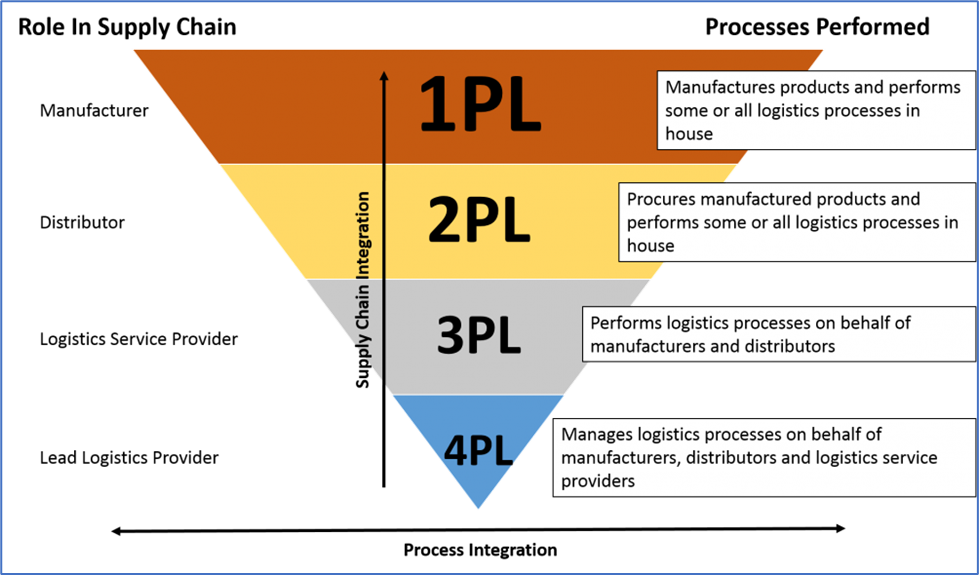 Source https://3plmanager.com Why use 3PLs? Everyone is looking for ways to trim and simplify operations, reduce overhead, and save on costs. For all these reasons 3PLs are on the rise. Typical reasons include:
Did you know 3PLs can be Accredited to the ASA-100? There’s a little-known nook in the ASA website which lists the current 3PLs which are accredited to the ASA-100. Here’s the link: https://aviationsuppliers.org/ASA100-List-3PL Some Accredited Distributors are already performing 3PL operations, but are not holding themselves out as such Are you Accredited but have empty warehouse space, and consider yourselves experienced with expertise for logistics and warehousing? Why not make that space more productive! Consider diversifying your services portfolio and holding yourself out as a 3PL. If you are already ASA-100 accredited and entering this growth area, consider asking the ASA to post your firm among the separate list of 3PLs. Operational, Quality, and Contractual considerations between the 3PL and inventory owners No two 3PL arrangements I’ve seen are exactly alike. There are peculiarities in every situation. The following should be considered for operational, quality, and inclusion in subsequent contracts or agreements between the parties:
Royboy’s tips:
Over ‘n out Roy ‘Royboy’ Resto NOTEWORTHY, Ed 1Posted By Jeanne Meade | April 01, 2022
Noteworthy is a compilation of interesting news items presented in summary form. In this issue:
Royboy’s comments are in italics. Airbus Targets Chinese Demand For Storage And Recycling‘To capture the emerging demand for aircraft storage, transition and dismantling in China, Airbus is joining forces with specialist Tarmac Aerosave and the city of Chengdu.” “Between leasing contracts, a commercial aircraft may have to be stored. It may also have to undergo maintenance and upgrade work in that transition phase, such as receiving a new cabin layout and livery. “Chinese lessors store two-thirds of their aircraft outside the country, whereas they tell us they are looking for a solution in China,” says Wolfgang Kortas, head of Airbus’ life-cycle solutions development.’ Aviation industry jobs have not only rebounded from the pandemic slump, but they have also soared 30 percent from pre-Covid levels‘Aviation industry jobs have not only rebounded from the pandemic slump, but they have also soared 30 percent from pre-Covid levels, according to employment service JSFirm. “Companies are scrambling and competing with each other to attract and retain qualified candidates,” said JSFirm’s executive director Abbey Hutter. “The current job market is candidate-driven and they have plenty of job opportunities in front of them.”’ ‘Pilots, airframe-and-powerplant mechanics, sheet metal technicians, avionics specialists, engineers, flight instructors, dispatchers, line service personnel, and sales managers are in high demand, according to JSFirm.com.’ On the other hand… Over 70% of workers regret quitting their jobs‘The majority of U.S. workers who changed jobs during the "Great Resignation" actually regret quitting and even feel a sense of buyer's remorse, according to a new survey. Seven out of ten workers — about 72% — admitted that they were surprised to learn that their new roles or companies were different from what they were led to believe during the interview process, according to the survey of more than 2,500 millennial and Gen Z job seekers by The Muse. The Muse CEO Kathryn Minshew described the trend as "shift shock." "They'll join a new company thinking it's their dream job and then there's a reality check," Minshew told FOX Business… As a result, Minshew said, more people are quitting rather than sticking it out. "It used to be that if you started a new job and didn't like it, you needed to stay for one or two years to avoid a black mark on your resume," she said. "But we've seen this really interesting shift in perceptions." About 80% of millennials and Generation Z workers say it's OK to leave a new job in six months if it's not as advertised, according to Minshew. Related, a high on highs… The number of working Americans testing positive in drug tests hit a two-decade high in 2021‘The number of working Americans testing positive in drug tests hit a two-decade high in 2021, according to The Wall Street Journal. Yet, as more states loosened their drug laws, fewer companies tested their employees for THC (one of the main ingredients in marijuana) and other substances. The shortage of workers looking for jobs in the last two years has also meant some companies relaxed their testing requirements. Despite this, the proportion of U.S. workers in 2021 who tested positive for the various drugs screened for rose to 4.6% — the highest level since 2001 — per drug-testing laboratory Quest Diagnostics. That percentage is over 31% higher than the low of 3.5% ten years ago, in the early days of a resurgent heroin epidemic in the U.S., said the Journal.’ Hybrid work isn't working for many‘Many businesses have pitched a hybrid work schedule as the “best of both worlds” for employees, with benefits that include escaping the commute on work-from-home days and enjoying in-person collaborations on office days. Yet, as Alison Green notes in Slate, many workers who return to the office for part of the week are finding that they are the only ones there, or that the colleagues who are present aren’t mingling, with most communication still happening over Zoom and Slack. This "worst of both worlds" scenario risks souring many on hybrid work. With WFH becoming a permanent feature of the economy, office vacancy rates in major cities keep climbing and signs of distress in commercial real estate loans are growing, per Axios.’ Business Aviation is red hot‘Business aviation is red hot, thanks to the COVID-19 crisis. U.S. business jet departures were up 51% year over year in November, led by fractionals and charter operators. Just 3.8% of the pre-owned business jet fleet is for sale, a historical low. Demand is so strong that NetJets, Executive Jet Management and Jets.com recently suspended jet card sales. While it is difficult to gauge accurately, business aviation captured tens of thousands of new customers since 2020, industry insiders estimate.’ Joby Aviation close to achieving Part 135 Air Carrier CertificationThis is fascinating given that certification issues regarding manufacturing and operations of eVTOL aircraft are just being established. Having a Part 135 for scheduled or on-demand eVTOL passenger flights seems to make sense. ‘A Part 135 Air Carrier Certificate is required for Joby to operate its revolutionary electric vertical take-off and landing (eVTOL) aircraft as an air taxi service in cities and communities around the United States. Alongside a Type Certificate and Production Certificate, this is one of three regulatory approvals critical to the planned launch of Joby’s all-electric aerial ridesharing service in 2024.’ EASA issues world’s first design specifications for vertiportsAs with the previous Joby article, this too is an example of emerging guidance to address the nascent eVTOL industry. ‘The European Union Aviation Safety Agency published the world’s first guidance for the design of vertiports, the ground infrastructure needed for the safe operation of Urban Air Mobility services such as air taxis in locations across Europe, including in urban areas. The Prototype Technical Design Specifications for Vertiports offers guidance to urban planners and local decision-makers as well as industry to enable the safe design of vertiports that will serve these new types of vertical take-off and landing (VTOL) aircraft, which are already at an advanced stage of development. “Urban air mobility is a completely new field of aviation and we therefore have a unique opportunity to develop a set of infrastructure requirements from scratch,” Patrick Ky, Executive Director of EASA said. “With the world’s first guidance for safe vertiport operations, EASA’s ambition is to provide our stakeholders with the ‘gold standard’ when it comes to safe vertiport design and operational frameworks. By harmonising design and operational standards for vertiports we will support European industry, who are already starting to embark on exciting projects in Europe and around the world to make new urban air mobility a reality.”’ What are the Global Top 10 International and Domestic Routes?This list, which was a snapshot of operations at the time, likely changes seasonably and is influenced by global events. Nonetheless these are likely to surprise you… 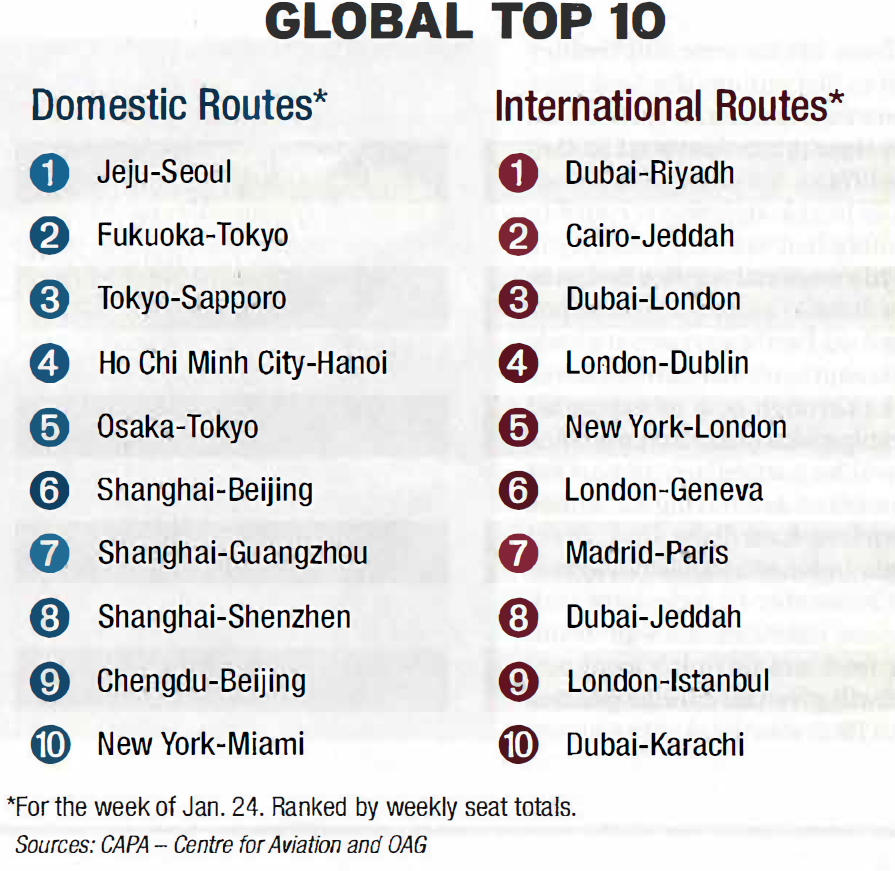 Over ‘n out WILL OEMs MAKE MANUALS AVAILABLE TO INDEPENDENT MROs? INDUSTRY COALITION ASKS FOR FAA INVOLVEMENTPosted By Roy Resto | January 31, 2022
There is no doubt that the movement of OEMs into the aftermarket in the last 15 years has caused tectonic change in the MRO (Maintenance, Repair, and Overhaul) and Distribution ecosystem. Such evolution is not uncommon, but unfortunately there appears to be ample evidence that more than a few of the OEMs are unfairly leveraging their monopolistic positions to withhold reasonable access to their repair/overhaul manuals (Instructions for Continued Airworthiness) from independent MROs. Independent Maintenance, Repair, and Overhaul (MROs) exhibit these characteristics:
If you’re such an independent MRO, you’re already painfully aware that many OEMs are making it unreasonably difficult, or impossible, to obtain their maintenance manuals; without these you can’t add new capabilities to your repair station/AMO (Approved Maintenance Organisation). The unavailability of these manuals clearly places an independent MRO at a competitive disadvantage, in fact it may be that this and other OEM behaviors are anti-competitive or monopolistic. 

“AIRLINE MAINTENANCE COSTS WILL GO UP” I’d like to conclude this article with an appeal to those OEMs exhibiting these behaviors. All these people know who you are, and your names are mentioned in terms which if quantified and made known, would puncture your ESG score (Environmental, Social, and Governance). Is it really worth a blemished reputation to continue these behaviors? 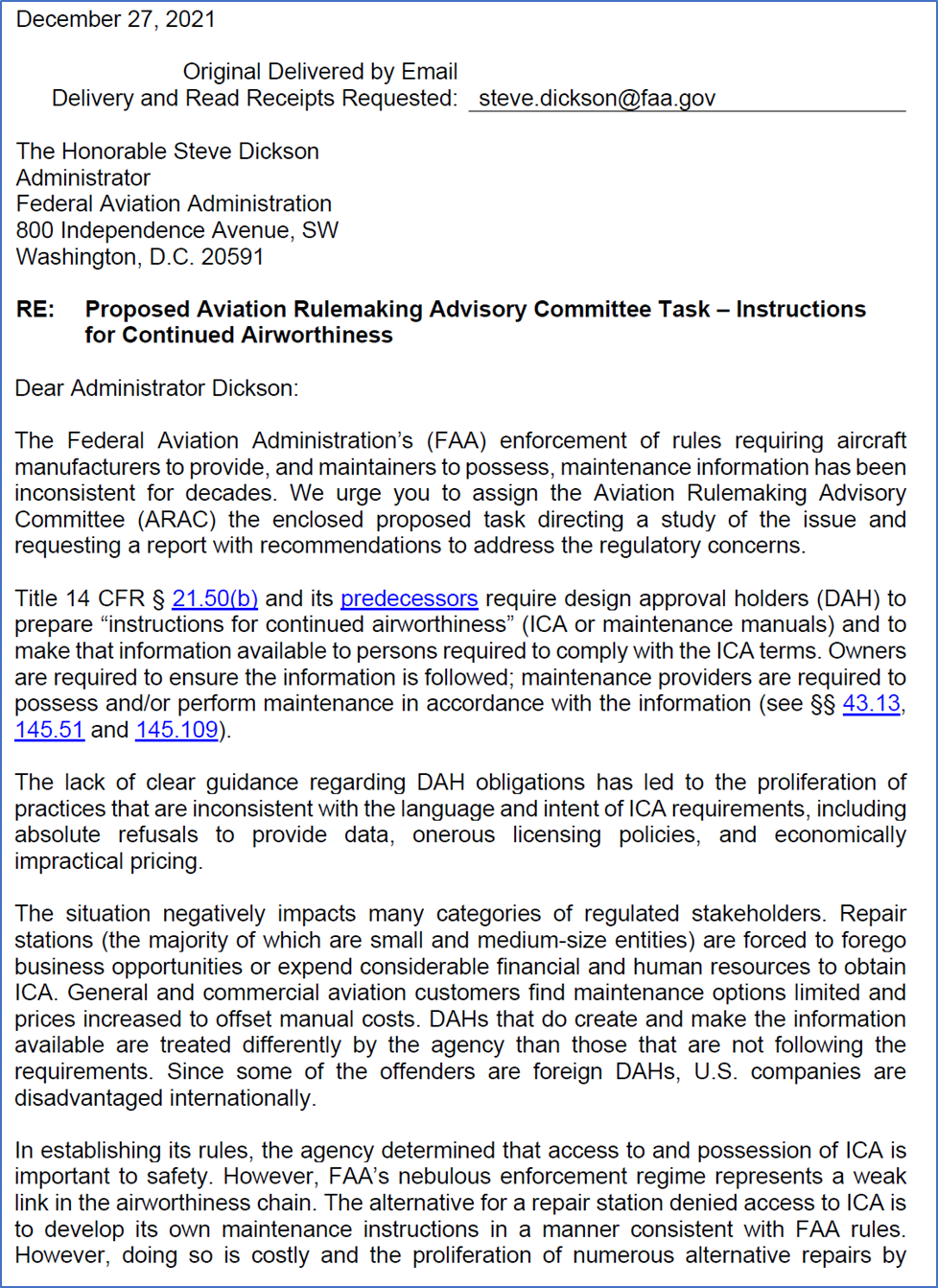 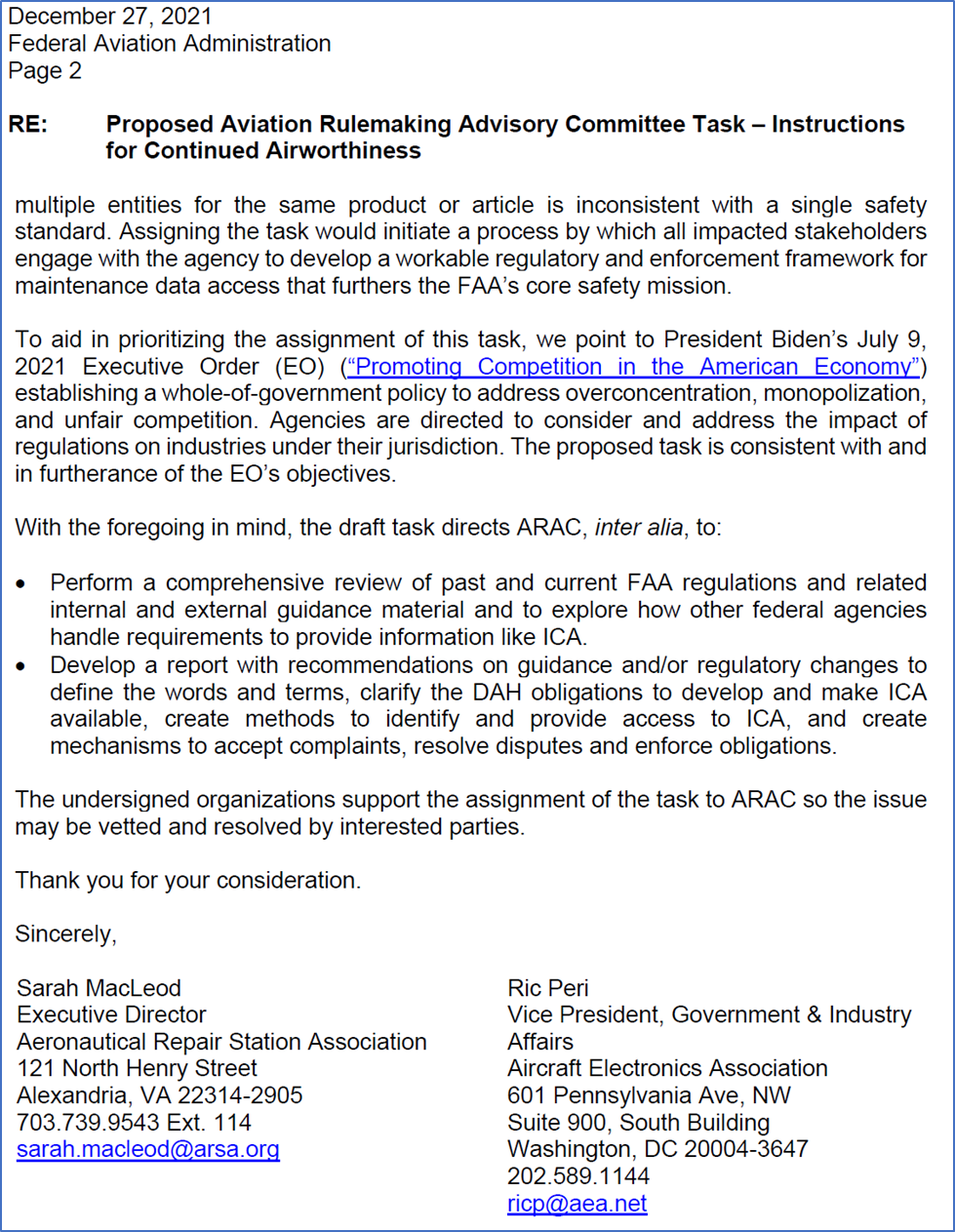   Over ‘n out Roy “Royboy” Resto TWENTY-FIVE YEARS OF FAA AC 00-56Posted By Roy Resto | December 02, 2021
A banal cliché overheard during political campaigns is ‘working together’. I figuratively roll my eyes at the lack of creativity in that diluted, overused utterance. Fortunately, despite cynics, there really are examples in governance where that term bore fruit. Every government organization has its head; the Administrator, or Director for example. An oft heard refrain among those leaders is that the goals of the organization can’t be met without the active participation of industry; in other words, working together (there’s that term) to achieve mutual goals. So…are there any examples of such collaboration? Without question, a paragon model has been the FAA’s Advisory Circular 00-56. Later in this article are some interesting statistics and facts, but let’s not get ahead of the story. To understand the profound impact the AC had on the industry, it’s important to understand the environment that existed at the time of its creation. Bogus Parts: those were the trigger words on everyone’s lips in the early 90’s. News programs and articles were saturating the marketplace warning of the perils of bogus parts. In fact there was such a tumult that Politicians held public hearing on the issues, and many independent ‘experts’, airline representatives, trade Associations, and FAA employees, among others gave testimony which at times painted a dire picture, and in some instances a somewhat sensationalistic, scary portrayal of the issues. At the conclusion of the hearings the Senate gave the FAA a list of problems that had to be fixed. In response the FAA established a special office whose charter was to fix the problems contributing to Unapproved Parts (or now commonly called SUPs – Suspected Unapproved Parts). Most of you recall Ken Reilly who headed that office for a long time and who, for his efforts was a recipient of the prestigious ASA “Eddy” award. But, back to the AC… One of the problems cited by the Senate for the FAA to fix regarded the state of distributors. Unlike manufacturers, operators, and repair stations, distributors were not regulated, had no oversight, and were not required to implement and follow aviation style quality systems. It was felt that if bogus parts were to find their way into the industry, the weak link would be the distributors who supplied parts to both manufacturers and operators. There were some in the industry (and at first I counted myself among them) which took the position that distributors should be regulated and certificated by the FAA. At the time I recall a number being bandied-about was 2000 regarding the estimate of the number of distributors (including stockists and brokers) globally. Certificate that! As you can imagine, the FAA was not going to be funded to regulate even a fraction of that number. So, the standoff stood; what to do about the wild-west among distributors? Enter the draft of the AC 00-56, ‘Voluntary Distributor Accreditation Program.’ To be sure, there was government-industry collaboration in writing, editing, and fielding it. A few names that come to mind in that campaign are Dennis Piotrowski, Ed Glueckler, and Al Michaels (also an “Eddy” recipient) among others. Out came the initial FAA AC. The Air Transport Association (now Airlines for America, A4A) distributed it to their constituent airline members, and here was my first exposure to it. I was working for a major airline and was handed the job of determining what the airline’s position was going to be regarding its substance. In a rather large meeting held with the heads of Purchasing, Material Control, and QA, I introduced the AC and solicited feedback. There were, and still are two lines in the AC that stood out to this management group: “We (the FAA) consider obtaining parts through accredited distributors is a sound safety practice.” And “If a certificated customer uses an accredited distributor, and voluntarily reports any known potential violations of 14 CFR rules, we would recognize the fact that the certificate holder obtained the part from an accredited distributor as a mitigating circumstance in any subsequent administrative or enforcement action.” The terms, “…sound safety practice”, and “…mitigating circumstance…” rang pretty well for this safety conscience airline. It took about 15 minutes of discussion and a senior Director gave the order to send out a letter to all its after-market distributors which stated they had a year to become accredited or risk being dropped from the airline’s approved supplier list, and oh yes, I was to administer this, and out went the famous letter to its suppliers. So-much for being a ‘voluntary’ program. Other airlines and manufacturers saw the benefits of the program and similarly used the program as a basis to approve their distributors. Thus steadily, the AC became a success and gained global acceptance. Interesting: When the AC was being drafted there was the thorny issue of who would administer the listing of firms meeting the requirements of accreditation; the “Database Listing”. This is not just a simple matter of posting a listing on a web site. There are administrative procedures that must be followed, records kept, follow-ups, and yes the web site upkeep. Read paragraph 10 of the AC and you’ll get the picture. At first it was thought that the FAA would perform this task, but alas, this too was not likely to get funded. The ASA volunteered. In the AC, the FAA delegates the keeping of the Database to the ASA. It’s an unheralded fact that the ASA has been flawlessly performing this mission pro bono since the AC’s inception; bravo ASA! The FAA has twice updated the AC and participated in ride-along audits. The AC and the accreditation program is a living document. Every day there’s countless activity in many parts of the world triggered by the AC; Manuals being updated, external and internal audits being performed, training imparted, records updated, findings and non-conformities being addressed, Approved Suppliers Lists being updated, documents generated, orderly scrapping of parts, inspections performed, and rosters updated, just to name a few, and all in conformity with… AC 00-56. 25 years of a very effective cooperative effort between government and industry. Some interesting Stats:
Over ‘n out Roy ‘Royboy’ Resto www.AimSolutionsConsulting.com
|