CAVU Café: Royboy’s Prose & Cons, Page 2 of 17

The views expressed in CAVU Café: Royboy’s Prose & Cons blog are those solely of the writer and are not necessarily shared by the Aviation Suppliers Association or the Association’s staff, members, or Board of Directors. About Roy Resto

TERMS & CONDITIONS BEING IGNORED

Posted By Roy Resto | October 01, 2025

Scenario 1:

A company reached out to me with a question. I thought it was an odd question coming from them. Did the parts they receive require an 8130-3? This was for some hardware, and we first established that the part numbers did not fit the definition of Standard Parts. So, under the circumstances presented and the requirements in their own manual the answer was yes. They then showed me the documentation received with the parts which they had already received and placed into working shop stock. There was no 8130-3 and just a typical C of C which did not mention a TSO or PMA statement, and the parts were not received from a TC/PC (Type Certificate/Production Certificate) holder. Based on this, I also informed them that under these circumstances I could not issue a DAR 8130-3 either, if requested. So, what caused this?

I asked to see their Purchase Order (PO) which at first, they thought irrelevant, but after asking again they provided it. Clearly on their PO standard Terms & Conditions it stated that unless the parts were standard parts, that for New parts trace to the OEM with an 8130-3 or EASA Form 1 is required. The initial root cause:

  • The supplier did not fulfill the PO Terms & Conditions.
  • This company’s receiving inspectors did not flag the parts for not having met their own requirements as expressed in their Terms & Conditions.

Why?

What prompted me to write this article is that this is not an isolated case.

I like to ask this question in a lot of my classes: Is a Purchase Order (PO) a contract? Yes, it is (business law 101). Are any Terms & Conditions (T&C) in a PO a part of that contract? Yes, they are.

Investigating for the root cause a little deeper, it seems both parties agreed to the transaction and available documentation (which was subsequently shown to be inadequate) during the quoting process. The actual PO was then subsequently issued by the company to the supplier whose T&Cs were not heeded by either party.

We need to talk.

Here are some quick, honest assessments of things occurring in our marketplace regarding this type of occurrence:

  • When the supplier is confronted about not meeting the subsequent T&Cs in the PO, the supplier forwards all the emails exchanged whereby during the quoting process the company was shown the available pictures and documentation, and the company inferred their acceptance (by any number of means), so why reject it now?
  • The purchasing employee of the company is primarily driven by the availability of the Part Number, price, and condition, and meeting their quotas for work output. Satisfied with this, the purchaser paid scant attention to the documentation provided and trace, and truth be known the purchaser is not after all, a documentation forensics expert. If it gets through their receiving inspectors, it must be good, right? Not to mention the supplier is on their Approved Suppliers List, so they must be good, right? There, I said it, and I meant it.
  • The supplier, satisfied with the results of the quoting process, did not read the T&Cs issued in the subsequent PO.
  • The company’s receiving inspector stated that those T&Cs are boiler plate, standard text on every PO, and that if there were any real special requirements it would be added as free text just below the PN field for the inspector to look for. Really?

And there you have it.

Scenario 2:

Here’s another example I encountered during an audit. I was reviewing the records associated with an order that had just shipped. The records reviewed included the customer’s PO and all documents sent with the order. From the review it became obvious that a requirement stated in the customer’s PO had not been complied with, resulting in an NCR (Non-Conforming Report). The Corrective Action included remedial training for all their sales employees. The focus of the training was that regardless of the outcome of the quoting process, the subsequently issued PO from the customer has to be carefully reviewed to assure all its requirements are being met.

Scenario 3:

Here's another pesky scenario which contributes to non-compliance with T&Cs. For Scenario 2 a good question to ask is, didn’t the supplier’s Shipping Inspector read the customer’s PO for any special requirements? Some of you do and some of you don’t. I encounter this during my observations of shipping inspections during audits. For those of you that don’t, the answer is always that if there had been any special requirements T&Cs, their ERP system would have it noted for the inspector to check during the shipping process, so the actual customer PO would not have to be reviewed. For many such arrangements those special requirements would be reflected in the Pick Ticket. That’s acceptable of course…but here’s the problem. Someone has to carefully review all T&Cs on the customer PO and manually enter that in the system. This requires discipline which is not consistently evident.

During audits when I’m told that any customer special requirement T&Cs will be noted on the Pick Ticket, I’ll ask to see the customer’s PO anyway, and guess what? Occasionally something was missed, a failure in the process.

Scenario 4:

An unfortunate but common practice which leads to missed T&Cs is that they are not easily accessible. The two common examples:

  • The T&Cs are stated to be at their website. You’ll be surprised at how often the link does not work. Also, if the PO with the link actually works, when the PO is copied or printed, the hyperlink feature won’t work and the web address has to be manually entered, a long process. Such posted T&Cs may be technically acceptable, but if we’re honest they seldom get read.
  • The customer makes the supplier sign or acknowledge the customer’s standard T&Cs. In some cases, it may be a part of an agreement or contract. Regardless, how do you flow this down into your system?

I know many of you have best practices regarding these scenarios. If you don’t mind sharing those, put them in the comments.

Over ‘n out

Roy ‘Royboy’ Resto

www.Linkedin.com/in/royresto

www.AimSolutionsConsulting.com

Written without the aid of AI content.

Continue reading

TRAINING VS COMPETENCY

Posted By Roy Resto | August 01, 2025

A noticeable trend which should give all of us pause for circumspection is that of training vs competency. The noticeable trend is that on paper, employees have the documented training, but in practice the corresponding skills are noticeably lacking. Overall, the issue of training in our challenged and evolving environment is well known. For background on this, read this prior article titled “Critical Need for Training Including Executives”:

https://www.aviationsuppliers.org/critical-need-for-training-including-executives

In this article, however, I want to focus on the topic of competency… to be competent. A simple definition: Competence is the proven ability to apply knowledge and skills to achieve desired results consistently.1

For those of you who may be IAS/ISO/EN/AS accredited by, for example 9001, 9110, 9100, or 9120, these contain a section 7.2 titled Competence. Minimally it contains this:

7.2 Competence

The organization shall:
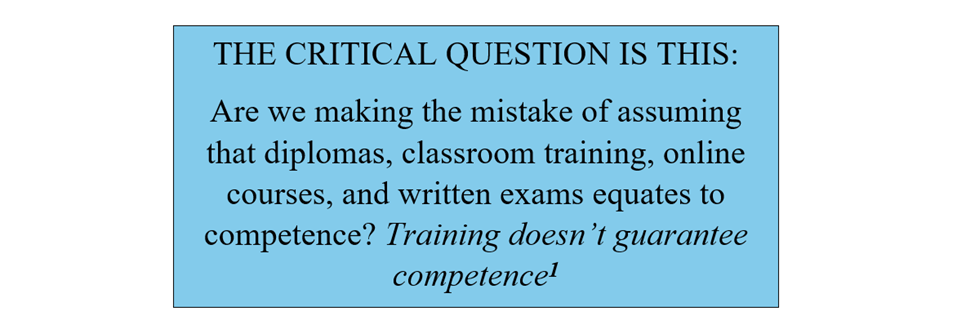
  1. determine the necessary competence of person(s) doing work under its control that affects the performance and effectiveness of the quality management system;
  2. ensure that these persons are competent on the basis of appropriate education, training, or experience;
  3. where applicable, take actions to acquire the necessary competence, and evaluate the effectiveness of the actions taken;
  4. retain appropriate documented information as evidence of competence;

Two tales from personal experience:

  • One of the hardest exams I have ever taken was for the FCC General Radiotelephone Operators License with a Radar Endorsement. Formally this was called the FCC 1st Class. You had to have detailed knowledge of electronic theory and regulations, and you had to have the electronic formulas memorized and be able to apply them. To this day many avionics MROs accept this as proof that you know electronics. The problem was that I had the head knowledge of electronics but had to go on to OJT to learn how to troubleshoot and do basic testing using the many forms of equipment; initially I had the training but not the competency on the topic. The FCC exam, although tough, did not test for this.
  • On the other hand, as a certificated pilot and mechanic, the tests for these consist of 3 parts, the written, the oral, and the practical. The oral and practical portions of the exam are designed to exhibit a minimum level of competency to the satisfaction of the Examiner.

How to Assess Competence1

The following is a good listing:

- Observation and supervision

- Performance metrics

- Simulation or scenario-based testing

- Peer or manager reviews

- Certification or licensing

Becoming and/or demonstrating competence

  • Observation and Supervision – Example: Supervised OJT: If there is an area of weakness with ASA-100 accredited firms it is that OJT is rarely performed and documented despite the standard stating in 4.C:
    • All training, both formal (classroom) and on-the-job training (OJT), shall be documented and the records shall be maintained for all employees who underwent training.

Classic OJT involves a trainer sitting side by side with the trainee. The best OJT models include a checklist of the tasks the employee is to be trained in, and to demonstrate competence in its performance to the satisfaction of the instructor.

  • Performance Metrics: Competence is verified through performance, and requires feedback, practice, and evaluation. Performance Metrics is a broad topic and can be applied corporately as in this article titled “23 Employee Performance Metrics to Track”2 or tracked to individual performance. Consider productivity and quality of the performed tasks. Also consider data which may reside in your system and through root cause analysis be found to be tied to employee performance, for example:
    • RMAs issued to customers to return products and are connected to employee errors
    • Customer Complaints
    • Results of surveys
  • Simulation or scenario-based testing: I like using this. For example, I have a test I use in my consulting business which is designed to check for competence in detecting errors in part’s trace, condition, and documentation. It has pictures, and many samples of typical documents. The test consists of writing any detected issues on a Receiving Discrepancy Log. This is not a knowledge test, it’s a test of the application of previously acquired knowledge.

I remember an interesting test from a customer when I worked at an MRO. The customer utilized us as a subcontractor to perform Non-Destructive Testing (NDT) on their parts using specialized equipment operated by highly trained inspectors to find any cracks in the metal products sent for testing. Every 3 years when it came time for us to be reevaluated as a supplier/subcontractor, the customer would send us a part with a known crack which could not be detected visually; it could only be detected by a skilled inspector using specialized NDT equipment. I know because the inspector brought to my attention that he had rejected the part on a red tag returned to the customer with a scrap recommendation and here it was back again 3 years later. The customer admitted to this tactic, and we remained on their Approved Supplier List.

  • Certification or Licensing. There are already a number of certifications or licenses which incorporate various methods to assess competence in our arena, for example:
    • IAS/AS/EN/ISO/IOSA/CASE Auditing
    • 6 Sigma Belts
    • Hazmat/DG
    • Maintenance Technicians
    • Pilots
    • Forklift and other heavy machinery operations
    • NDT/NDI Inspectors
    • Dispatchers

Over ‘n out

Roy ‘Royboy’ Resto
AimSolutionsConsulting.com

Written without the aid of AI generated content

1 – Information from Sam O’Connor’s PowerPoint titled “Training Vs. Competence”

2 - https://www.aihr.com/blog/employee-performance-metrics/


Continue reading

Where Does Your Quality System Stand on the Matrix?

Posted By Roy Resto | June 01, 2025

As an auditor of Quality Systems and a consultant, I find myself in a unique position to observe the evolving conditions of many companies both domestically and globally. A conspicuous phenomenon is that the status quo or stability in Quality Systems which existed before the covid period have been profoundly upset in the post covid era. Generally, factors which have influenced instability in Quality Systems during and since covid include:

  • Many companies had to go into survival mode to stay in business, including:
    • Downsizing staff.
    • Rethinking their core business models; engaging in new operations and shelving legacy methods of generating revenue.
    • Existing staff being cross utilized into new responsibilities and roles they have to learn from scratch.
    • People performing quality functions who are noticeably inexperienced and not necessarily pleased to have found themselves in these roles all due to the aforementioned reasons. Yep, quite true.

    Quality and safety are complementary terms; you can’t have one without the other, and understandably the flying public and regulators place great emphasis and expectation on aviation firms exhibiting both characteristics. Company websites and CEOs/Presidents are thus fond of stating their unequivocal devotion to quality and safety. The question arises, that in the current environment previously described, what is a no-nonsense, honest assessment of your Quality System?

    In their article “How to Incorporate AI Tools Into Your Quality Management System”1, simpleQuE presents a matrix called the 5 Maturity Levels of a QMS (Quality Management System).
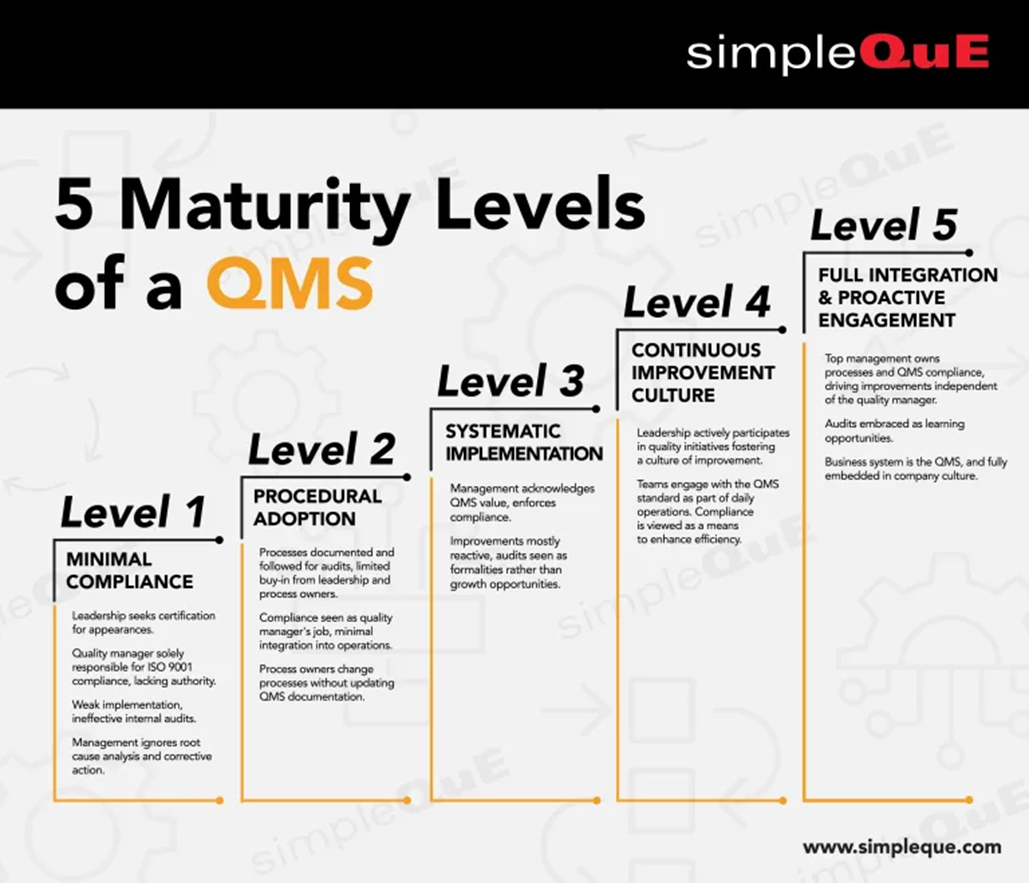
    In case the font on the chart is too small, here are the same descriptions:

    1. Minimal Compliance (Lowest Maturity) – In this level, leadership seeks certification only for appearances. The quality manager is solely responsible for compliance but lacks authority, leading to weak implementation across the company. Internal audits do not provide value. Management doesn’t understand the importance of root cause analysis and corrective actions, so the quality manager ends up trying to address someone else’s problems that they don’t have responsibility for.
    2. Procedural Adoption – Processes are documented and followed to pass audits, but buy-in from leadership and process owners is limited. Compliance is seen as the quality manager’s job, with minimal integration into daily operations. Processes get changed by the process owners without updating QMS documentation.
    3. Systematic Implementation – Management acknowledges the value of a QMS and enforces compliance within their teams. However, improvements are mostly reactive, and audits are seen as necessary formalities rather than opportunities for growth.
    4. Continuous Improvement Culture – Leadership actively participates in quality initiatives, fostering a culture of improvement. Teams engage with the QMS standard as part of daily operations, and compliance is viewed as a means to enhance efficiency.
    5. Full Integration & Proactive Engagement (Highest Maturity) – Top management owns their processes and QMS compliance, driving improvements independently of the quality manager. Audits are embraced as opportunities for learning, with leadership developing and challenging auditors to uncover weaknesses for continuous enhancement. Fear of reprisal is absent, and the business system is the QMS, fully embedded in the company’s culture.

    Currently, external quality system auditors are not required to rate your system according to this matrix. Its value lays in its use as a self-assessment tool.

    A consistent principle in quality system standards is that of Continuous Improvement. Are you moving up, down, or are you stagnant on the scale? The suggestion here is that you consider using the matrix to analyze the state of your Continuous Improvement efforts. For example, integrate it into your internal/self-audit process. Create action plans to move to progressively higher levels.
    For those you with ISO/EN/AS/IAS quality systems, consider making it an integral part of your Management Review process.

    Make it happen.

    Over ‘n out

    Roy ‘Royboy’ Resto

    www.AimSolutionsConsulting.com

    Continue reading

    AI In Our Market Segment

    Posted By Roy Resto | March 30, 2025

    POV: Forever that acronym will be etched in my memory as Privately Owned Vehicle of government expense report fame, but today it has gained social media popularity as Point of View. Today I’ll stick to the latter.

    Depending on your POV, Artificial Intelligence, herein AI, is either a panacea fueling aerospace growth, or is a harbinger of the apocalypse. I’ll stick to the former.

    As many of you know if you have been following my posts for any length of time, I fancy myself an unofficial historian for all things of significance contributing to aerospace and its aftermarket, and as it is, AI is shaping up to be worthy of such recognition.

    In this article we’ll review the following:

    • WHAT IS AI?
    • AI CONCEPTS DU JOUR
    • AI APPLICATIONS IN THE SUPPLY CHAIN AFTERMARKET
    • CURRENT USE BY AIRLINES
    • WHAT TO LOOK FOR IN THE NEAR FUTURE

    WHAT IS AI:

    There is a myriad of definitions for AI, but I found a simple basis from an aerospace source, NASA1.

    Artificial intelligence refers to computer systems that can perform complex tasks normally done by human-reasoning, decision making, creating, etc.

    • Any artificial system that performs tasks under varying and unpredictable circumstances without significant human oversight, or that can learn from experience and improve performance when exposed to data sets.
    • An artificial system developed in computer software, physical hardware, or other context that solves tasks requiring human-like perception, cognition, planning, learning, communication, or physical action.
    • An artificial system designed to think or act like a human, including cognitive architectures and neural networks.
    • A set of techniques, including machine learning that is designed to approximate a cognitive task.
    • An artificial system designed to act rationally, including an intelligent software agent or embodied robot that achieves goals using perception, planning, reasoning, learning, communicating, decision-making, and acting.

    AI CONCEPTS DU JOUR

    • Machine Learning: A basic building block of most other forms of AI, these systems learn and improve from experience without being explicitly programmed by a human. The software is enabled by algorithms that identify patterns, make decisions or predict outcomes based on the data input2.
    • Generative AI or GenAI: Generative AI can be thought of as a machine-learning model that is trained to create new data, rather than making a prediction about a specific dataset. A generative AI system is one that learns to generate more objects that look like the data it was trained on5.

    AI APPLICATIONS IN THE SUPPLY CHAIN AFTERMARKET:

    • Incorporate AI Tools Into Your Quality Management System. According to simpleQuE, “AI tools can significantly enhance implementation and compliance by improving documentation management, performance analysis, internal audits, and corrective action tracking.”6. For devotees of Quality, if there is one article in the many links referenced herein, this is must-read. Author Jim Lee gives simple and practical advice on how to integrate AI into your Quality Management System based on the firm’s Maturity Level.
    • Inventory Control: The issue of how many spare parts to have in inventory is a subject that generates considerable heated debate among operators and their suppliers. Add variables such as pooling, exchanges, aging or changing fleet sizes, obsolescence, ADs/SBs, and finance pressures, and the topic gets mired, quickly. These all equate to thousands upon thousands of data points screaming for AI analysis and intervention. Legacy EOQ (Economic Order Quantity) and IP (Initial Provisioning) models simple don’t work neatly in this dynamic operations world. There’s a plethora of AI based programs available on the market, but before you engage any one of these, make sure they have AI capability for:
      •  Demand Forecasting
      • Inventory Optimization
      • Real-time Data Analysis
      • Automated Replenishment
      • Supplier Management
      • Predictive Analytics
    • Safeguarding parts against fake or improper paperwork: A company called Alitheon is using an AI based program called FeaturePrint which applies optical AI to create unique digital fingerprints using standard industrial cameras or mobile phones. This will augment elements such as removal tags, QR Codes, and paperwork to trace part history and authenticity. GA Telesis plans to integrate FeaturePrint into its Wilbur parts provenance and records platform4.
    • MRO: A GenAI tool, Charlie, aims to improve processes by quickly finding part numbers within reams of documentation and thereby speeding up the replacement process – good for the airline’s punctuality stats (read that delays and cancellations)3.
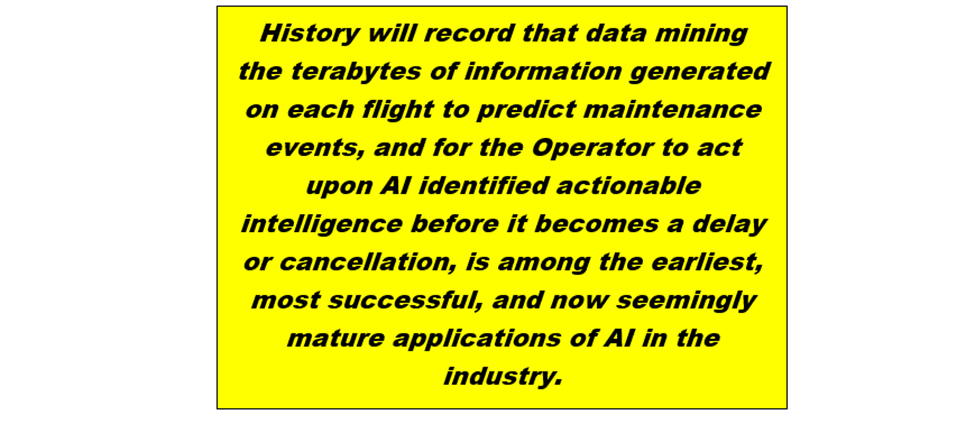
    • Predictive Maintenance. A very good primer on this esoteric topic can be found in an earlier article titled “AIRCRAFT BIG DATA, ANALYTICS, AND THE AFTERMARKET.” Here’s the link:

    https://www.aviationsuppliers.org/AIRCRAFT-BIG-DATA-ANALYTICS-AND-THE-AFTERMARKET

    CURRENT AI USES BY AIRLINES:

    In addition to Predictive Maintenance, the airlines also are implementing these programs.

    • Pricing: If there is any aspect of running an airline that commands continuous attention and refinement it is that of pricing. For every flight and every seat, the price is being adjusted in real time based on classic supply and demand models and there are endless variations. This would seem like a good fit for AI and GenAI in particular. Currently there are eight airlines experimenting with GenAI with a program fielded by a company called Fetcherr. Their first US customer is Delta Airlines who said, ‘The initial results show amazingly favorable unit revenues versus the beta…We’re all in on this.3.
    • Operations: During my airline experience my world was effected by the continuous decisions being made in the Airline Operations Center (AOC) and the Maintenance Operations Center). The AOC in particular sees minute by minute challenges 24/7 in running operations. For example, consider a major airline with over 2000 flights a day being affected by weather, aircraft problems, delays and cancellations, crew positioning, equipment and system outages, and Air Traffic Control issues among many others. The AOC must address all these, continuously, and so appears to be a good candidate for GenAI. Fetcherr’s Jetstream uses GenAI in its product being implemented by EasyJet in its AOC called the Integrated Control Center which commands over 2000 daily flights and is staffed by 250 specialists 24/7. According to EasyJet the GenAI tool gives their team ‘instant access to policies, procedures, and information which will enable them to solve operational issues as they occur.’3.
    • Maximize Ancillary Revenue: Ancillary Revenue are those pesky charges we’re made to pay as passengers in addition to the basic seat price, which includes luggage, food, beverages, airline credit cards, inflight Wi-Fi, catalog product purchases, and the like. AI is being used in the marketing and price optimization effort.
    • Cyber Security: Cyber-attacks on airline networks is a constant worry, and airlines are using AI to safeguard their operations. For example, AirBaltic says it deploys multiple integrated AI tools to continuously monitor its network allowing it to identify and respond to potential threats in real time.3.

    WHAT TO LOOK FOR IN THE NEAR FUTURE:

    • Applications in Autonomy:
      • It should come as no surprise that much of AI in civilian use found its genesis in the Research and Development labs of DoD entities. If you read any trade journals such as Aviation Week & Space Technology, or any of the aviation news outlets, keep abreast of what the military is doing for its collateral, trickle-down effect on the civilian side. The topic of ‘autonomy’ is of particular interest to me… autonomy being loosely defined as an application to a system such that it can perform its task without active continuous human intervention. Why should this be interesting?
      • o Today we’re on the cusp of launching eVTOL operations. It’s my opinion that eVTOL for the use of ferrying passengers will not be as profitable as hoped for since most emerging models are piloted. On the other hand, if those same flights from point A to point B were autonomous, un-piloted, the business model profitability equation changes significantly. It wasn’t too long ago that all elevators and trains were operated by humans, but today we take the automation for granted. Why not eVTOL flights? Royboy: It will happen here first. The military has been conducting safe and autonomous flights for years, albeit with no passengers, but the technology exists and is evolving. The poster child for this is the RQ-4 Global Hawk and its offshoot the MQ-4C Triton.
      • Look for autonomy to be fielded for cargo operations. If it works successfully in cargo operations, look for the technology to be applied to commercial cockpits.
    • Commercial Cockpits and Air Traffic Control:
      • In the Business Jet world, jet aircraft have already been certificated for single pilot operations, and single pilot cargo operations, for example using Textron Caravans, have been routine for years. But what about commercial size aircraft? This implies airline operations. For Part 135 sized operations, single pilot operations carrying passengers have also been routine for years. Manufacturers have been quietly urged by their airline customers to look at single pilot operations in their new designs. Why quietly? Because if known, their pilot unions will predictively resort to sanctimonious platitudes of ‘safety’ in an effort to protect their dues base of income. Nonetheless, it is Royboy’s opinion that single pilot operation will first occur for cargo flights for transport category aircraft, then onto passenger flights. Also, this will lead to autonomous passenger flights in this millennium for transport category aircraft.
      • After the recent DCA accident of the Army Helicopter and Airliner midair collision, many asked, “how could this happen? In ATC recordings for the controller, the automated warning of the pending collision could be heard. How old is that technology? There is already talk about the need to update ATC systems and AI will play a critical role in adding another layer of safety and automated intervention.
    • Quantum computing affecting AI:

    It’s no secret that AI has some teething pains in the way of limitations. According to Ahmet Erdemir, “AI methods are currently limited by the ability of classical computers to process complex data. Quantum computing can potentially enhance AI’s capabilities by removing the limitations of data size, complexity, and speed of problem solving.”7. This will supercharge AI.

    Dilbert:
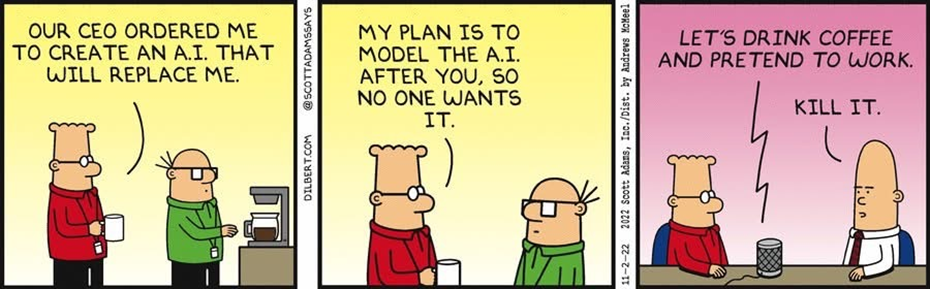
    Dare I say it? This article was written without the use of AI generated content.

    Over ‘n out

    Roy ‘Royboy’ Resto

    www.AimSolutionsConsulting.com

    https://www.linkedin.com/in/royresto/

    1 https://www.nasa.gov/what-is-artificial-intelligence/

    2 The State of AI; Aviation Week & Space Technology; January 13-26, 2025; Page 40.

    3 Generative AI ‘Super Analyst’ May Change How Airlines Set Prices; Aviation Week & Space Technology; January 13-26, 2025; Page 46.

    4 MRO Industry Expands Potential AI Use Cases; Aviation Week & Space Technology; January 13-26, 2025; Page 51.

    5 https://news.mit.edu/2023/explained-generative-ai-1109

    6 https://www.simpleque.com/how-to-incorporate-ai-tools-into-your-quality-management-system/

    7 https://www.lerner.ccf.org/news/article/?title=+How+quantum+computing+will+affect+artificial+intelligence+applications+in+healthcare+&id=79c89a1fcb93c39e8321c3313ded4b84005e9d44

    Continue reading

    THE UNIQUE WORLD OF AERIAL FIREFIGHTING

    Posted By Roy Resto | February 02, 2025

    INTRODUCTION:

    As I was researching and writing this article the morning headlines read “Thousands Flee as Wildfires Burn Out of Control Around Los Angeles.” Honestly, I was in wonder at this coincidence, but here we go.

    I had the pleasure of being engaged in working on a project to certify aircraft on behalf of a US State who contracts with Aerial Firefighting companies. In the process I learned a lot about the distinctive aspects of these aviation operations, and since I know a few of ASA’s constituents support such companies, I thought you’d find this interesting.

    For an aircraft to be considered eligible to be contracted to engage in fighting fires, the aircraft must go through a procedure which ensures it is properly equipped and airworthy to perform in this role. This process is informally called ‘carding’ because upon a successful inspection the aircraft is issued a Certificate which is printed on card stock and must be carried onboard the aircraft, typically in the logbook, while performing firefighting duties. This was the process I was engaged to perform which will be detailed later.

    Not surprisingly, pilots must also be carded since flying skills involved in firefighting transcend those of just having professional licenses; Commercial, ATP, etc. They must have documented training and demonstrated skills on both the operational protocols and unique maneuvers of aerial firefighting.

    OPERATIONS:

    First, to understand the unique operational environment of aerial firefighting, you have to become familiar with certain definitions1:

    • Air Attack: The Supervisor in the air – typically in a fixed wing aircraft – who oversees the process of attacking wildfires and directs all air traffic within the fire zone. It can also refer to the aircraft in which the Supervisor travels, and that is piloted by someone other than the Supervisor.
    • Air Tactical Group Supervisor (ATGS): Senior official who coordinates the incident airspace and manages air traffic within the fire zone. Sometimes used interchangeably with ‘air attack’.
    • Wildland Fire: Any fire, other than a prescribed burn, that occurs in a natural setting. Distinct from structural fires, wildland fires can also spread and affect structures.
    • Wildland-Urban Interface (WUI) Refers to the growing phenomenon of civilization encroaching on areas previously deemed to be wild, creating zones in which wildfires can quickly spread to structures and communities with significant human populations. One of the biggest problems in modern wildland firefighting.

    No two wildfires are the same. The question of who has absolute on-scene leadership of the event is bewildering and is affected by:

    • Is the fire on US National Forest Property?
    • Is it on state property?
    • Is the fire in remote and isolated areas or in WUIs?
    • What is the size of the fire?

    Typically, as soon as leadership for the event is established and the decision is made to use aerial firefighting resources, a TFR, Temporary Flight Restriction is issued by the FAA to keep out non-firefighting aircraft and privately owned drones from the area. The Air Attack or ATGS directs all authorized aircraft and authorized drones in the area and acts as an on-scene air traffic controller. There are air-to-air and air-to-ground communications on dedicated frequencies. These air assets, including drones with infrared capability, create real-time maps of the moving fires. These maps are used to coordinate the efforts of ground-based firefighters and aircraft.

    In the US, there are 674 Million Acres of federally owned lands2. In response to wildfires on these lands the National Interagency Fire Center (NIFC), based in Boise, Idaho, leads the air and ground response. Their coordinating efforts may involve five agencies, the military, and state forestry services.

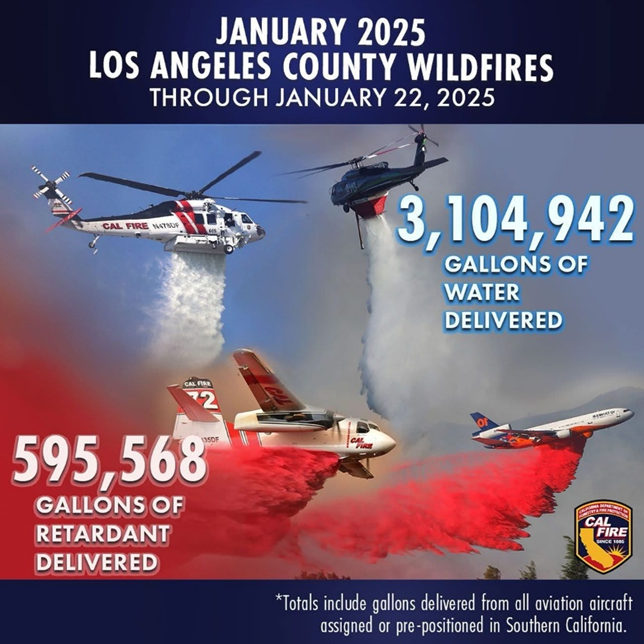
    Consider the huge aerial effort for the LA Fires6:
    AIRCRAFT STATISTICS:

    Interestingly, globally, ownership and operations of firefighting aircraft falls generally into these categories:

    • Nation/State Governments including civilian and military.
    • Privately owned; company owned.
    • Government aircraft operated by private contractors3.

    Although the numbers vary from year to year, in the US the fleet available for aerial firefighting consists of 340 aircraft composed of 29 large air tankers, 35 smaller tankers, 10 single and multiengine water scoopers, 161 helicopters, 97 fixed wing support aircraft, and 8 specially equipped C-130s that can be activated by the military as needed2.

    Globally, Wikipedia’s article “Aerial Firefighting”, lists 21 active, different fixed wing models, and 8 helicopter models.

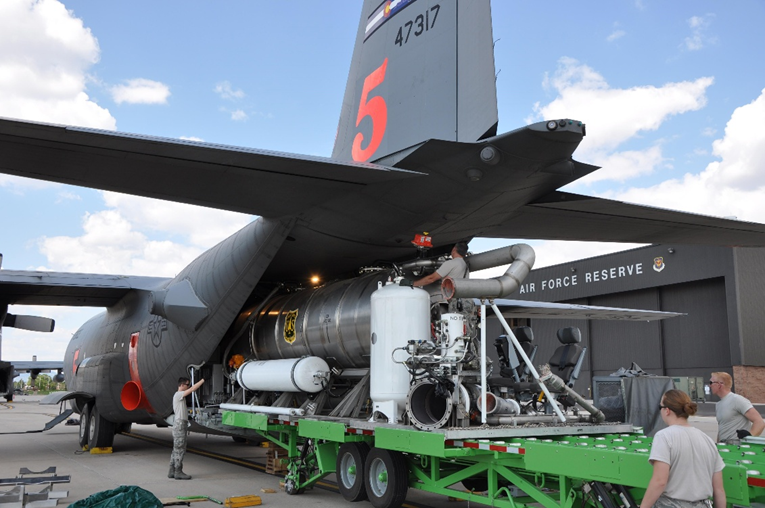
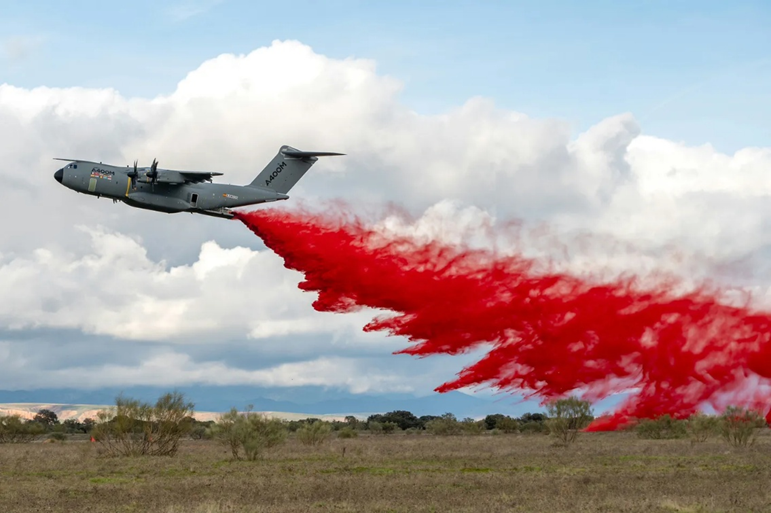
    For fixed wing models, I’m particularly fond of the C-130 equipped with MAFFS, the Modular Airborne Fire Fighting System. MAFFS is a roll-on, roll-off system that allows the aircraft to return to their normal mission when not engaged in firefighting4. Airbus has a similar concept for its A400M5.

    C130 MAFFS being loaded:
    Airbus A400M:
    SOME WILDFIRE STATS:

    According to the NIFC National Interagency Fire Center2, in the USA:

    • In 2023 (the last year of published info), there were 56,580 large fires and 2.7 million acres burned.
    • In 2022 there were 68,988 fires with 7.6 million acres burned.
    • In 2020 58,950 fires burned 10.1 million acres. 2021 data was not listed.

    “In EU countries, 2022 was a record-breaking year for wildfires. According to the European Commission (EC) Joint Research Centre’s Annual Report on Forest Fires in Europe, the Middle East and Africa, published in October 2022, more than 8,600km2 of land was burned across the EU before the end of summer 2022, compared with 5,500km2 in 2021.”7

    THE CARDING PROCESS:

    Think of the Carding process as a certification for the aircraft to perform its firefighting duties. I was contracted jointly by a state and private operator to perform two tasks:

    • Develop a state-level checklist, forms and reports used to perform the aircraft carding functions which reflect federal level processes and procedures.
    • Perform the aircraft inspection per the developed procedures.

    Each of the two tasks took 4 days, with 4 days onsite in the hangar and 3 technicians to assist as needed in the inspection. The aircraft inspection involved checking for AD compliance, a general inspection of the airframe condition, flight manual contents, maintenance logbook entries, checking for the presence of and operational checks of the avionics equipment, status of scheduled maintenance, and a sampling of Life Limited Parts records. I recorded 6 discrepancies which the operator satisfactorily addressed and were closed out. I signed the ‘card’, and the aircraft entered firefighting operations shortly thereafter.

    ROOM FOR IMPROVEMENT:

    Coming from my world of uniform and mature aerospace models defined by FARs 21, 43, 121, 145 etc., I was unexpectedly surprised by the seemingly duplicative processes and procedures across many federal and state agencies and the apparent unnecessarily complicated terms and conditions flowed down in the typical bidding process via solicitations which can be 132 pages long! Consider also that you may have invested millions in certifications and aircraft and be bidding on CWN contracts; Call When Needed. Your bid is accepted but you are essentially told ‘don’t call us, we’ll call you.’

    Also, consider that the following organizations may have duplicative or overlapping interests in the aerial firefighting world: BLM Bureau of Land Management, USFS United States Forest Service, US Department of the Interior’s OAS Office of Aviation Services, the FAA, and not to mention state and local agencies. These all represent significant barriers to entry. Is there hope for simplification and standardization?

    A book I purposely read slowly to absorb its details is Mudslingers.

    Many of the topics I have touched upon are reflected in this work of non-fiction. Sheehy repeatedly illustrates the difficulty of operating in this segment of aviation. But guess what? Sometime after publishing this book he got elected as a US Senator for Montana. In fact, many of you may have seen him on numerous news programs giving expert commentary on the LA fires. Expect him to wield his new position to bring much needed reform to this industry. BTW, I highly recommend the book for all aviation aficionados.

    Over ‘n outRoy ‘Royboy’ Resto

    www.AIMSolutionsconsulting.com

    The contents of this article were written without the aid of AI products.

    1 Mudslingers; Tim Sheehy; 2023; Permuted Press.

    2 The Fire Marshal; Bill Carey, Aviation Week & Space Technology; December 9-22, 2024; Page 40.

    3 https://avitrader.com/2025/01/21/avincis-wins-seven-year-contract-to-operate-italys-firefighting-canadair-fleet/

    4 https://www.dvidshub.net/video/950253/california-air-national-guard-c-130j-maffs-flight-deck-footage-hughes-fires

    5 https://www.airbus.com/en/newsroom/press-releases/2023-12-airbus-upgrades-a400m-firefighter-prototype-kit

    6 https://www.linkedin.com/in/daniel-berlant-86476143/recent-activity/all/

    Daniel Berlant CAL FIRE Fire Marshal

    7 https://www.airmedandrescue.com/latest/long-read/government-or-contract-aerial-firefighting-around-world

    Continue reading

    Considering Opening A FAA Repair Station in the USA?

    Posted By Roy Resto | December 01, 2024

    I have received many inquiries about opening FAA repair stations in the USA and have had the pleasure of working with clients on many such projects. I have also worked with clients to open a Canadian AMO and Brasilian repair station, but those are ideas for another article someday.

    Since this has become a topic of consideration in many a business plan, I thought I’d share some practical nuggets from experience for you to better develop your implementation and execution strategy. This information is an introductory overview and by no means a detailed listing of the process. In this article the following will be discussed:

    • Business options to consider.
    • Availability of maintenance manuals.
    • Key personnel and Licenses.
    • EASA and UK CAA Approval.
    • Time and expense.
    • The actual process.
    • Do It Yourself (DIY)?
    • Your relationship with the FAA.

    Business options to consider:

    Three options exist for most firms considering entry to the MRO (Maintenance, Repair & Overhaul) market.

    • Buy an existing repair station.
    • Partner with an existing repair station.
    • Start a repair station from scratch.

    If you’re considering buying or partnering, start your research at this FAA website:

    https://www.faa.gov/av-info/facility-dashboard

    When I last looked, there were 5,857 FAA repair stations globally. If you’re based outside the USA, consider that there may be an option in your locale.

    Most of this article will be expressed from the point of view of starting from scratch.

    Availability of maintenance manuals.

    Before investing a penny in any venture, Royboy asks that you critically examine this issue.

    If you can’t obtain the manuals, for example the applicable CMMs, Component Maintenance Manuals, then you can’t add those parts to your Capabilities List or Operations Specifications. For more information on this thorny issue, read my article on this topic.

    https://www.aviationsuppliers.org/will-oems-make-manuals-available-to-independent-mros-industry-coalition-asks-for-faa-involvement

    Key personnel and Licenses:

    The two critical positions you must immediately give thought to are those of the Accountable Manager and Chief Inspector. Finding qualified people to fill these positions is difficult, so start your search early. If you’re challenged in this search yourself, this is a good time to consider the services of a headhunter, AKA Recruiter.

    Think of the Accountable Manager as the person who will be the General Manager; the person who will run and be accountable for operations. This position does not require the person to be a licensed Technician. The actual title of the Person can be anything, for example, President, CEO, GM, Director, Manager, etc., but a person must be designated as the Accountable Manager.

    ‘Chief Inspector’ is now a dated title for repair stations which is no longer officially recognized in FAR 145 but continues to be used descriptively if not literally on organization charts and Rosters. Airlines do, however, continue to use the title officially per FAR 119. The Chief Inspector (or Quality Director, or Quality Manager, etc.) will have to be a certificated Mechanic. In the USA this means having:

    • An FAA A&P Mechanic certificate. This is actually two certificates, Airframe and Powerplant. Depending on the work performed by the repair station, either an Airframe or Powerplant may suffice. For example, if you only work on engines, the Powerplant certificate will be adequate, or
    • Be eligible for a Repairman certificate. This is only effective as long as the person is employed by the repair station, and a key requirement is 18 months’ experience in the area being applied for. The person can either bring this experience with them in the form of documented work at a previous repair station or have gained it within the existing repair station.

    Can one person in my small repair station fill both positions? The answer is yes, but he/she must have the Mechanic or Repairman certificate.

    EASA, UK CAA, and/or Brasil ANAC Approval:

    Due to business considerations many of you will seek to have your USA based repair station approved by EASA, UK CAA, and/or Brasil ANAC. If so:

    • You cannot apply for any of these until you have your FAA 145 Certificate. I usually counsel that the day after you are awarded your FAA Certificate is when to apply for these.
    • Aviation authorities will only consider issuing these if there is a need. For example, to demonstrate this, you will have to present letters from aviation firms in those nations attesting to their intention to use you upon your certification.
    • Aiding in these certifications is a key document called the MAG (Maintenance Annex Guidance) which is used as a primary guide telling you how to apply, renew, and what the contents of your manual called a Supplement, should address. There is a MAG for each of these Aviation Authorities, and fortunately there is much in common between the three.
    • Note that each approval lasts 2 years and there is a fee for each one from the Aviation Authority.

    Time and expense:

    Timewise, budget at least a year. The FAA has been whittling away at the backlog that was created during the covid period, but even without such a backlog it remains a long and careful process for good reasons.

    • Note that the FAA does not charge anything for domestic applications.
    • If you choose to use consultants to assist you be prepared to budget between $20-45K depending on the scope of assistance you need.
    • Additional investment costs will be associated with the work you intend to perform and may include:
      • Hand tools.
      • Measuring and testing equipment.
      • Calibration program.
      • Spare parts.
      • An ERP system.
      • Stands, jacks, power, air compressors.
      • Shelving, cranes, forklifts.
      • Subscriptions to OEM manuals. Most manuals have a listing of required tools and equipment including any consumables in the back of, for example, the CMM. This should give you a pretty good idea of what’s needed.

    The actual process:

    The FAA has pretty good website information on the process which consists of 5 Phases. Start your familiarization journey here:

    https://www.faa.gov/licenses_certificates/airline_certification/part145_certification

    The minute you decide you want to launch, submit the simple Preapplication Statement of Intent (PASI) FAA Form 8400-6 as soon as possible. This does not commit you to anything but places you in a queue; an important step given the backlog of applicants. Your bonafide commitment comes later when you submit the Formal Application.

    If the process seems overly bureaucratic and time-consuming keep in mind that it really should be. The FAA is vetting you and your system. You are about to be certificated to perform work, which if improperly accomplished could lead to loss of life, accidents, or incidents.
    Do It Yourself (DIY)?

    If you decide you want to take on this project yourself here’s what I recommend:

    • You will need to have customized manuals stating how you comply with the regulations. This is mainly for your employees but is especially important during your certification effort. Expect to spend a surprising amount of time negotiating with the FAA on the adequacy of your drafts given the scope of your operations; no two are alike. A good source for a template and if needed additional assistance is at:

    Your Relationship with the FAA:

    From day one you must focus on developing a relationship of mutual trust and respect.

    • If you don’t understand something, ask.
    • If you need help, reach out. The FAA has a great deal of resources and expertise.
    • Be humble, expect to learn. Each project I have worked on I learned and learned and learned.
    • Do not lie about anything! If you are asked anything potentially embarrassing, admit it, come clean, and get on with it.
    • Communicate. You can’t overcommunicate during the certification process. During lulls in the process drop your contact an email saying you just hired some more employees, obtained more equipment, accomplished training, etc.
    • The FAA won’t accept gifts or even allow you to pay for lunch.
    • Don’t be afraid to push back. If you feel you’re unreasonably being asked to do something, respectfully state your case and ask for a second opinion. I have won some and lost some. Not once has this jeopardized the project.
    • Don’t expect the FAA to be experts on the components, aircraft, or engines you’re working on. Instead, they’ll be looking to see that you are carefully following your repair station processes and procedures and meticulously accomplishing the tasks in the maintenance manual. That’s on you.

    In this article I tried not to simply restate rules and regulations, but to focus on the practical aspects of this important process based on my experiences of working on more than a few certification projects. Best wishes to you!

    Over ‘n out

    Roy ‘Royboy’ Resto

    www.aimsolutionsconsulting.com

    This article was written without the use of AI.


    Continue reading