CAVU Café: Royboy’s Prose & Cons, Page 3 of 17 The views expressed in CAVU Café: Royboy’s Prose & Cons blog are those solely of the writer and are not necessarily shared by the Aviation Suppliers Association or the Association’s staff, members, or Board of Directors. About Roy Resto RETURNS, RMAs, AND UNDERREPORTED QUALITY ISSUESPosted By Jeanne Meade | October 02, 2024
In this age where we bask in torrents of overwhelming data, we must pause and ask, as we used to say in the military, what bits of this information comprise actionable intelligence? Most importantly is which bits can be data-mined for analysis which will contribute to continuous improvement in your operation? BACKGROUND: In my experience in working with many firms, an often-overlooked opportunity exists to data mine product returns to suppliers, or from customers and/or RMA (Return Material Authorizations) activity, or reported discrepancies, for possible quality issues. Among firms that do track such data, there is great variation in the level of data mining occurring. There is no question that for firms with robust tracking of this data, when quality issues are identified it may drive as applicable:
Regarding product returns from customers and/or its RMA activity, it’s interesting that none of the FAA AC 00-56, ISO/AS, ASA-100, or AFRA BMP standards appear to require the tracking of this data. ISO/AS/EN may infer or encourage such data to be tracked but it is not specifically called for and so once again there are some ISO/AS/EN firms that do, and some that don’t. So, if you choose not to analyze this data, you are not literally breaking any standards or regulations. For firms with Quality Systems not based on ISO/AS/EN, this is rarely tracked. Regarding returns to suppliers or reported supplier discrepancies, standards like the ASA-100 require that a ‘Quality History’ for the approved suppliers be established. CATEGORIES: The broad issues under consideration here naturally fall into three types of data with their own peculiarities and thus should be tracked separately:
DATA COLLECTION: If you’re convinced of the need to monitor this activity, the initial challenge arises from how you will gather the data.
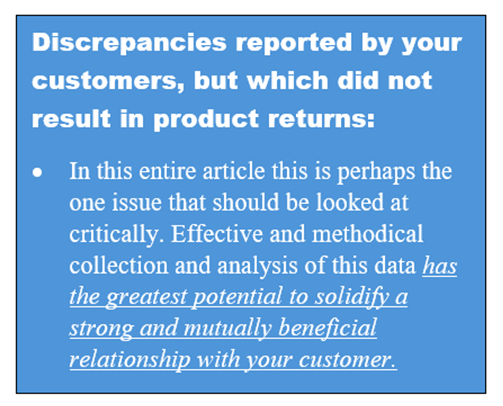
DATA MINING: Regarding the data which either of the three scenarios creates, the mining aspect would consist of the following:
ANALYSIS: An employee who is good at analysis is always a rock star on the staff. Analysis not only requires a command of the subject material, but skills at connecting the dots - taking apparently disparate points of data and seeing common connections. Effective skills often reflect a bit of creativity in this processing.
BEWARE OF UNDOCUMENTED UNDERREPORTED ACTIVITY: You have a favorite customer. They have been tracking the discrepancies caused by your shipments to them. Very few of these resulted in product returns to you via RMAs, and your sales staff have been rectifying each issue directly with the customer. Suddenly, you stop getting POs from them. It turns out that like so many major customers, there are set limits with quality issues which, once exceeded result in your being restricted from further business activity. When your company is apprised of the circumstances, your QA Manager is held to answer but was never made aware of the activity in the first place. Whose fault is this? It's similarly interesting that some of the product return activity from customers may be deliberately underreported or handled in such a way that it does not draw too much attention within the firm. For example, the firm may be using an ERP system that has an RMA capability built in, but when asked how many RMAs have been issued to their customers for returns, they appear proud to say that there have been none or its remarkably low; probing further it’s discovered that certain salespersons have deliberately gone around the RMA system and discreetly handle the return with emails and personal intervention. The QA Manager remains in the dark. Put the right data to work for you; be a rock star with your customers; make it happen… Over ‘n out Roy ‘Royboy’ Resto www.aimsolutionsconsulting.com The content of this article was written without the assistance of any AI programs. CRITICAL NEED FOR TRAINING INCLUDING EXECUTIVESPosted By Roy Resto | August 01, 2024
In aviation a conspicuous requirement among all the standards and regulations is training, Every. Single. One. Do you claim to have a Quality and Safety culture? Show me your training program. If there has ever been a critical time to revisit and emphasize your training program it is now. In this article we’ll address the following:
Industry Characteristics. Consider these following current characteristics of our industry:
Executives: We need to talk (don’t you hate it when an exchange starts out with that characterization? This will be one of those). I’ve noticed a troubling trend among executives; they don’t attend their company’s training sessions. Let me share a few stories:
For sure no one is suggesting that your executives take introductory classes such as those for new employees, but some course material is more relevant and of importance to the broader staff. Go; turn off your cell phone, ask questions, and at the end make a supportive statement for the attendees regarding the imparted topics; it will gain the respect of your staff and demonstrate management’s support for the importance of training. 
Types of Training:
Methods to Deliver Training:
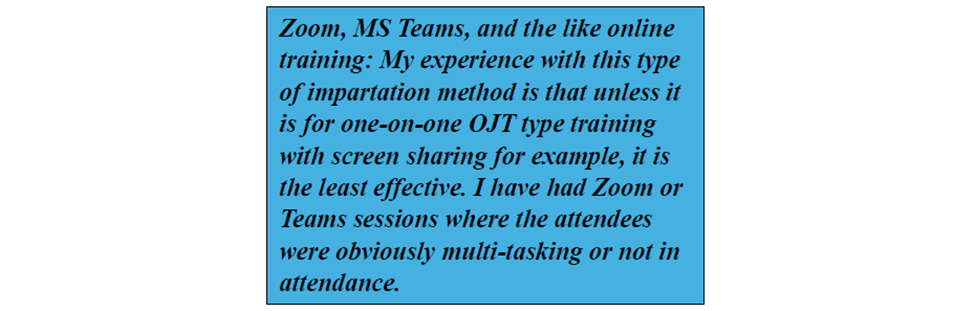
The Science of Training: Immersive Virtual Reality, Artificial Intelligence, LMS, and Learning Analytics are among the many buzzwords trainers are today embracing to make learning more effective and useful. While it is certainly beyond the scope of this article to discuss these, the point is made that the methods to impart effective training are evolving and so should your analysis of the quality of training in your own operation. Over ‘n out Roy ‘Royboy’ Resto www.AimSolutionsConsulting.com https://www.linkedin.com/in/royresto/ This article was written without the use of AI generated content. COUNTERFEIT ELECTRONIC PARTSPosted By Mat Meyer | May 31, 2024
As many of you know I have a fondness for electronics born of my avionics and electronic warfare background and experience, so the subject matter herein always commands my attention, as it should for you too since so many of you either sell assemblies with electronic/electrical components in them or sell the individual electronic/electrical components themselves. In this article we’ll review:
DEFINITIONS OF COUNTERFEIT:
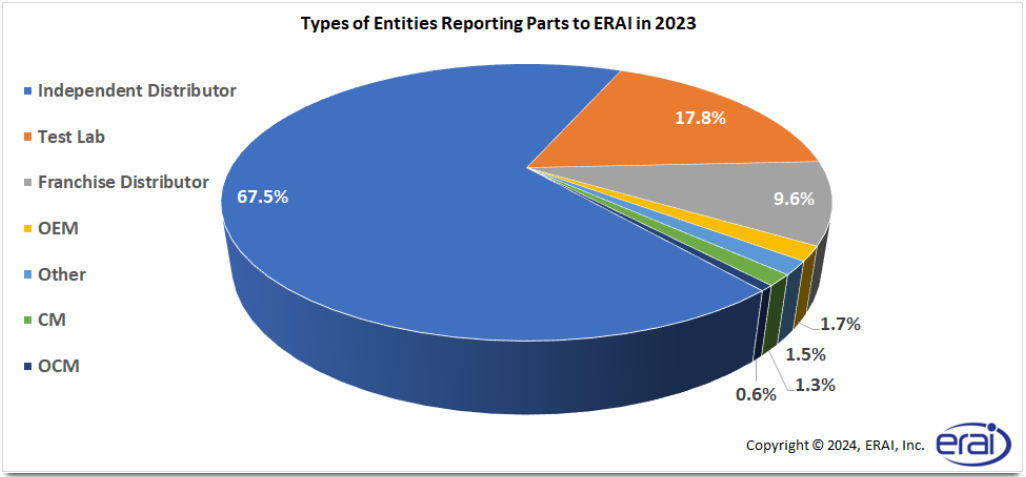
WHO IS ERAI? Founded in 1995, ERAI, Inc. is a global information services organization that monitors, investigates, and reports issues affecting the global electronics supply chain. As the industry’s leading source of risk assessment tools, ERAI provides exclusive services and in-depth information that enable its members to perform industry-specific risk mitigation on suspect counterfeit, high-risk, and non-conforming parts and identify problematic suppliers and customers.1 I follow ERAI on LinkedIn2, so I tend to keep up with their data on the topic. The latest for the complete year of 2023 was recently posted3 which is being shared herein. THE DATA: A very telling graph of the total number reported against total sales. 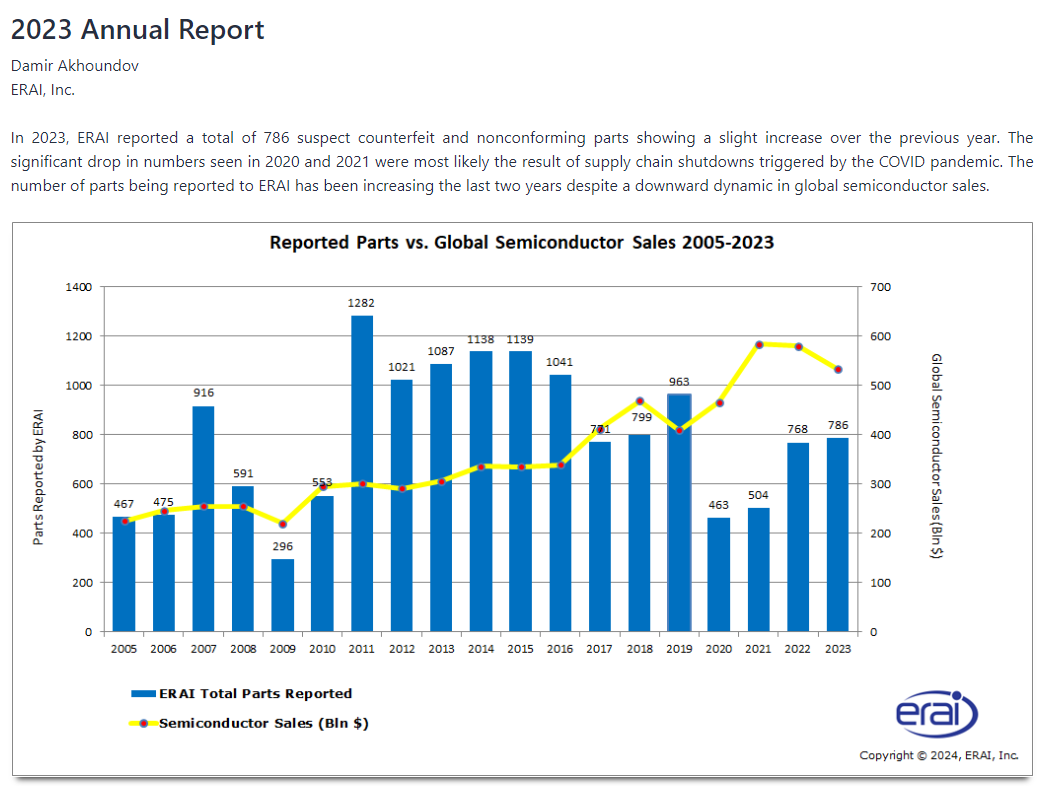
What parts are affected? 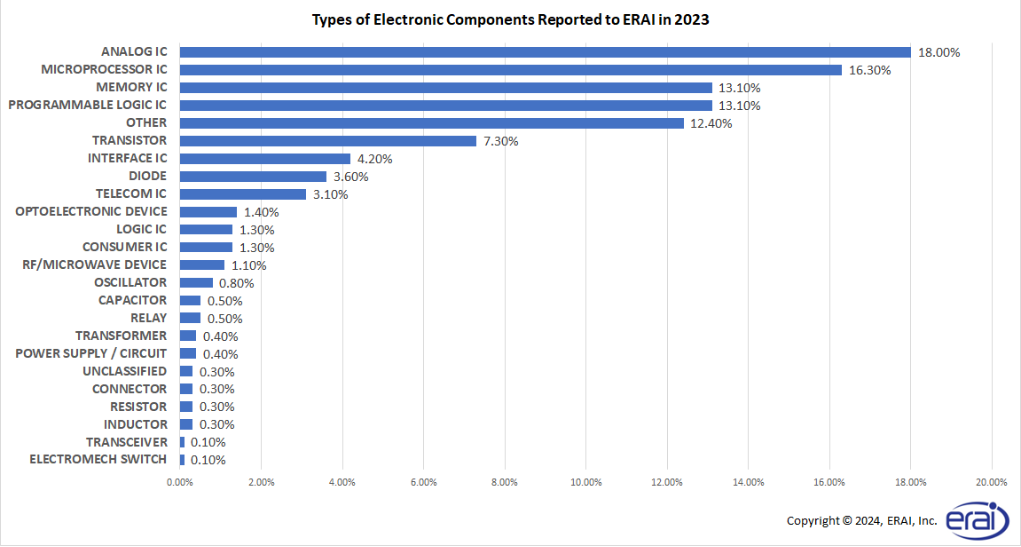
  NEW QUALITY STANDARDS BEING FLOWED DOWN TO SUPPLIERS WHICH SPECIFICALLY TARGET THESE PARTS WITH MITIGATION MEASURES: Notice that these (see below) are all AS numbered for Aerospace Standards. Suppliers who these are being flowed down to are either being asked to implement them with full accreditation, or to be compliant with key aspects. I’ve audited a company who was fully accredited to one of these and worked with another to write compliant procedures for limited aspects. Both are ASA-100 accredited as well. 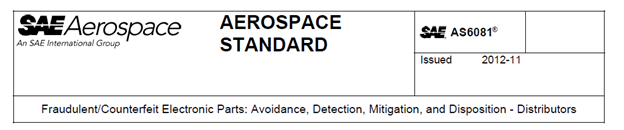
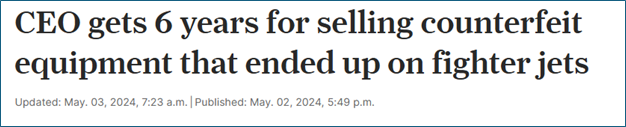
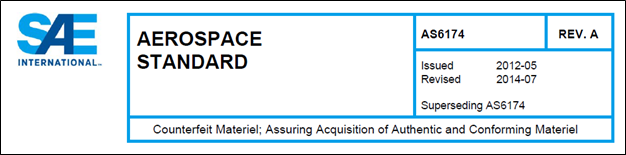 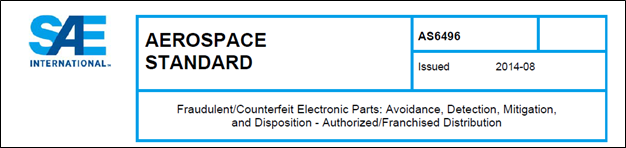 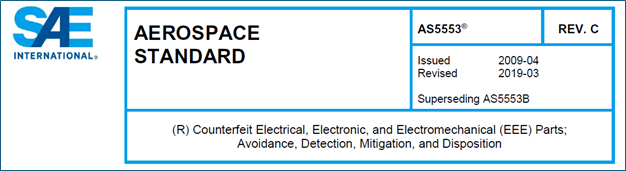 With certainty the data covers the broadest cross section of different industries, but as can be seen in the AS Standards, Aerospace is taking positive action to mitigate the phenomenon. The DoD has taken a well-founded alarmist view of this, and a Senate Armed Services Committee Hearing was held to herald the issues. The trouble is that the data seems to show that the activity continues unabated except for the dips in reports during the Covid period. Here are recent press releases reflective of this disturbing activity.4, 5 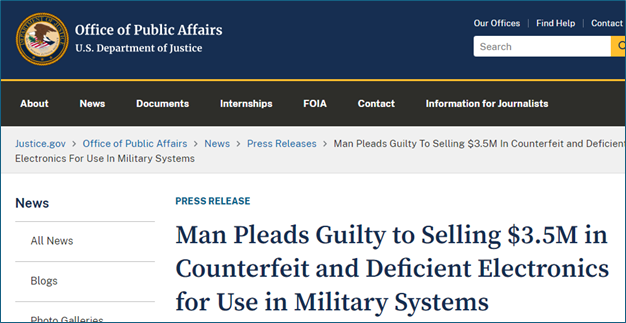
 This article was written without the use of AI generated content. Over ‘n out Roy Resto www.AimSolutionsConsulting.com https://www.linkedin.com/in/royresto/ 1: https://www.erai.com/aboutus_profile 2- https://www.linkedin.com/groups/3758841/ “REMARKS” On Your Documents Are Your FriendPosted By Jeanne Meade | April 02, 2024
Me at home: ‘Honey, where’s the ketchup, did you finish it?’ Wife: ‘It’s in the fridge’ Me: ‘I looked, it’s not there’ The sound of pounding footsteps on a mission are heard marching to the fridge, whereupon an impressive and commanding opening swing of the door is given, the wife’s hand swivels like a whip, tip towards the now mysteriously reappeared bottle of ketchup and voila, there it is. I bow and kiss her backhand then meekishly apply the condiment. Occasionally solutions to our problems are right in front of us, and like ketchup on a burger, sometimes it’s advisable to add additional words to season our documents for the many reasons we’ll discuss. What are one of the entries that all these forms have in common?
As you’ve likely deduced, these all have provisions for Remarks. From my experience this feature is one of the most underutilized blocks in any form. Use of this block can prevent a customer from rejecting your part or be used to explain issues that might otherwise cause angst upon receipt. Let’s look at some real-world examples.
There was no problem with the customer and the Igniters were accepted.
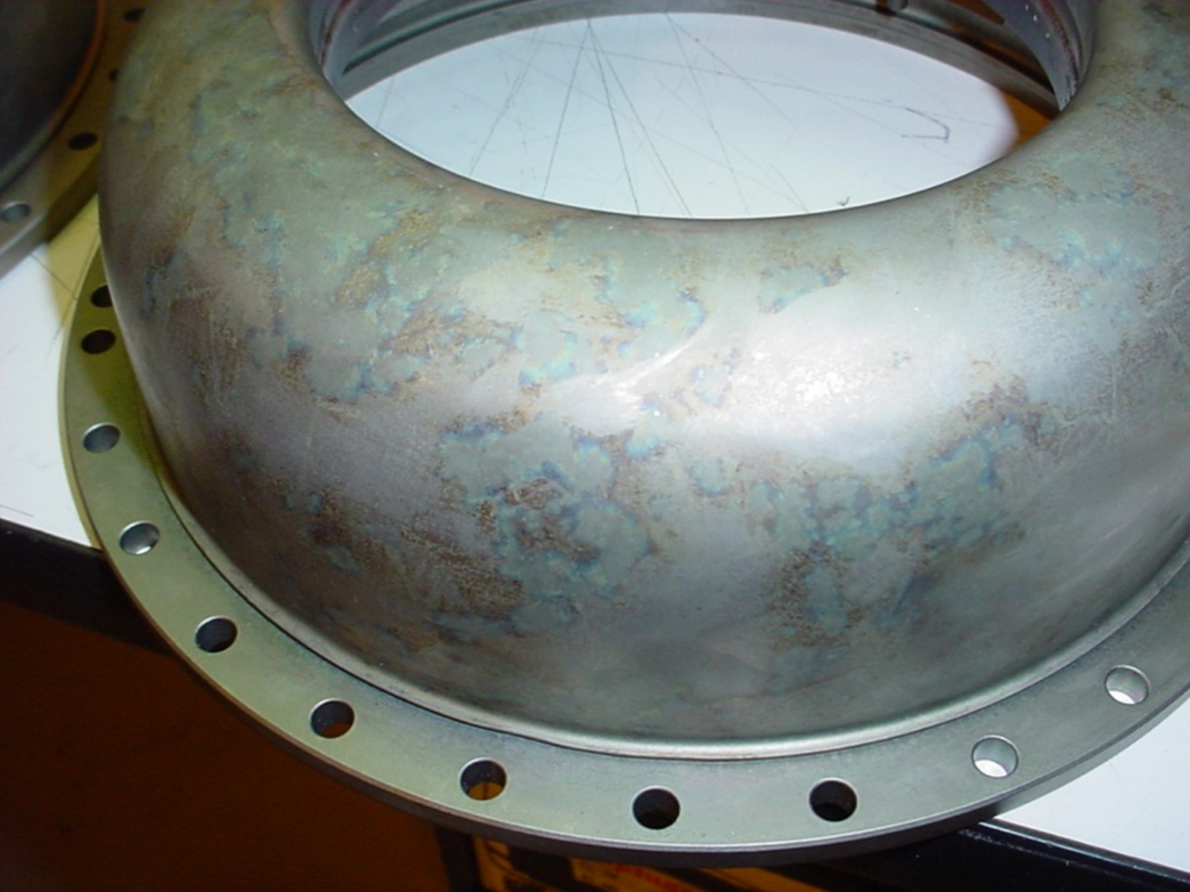
The part was accepted with no problems.
By the way, I wrote an article on the importance of MRO Tear Down reports which I hope you’ll find interesting. Here’s the link: https://www.aviationsuppliers.org/THE-VALUE-OF-TEAR-DOWN-REPORTS
Even though the fresh tag is now in Inspected status, under this simple example Royboy would support you marketing the part in New condition since the part still has zero Operating Time and Cycles, which is the de facto definition for New parts. By the way, regarding the ‘silly’ requirement in my characterization, here’s another article I wrote directly challenging it: https://www.aviationsuppliers.org/aftermarket-tags-overhauled-vs-repaired-vs-2-years TO MANUFACTURERS AND MROS. If your parts have shelf life, PLEASE put this information in the Remarks Block of your Airworthiness Release Certificate; some of you do and some of you don’t, and it may get overlooked on page 3 of your certs or Tear Down Report. IN SUMMARY: Regardless of what form and ERP system you are using, these all have provisions for the addition of free text. Use it for Remarks! This article was written without the use of AI assistance. Over ‘n out Roy ‘Royboy’ Resto PERFORMING LIMITED DISASSEMBLY IS ON THE RISEPosted By Mat Meyer | January 31, 2024
Scenario: You are a distributor, and you have an MMR (Multi Mode Receiver) in your Quarantine Cage because the MRO- Maintenance Repair & Overhaul shop returned the part to you as BER- Beyond Economical Repair due to an unrepairable power supply. There is a customer who is looking for a cover whose part number is the cover for the MMR in the Q Cage. You simply remove the 10 screws to disassemble the cover from the MMR assembly, and voila, you have an AR- As Removed condition part and you’re a hero to your customer because this part was not to be found on the market. Certainly, this is a simple example, but the concepts we’ll go over in this article can be applied to this small assembly (the MMR) or to major assemblies such as Landing Gears, APUs, and Air Cycle Machines. This brings to mind many details we’ll cover in this article including the following:
BACKGROUND: USM or Used Serviceable Material is increasingly popular as an alternative to factory new parts whose prices have soared, and lead times extended. Besides those well-known supply chain issues there are in some cases a challenged aftermarket environment due to certain OEM behaviors as explained in this blog article: https://www.aviationsuppliers.org/AIRLINE-MX-COSTS-WILL-GO-UP An increasingly popular source of USM parts is from aircraft and engines which have been disassembled. Before we go any further, we need to point out that the ‘S’ in USM means Serviceable (Inspected, Tested, Repaired, Overhauled). Nearly all parts disassembled from a NHA- Next Higher Assembly are at that moment in AR- As Removed condition. That AR part will have to be sent to a Repair Station/AMO- Approved Maintenance Organisation which will reestablish the part’s airworthiness before it can be installed on an aircraft. I only mention this because the USM moniker is bandied about for a broad range of parts in the aftermarket including these AR unserviceable parts, so its ok to continue to use USM if this is kept in mind. Do I need to be Certificated by an AA- Aviation Authority? As long as you are not declaring any of the disassembled parts as airworthy, then the answer is no. This is neatly articulated in Jason Dickstein’s blog article: AFRA Intro. For firms whose core business is disassembly of entire aircraft, engines, or any subcomponents, there is likely an affiliation with AFRA, Aircraft Fleet Recycling Association. AFRA has established disassembly and recycling standards whereby compliant firms can be accredited for Disassembly, Demolition, and Recycling; see the Directory tab at the noted website. With a certainty this article is not suggesting that any of your limited disassembly activates as a distributor be accredited by AFRA, but you should be made aware of their standards and activities in case you want to step up your game. It is interesting to note the synergies between the ASA and AFRA which are quite natural considering the overlapping activities of each other’s members. For example, many AFRA accredited firms are ASA-100 and vice versa. You’ll also notice that the ASA and AFRA annual conferences have been held concurrently now for many years. FORMS AND PROCEDURES TO CONSIDER. Procedures in your manual. The ASA-100 paragraph 1.A.1) states:
If you’re selling parts from your disassembly operation under your accredited name and enjoying the business benefits of your ASA-100 accreditation therein, then there is the expectation that your Quality Manual will describe your disassembly operations (exception: you are also AFRA accredited and disassembly procedures are described in the AFRA manual). Consider some of the items presented here for inclusion. Consider placing this in your manual:
Tags: Perhaps one of the most important documents to implement which facilitates the sale of the part and establishes the trace trail (more on that later), is the use of the Removal or Identification Tag. Here is a blank sample and a filled-in example: .png) Currently, use of such a tag is dominant in the industry and is sometimes supplemented by, or replaced by a Manifest of removed parts, but the current best practice is the simple tag. It should be affixed immediately upon removal. This is just a sample, and variations of it are common. Do I need a certificated Technician to perform the disassembly? There are certainly advantages to using a Certificated Aircraft Technician to perform your disassembly operations. Generally, they are familiar with Technical Manuals, tools, and proper handling of aircraft parts. Some firms also feel that having a Technician exercise their credential on the removal tag, for example “A&P Joe Smith” is added value or adds credibility to the process. To be certain, however, this is not required. Royboy’s recommendation is then to use someone with attention-to-details, and who is mechanically inclined. Who can issue an ‘Inspected’ 8130-3 or equivalent for removed parts from a disassembly of an aircraft? If you are a Repair Station or Approved Maintenance Organisation, and you have a written procedure in your manual to do so, you’re the one who can issue an Inspected tag (8130-3 or equivalent). I have written procedures accepted for this process, and these should always have a document number, for example WI-1501. Here’s a quick summary of the logic. An aircraft arrives at your hangar for disassembly. For it to have flown there it must have been Airworthy, and the Airworthy Certificate carried on board. Except for any open write-ups in the logbook, you can reasonably assume that the aircraft (and its parts and components) are airworthy. If there are any open write-ups, they will be found in the logbook with its ATA chapter noted. Let’s say you want to start to remove all the radios. You look in the logbook and there are no ATA Chapter 23 write-ups. Next you go to the AMM- Aircraft Maintenance Manual and find in chapter 23 where it typically requires a visual inspection of the system during operational checks or troubleshooting. You perform the visual check and find nothing untoward. You remove the radio, cap it, and the resulting 8130-3 says Inspected as its condition. I highly recommend that the remarks block transparently and plainly state the circumstances involved, for example, “Removed from MSN 12345”. Of course, the remarks must also contain a reference to the AMM and cite your written procedure. For example, “Visually Inspected per AMM 23-15-44 paragraph 23-14, and (Company Name) Procedure WI-1501.” Regarding this process, some customers will accept such parts, and some won’t. I was once told by an airline person wagging their loaded finger at me that this could not possibly be allowed! I countered by saying, ‘then how is it that you’re allowed to do it?” What! For more info read this background article titled “Cannibalizing, Robbing, and Swapping Aircraft Parts” at this link: https://www.aviationsuppliers.org/Cannibalizing-Robbing-and-Swapping-Aircraft-Parts The following is a simple and generalized flowchart regarding tagging options for a disassembly I have presented in the past at conferences. Apologies if it seems small for the posting. 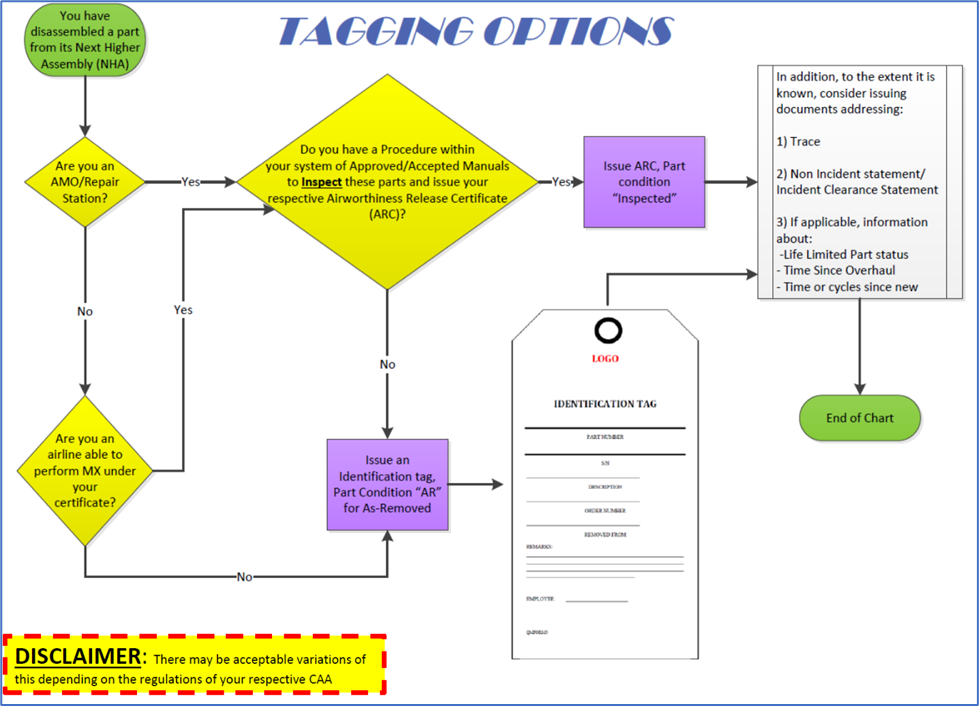 Removal Log. If you have a complete assembly of any kind and you start to harvest parts from it, Royboy highly recommends that you have a method to track the parts removed from this Next Higher Assembly. Why? The reason is that if for any reason you are now presented with a PO (Purchase Order) for the entire assembly, you’ll have to restore or provide the parts removed in order to sell it as a complete assembly. If you have a Removal Log entry for every part that was removed, you now have a simple listing to facilitate the process. The Removal Log would always stay with assembly. I distinctly recall my airline days whereby we had spare engines at a few major bases, and those engines were always tempting targets to harvest parts which were not in stock. The written procedure included posting a Removal Log so anyone would instantly know what parts were missing and on order. Tooling, Capping, Bagging, Packaging. In addition to a wide assortment of tools it is recommended that you also have a wide assortment of caps and plugs for electrical, pneumatic, fuel, oil, and hydraulic connections upon disassembly. This must include a reasonable assortment of ESD caps and bags for such parts. Depending on the size and type of part being disassembled, consider hoists, drip pans (for parts with oil, fuel, or hydraulic fluids which will leak), or stands made for major assemblies such as engines and APUs, see below. 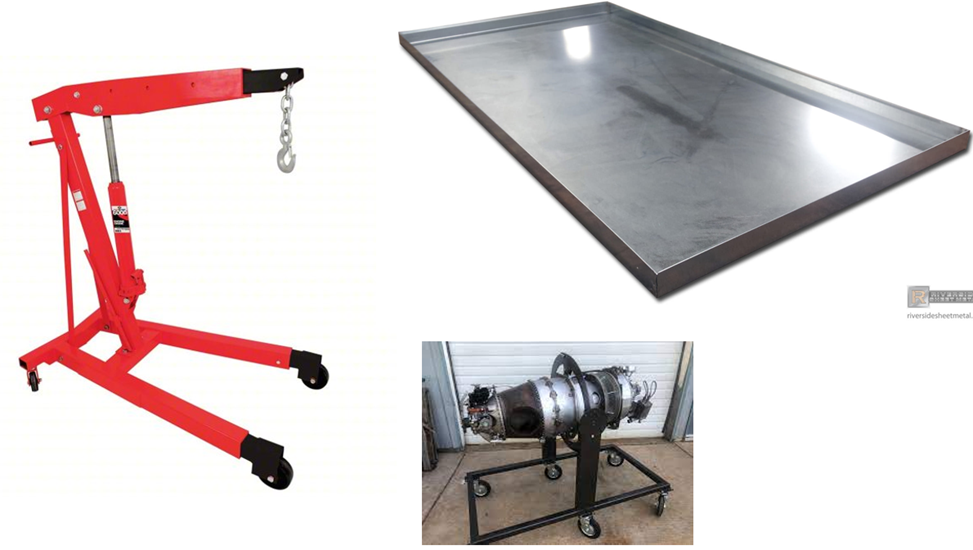 Trace Considerations/representations. If you have heard me speak or read many of my articles, you’ll have taken notice of my repeated use of the word ‘transparency’, and so it is with parts that have been disassembled from a NHA. Our customers continue to require clear and transparent trace as stated on their T&Cs- Terms and Conditions on their Purchase Orders. For the example given for the MMR cover, providing the removal tag (or copy) is important. Next is what is the trace for the MMR? Unless you’re selling the part in AR condition, then of course your documentation package would include the Airworthiness Release Certificate from whomever you used to perform the Overhaul, Repair, or Inspected/Tested. Records: As with any activity occurring in your distributorship, and as required by the ASA-100 and nearly all Quality Standards and Aviation Regulations, keep precise records which are reasonably accessible upon request. Royboy’s Parting Counsel:
This article was written without the use of any AI apps or programs. Over ‘n out Roy ‘Royboy’ Resto ATA SPEC 106 REVISIONPosted By Mat Meyer | December 01, 2023
It has been 22 years since the ATA Spec 106 was updated, and it is now at revision 2023.1. The proper and full name of this document is ATA Specification 106, Sources & Approved Parts Qualification Guidelines (herein ‘the spec’). In this article the following will be presented:
COMMON MISCONCEPTIONS
INTERESTING FACTS ABOUT THE SPEC
And there you have it, the birth of the Non-Incident Statement WHAT HAS CHANGED WITH THE FORM?
Section 3-1 paragraph D of the spec which refers to paragraph C: Although the above paragraphs appear to have some minor issues with the cross references, the following can be reasonably concluded:
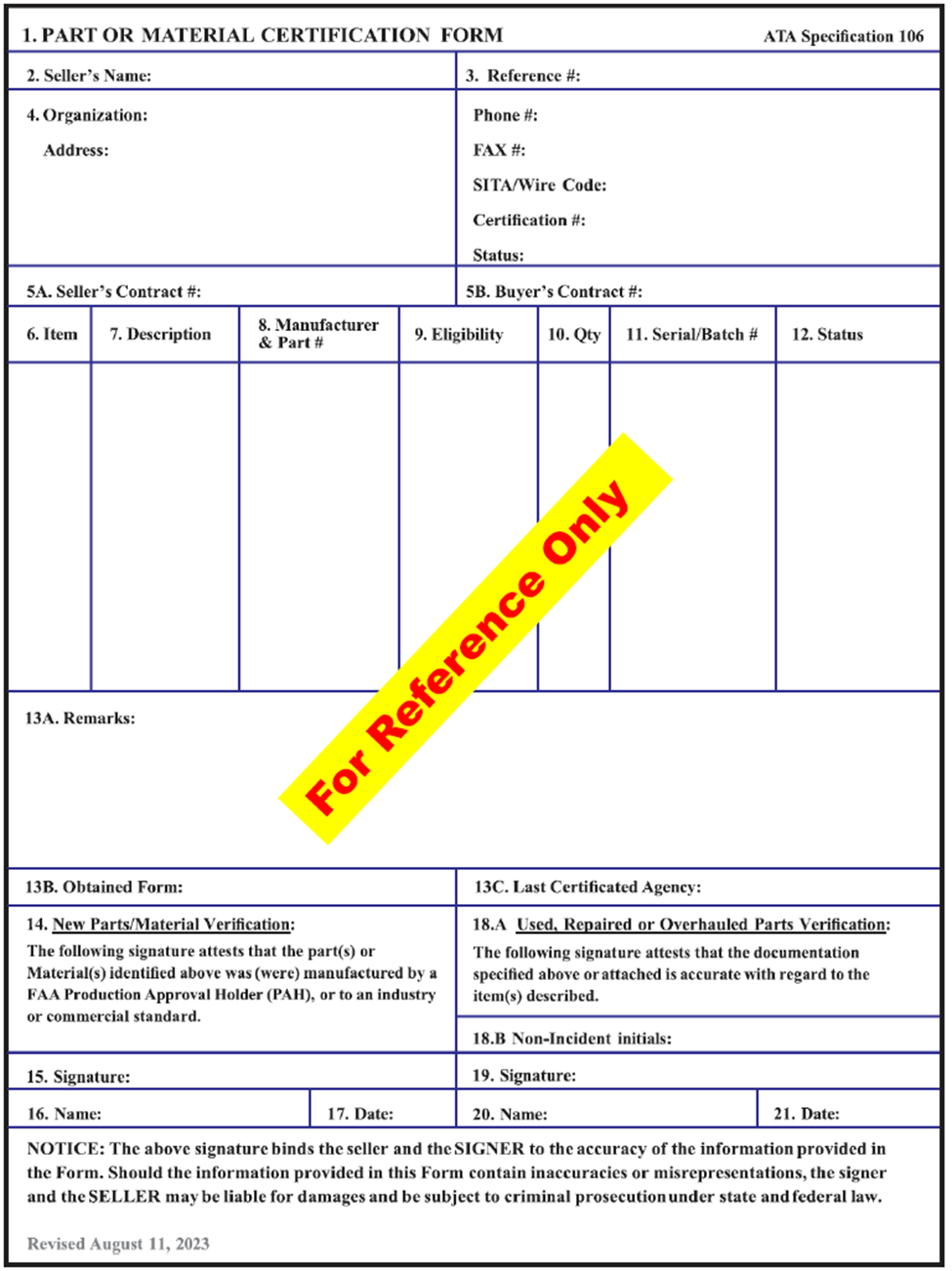 USE OF THE FORM TO COMPLY WITH THE ASA-100 Likely contributory to the mistaken perception that the ASA requires use of this form and/or that it is an ASA form, is that many accredited firms use it to comply with a section of the ASA-100 standard. Section 10 of the standard is titled: Certification and Release of Materials. Its paragraph B: “B. Additionally, a certified statement disclosing the following should be issued about the material or parts, certifying that they were or were not: 1) subjected to conditions of extreme stress, heat or environment, 2) previously installed in a public aircraft, such as a government use aircraft or a military aircraft.” To date, the form most used to express these statements is the ATA Spec 106. CONTINUING ISSUES WITH THE 106 FORM
THE ASA STATEMENT FORM For all the reasons cited above, the ASA’s QA Committee worked on developing the ASA Statement Form 2020. It brings into the 21st century the desired information and retains the one-page summary of the essential data needed to expedite the receiving process – BRAVO! Here’s the link to the form, training, and detailed instructions: https://www.aviationsuppliers.org/asa-statement-form-2020 Most importantly: It has been a long time since I’ve seen a customer’s PO specifically call for an ATA Spec 106 from their supplier. If your customer uses generic titles in their Terms & Conditions requiring your ‘C of C’, or ‘Material Certification’ then you are free to use the ASA Statement Form… make it happen! This article was written without the use of any AI apps or programs. Over ‘n out Roy ‘Royboy’ Resto www.AimSolutionsConsulting.com |