CAVU Café: Royboy’s Prose & Cons, Page 10 of 17 The views expressed in CAVU Café: Royboy’s Prose & Cons blog are those solely of the writer and are not necessarily shared by the Aviation Suppliers Association or the Association’s staff, members, or Board of Directors. About Roy Resto Things People & Firms Say They Do in Our Industry but…Posted By Roy Resto | October 02, 2017
Ok, time to wax cynical and poke fun at some non-performers
in the aerospace and aviation industry. Ah, the tyranny of the ‘but’ word. ‘But’ is a conjunction
used to introduce something contrasting with what has been already mentioned. Anticipation
of the ‘but’ word most of the time makes us cringe. For example, ‘Joe you’re a
good worker but…’ oh no, here it comes, the
compliment- criticism strategy. Really now, is it worth anything at all to
the listener to hear that compliment? Probably not, especially when followed by
the ‘but’ word. Management mentors would suggest that use of the compliment-criticism is too
blunt and ineffective. The compliment-neutral
transition/positive reinforcement-coaching strategy might be more
palatable, e.g. ‘Joe you’re a good worker but we have suggestions for
improvement to make you a star performer.’ Hmm,
nice landing boss as you prepare to jolt me. Speak of jolting, there are some
things in our industry which people or firms say they do, but… 24/7/AOG SERVICE Really? This is an overused claim in the aviation support sector.
What it really means (at 2am your time)
is that you’ll take the information (while
assuring the caller that you’ll get right on it) but (there’s that word) really get to it at the first opportunity of
regular working hours. At worst it means that you have 24/7 voicemail
capability which someone will access during regular working hours. Oh, you got the hot call but have no
inventory? Hopefully the source of the part you intend to call has a
genuine 24/7 AOG capability; good luck
with that. As a young Supervisor over two avionics shops at a major
airline, I recall the 24/7 AOG service we had to give to our internal airline
customer and our external customers who used us for repair and overhaul
services. During the week it seldom was an issue since we had 2 and 3 shift
services for the shops, but during the weekends the supervisors rotated having
‘weekend duty coverage’. Friday afternoon you’d sign out the ‘briefcase’ which
was prepared that day. It had the latest seniority lists of all the
technicians, contact phone numbers, and a dedicated pager (yes those are still used today for critical applications). If I
got a call it was from Maintenance Operations Control, usually. the AOG desk. You had all the resources and
authority to get people into the shops to get the product out, and yes, pity
the poor fellow on Monday who might have to explain an unfulfilled need. That was indeed 24/7 AOG service. Excuses for saying you have the service but not living up to
it varies and are well rehearsed. Royboy’s counsel is that if you’re an
operator and considering signing on with a service provider, don’t sign
anything until you’ve made a test call at 3am Sunday morning. The results will
surprise you.
YOUR INVENTORY You list inventory on public websites as if you actually had
the parts but you don’t. On the other hand you know who certainly does have it,
but you list it in your name in the hope that you, instead of them will get the
call. When you get the call you simply place an immediate order to the source (there were two buts in this one…). MISSION STATEMENT There are a few blue-chip companies which are absolutely
driven and consumed by their mission statement; in fact that’s what contributed
to their being classed as a ‘blue-chip’ performer. The military is 100% mission
driven. Your rank, promotions, awards, and decorations are all dependent on
your contribution to attainment and sustainment of the mission. For these reasons it’s surprising how many
firms have hollow mission statements. You see the statements in manuals, banners,
and marketing channels. The problem is there’s no follow-up, targeted metrics,
or performance accountability; in short, the mission statement is Papier-mâché
window dressing designed to mostly impress outsiders. I recall when creating a mission statement was quite a deal.
It might have involved a weekend retreat with key employees and a professional
facilitator. After the meeting room was impressively plastered with post-it
posters of draft statements (which made
you feel quite productive), the group arrived at the pinnacle consensus
mission statement with the requisite oohs and ahhs; this, while you all stared
in wonderment at the creation. This was
followed by the trumpeted roll out and broadcasting of the statement on shiny
wood and brass plaques posted in high visibility areas…to be quickly forgotten. Maybe you really meant it when you said it but… STATEMENTS ABOUT
QUALITY It’s expected and quite fashionable to make grand statements
about corporate policy regarding the quality of its products. Do you want to
know who really lives up to their quality policies? Just ask the receiving
inspectors at any firm and you’ll get an ear full of those who don’t. I
guarantee that the firms being cited by those inspectors have impressive
grandiose statements purporting to support quality as if their very life
depended on it, but… CUSTOMER SERVICE The quality of customer service seems inversely proportional
to the size of the firm. Cynical perhaps, but it seems to apply to many firms. You can order that car in any color as long
as it’s black (a famous quote from when Ford Model T’s were the dominant car).
Many times the big supplier hubris seems directly tied to the amount of
exclusive distribution rights they have; you
can’t get it from anyone but me and you’ll like it… The biggest complaint I hear is how big suppliers treat
small customers. Those big suppliers no doubt have avowed policy to treat all
customers fairly and equally, but… PEOPLE WHO SAY
THEY’RE GOING TO DO SOMETHING Of all the areas I have cited in the article, without
question the biggest source of disappointment is when someone says they are
going to do something but don’t. I’m sure in fact, that when they said it they
meant it, but time fly’s by and guess
what? Zip, nada. I charitably attribute this to poor management skills. Purveyors
of this behavior are chronic, and particularly skilled at making excuses. I’ve seen this same pattern among persons who
are habitually late, but that’s a topic for another time. Don’t say you’re
going to do something unless you’re organized to do so. If you get sidetracked
by other priorities, let the other person know. This always impresses them; you’re on your game. Remember, you may have forgotten the topic, but
the other person has not. Most of the time they’ll be polite and not bother you
with the issue, but they’ve mentally written you off as unreliable. Just sayin… ROAD RUNNER ACME AERONUATICS MISSION STATEMENT We shall
deliver unsurpassed quality supported by unrivalled customer service, 24/7. “And
I’ll get you that information by COB Tuesday…” but of course… Over ‘n out Roy ‘Royboy’ Resto www.AimSolutionsConsulting.com COUNTERFEIT AND UNAPPROVED AIRCRAFT PARTS: STATUSPosted By Roy Resto | August 04, 2017
If a tree falls in the forest and the wife does not hear it, is the husband still wrong? Of course he is, or will be! So, if reporting or notifications of certain events appear to be waning, does that infer those events are correspondingly declining?
Regarding Counterfeit Parts, consider the following:Regarding Counterfeit Parts, consider the following: 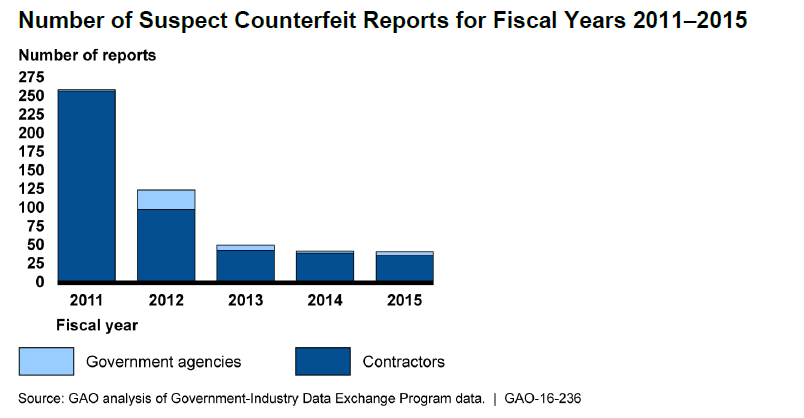 Your initial impression of this graph might lead you to conclude that Counterfeit parts are on the decline...unless of course there are problems with the methods used in the reporting system. That's the conclusion reached in a Government Accounting Office (GAO) report titled "COUNTERFEIT PARTS: DOD Needs to Improve Reporting and Oversight to Reduce Supply Chain Risk 1." How about the reporting of Suspected Unapproved Parts (SUPs)? Consider this illustration: 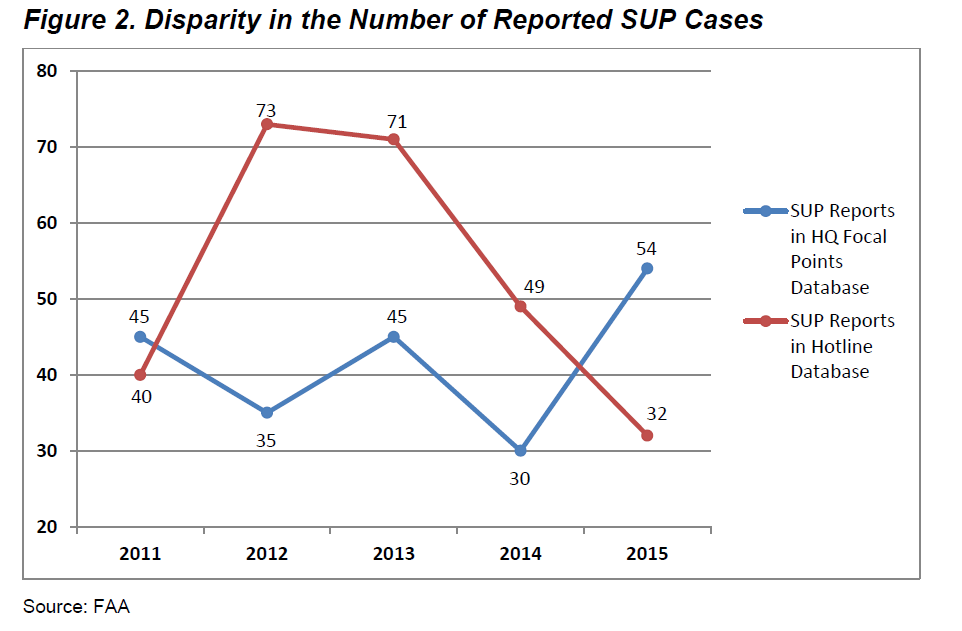 According to an FAA Report, the "FAA's" process for monitoring and investigating SUPs is not as effective as it could be, because of recordkeeping weaknesses and the lack of a management control to capture and accurately report the number of SUPs." This, from a report by the Office of Inspector General titled "ENHANCEMENTS ARE NEEDED TO FAA'S OVERSIGHT OF THE SUSPECTED UNAPPROVED PARTS PROGRAM 2" In this blog we'll address the following:
Selected topics from the Counterfeit Parts report including GIDEP information When it comes to jeans, purses, shoes, jewelry, watches, and paper money, counterfeit activity is well known and quantified, but what about our segment of business? Consider this from the GAO report: "Department of Defense (DOD) agencies and contractors submitted 526 suspect counterfeit parts reports in the Government-Industry Data Exchange Program (GIDEP) from fiscal years 2011 through 2015..." That figure should raise some eyebrows, especially considering that "The DOD supply chain is vulnerable to the risk of counterfeit parts, which have the potential to delay missions and ultimately endanger service members.1" For those of you involved in supplying parts and services to the DOD, I'd like especially to remind and/or introduce you to GIDEP, the Government-Industry Data Exchange Program. According to their website3: "GIDEP (Government-Industry Data Exchange Program) is a cooperative activity between government and industry participants seeking to reduce or eliminate expenditures of resources by sharing technical information essential during research, design, development, production and operational phases of the life cycle of systems, facilities and equipment." Now or in the future you will be required to participate in GIDEP by clause and/or DFAR. If you encounter any instances of impropriety including suspected counterfeit parts, the preferred means to report it is the GIDEP. The report cited some weaknesses with this process however, which the DOD has acknowledged and is in the process of fixing. These include the following portions of the report which I've bolded:
Observations and selected topics from the SUPs report Following Congressional hearings in the 90's, the FAA created a SUPs Program Office. It was the focal point for fixing known issues regarding unapproved parts. Part of its charter was to flow-down training to the rest of the FAA on how to handle SUP reports. By the way, for most of its years, the FAA Program Office was headed by Mr. Ken Reilly, who became a recipient of the ASA's life-time achievement recognition, the Edward J. Glueckler Award. The Program Office hosted and worked closely with the SUPs steering committee which the ASA and I participated in for many years. In 2007, the program office was disbanded after the Agency determined its functions had been firmly established at FAA offices at the regional, directorate, and local levels2. Although in theory the disbanding of the SUPs Program Office was based upon sound training and planning flowed down to other FAA employees and departments, this subsequent FAA report has determined that enhancements are needed to shore up apparent shortfalls on the handling of SUP issues. The issues identified in the report included:
The FAA response to the report was contained in a Memorandum (attached to the published report) in which the FAA concurs with all 11 recommendations and established closeout corrective-action deadlines. All very good developments. By the way, I researched the amount of FAA Unapproved Parts Notices since their inception. Here are the results in graph form: 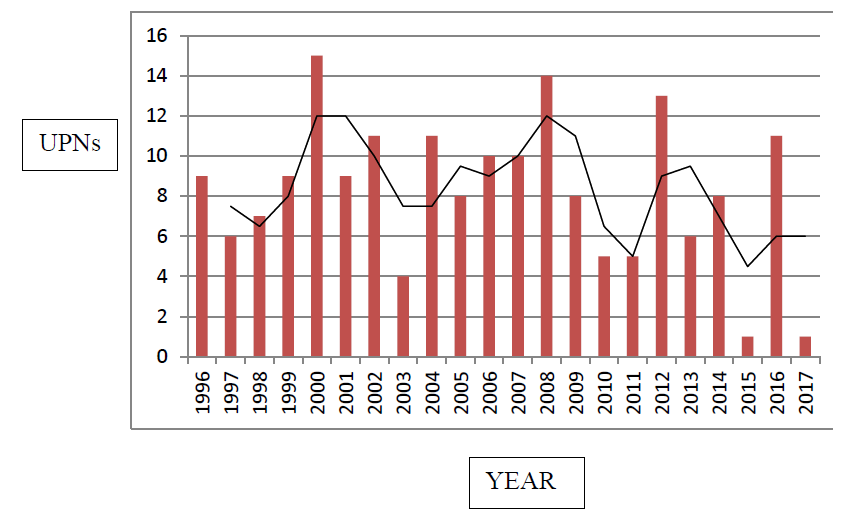 It seems the instances of UPNs are trending down. If that is the result of our industry taking effective steps to mitigate and eliminate Unapproved Parts, then that is a good thing. If however that is the result of less reporting and/or less of an industry focus on the issue, is not clear, and certainly remains un-analyzed and unquantified. Since the disbanding of the FAA SUPs Program office, one of the things we don't have is in-depth analysis of quantified data. When the Program Office was active, we on the steering committee would see such useful analyzed data as follows (of course this is quite dated): 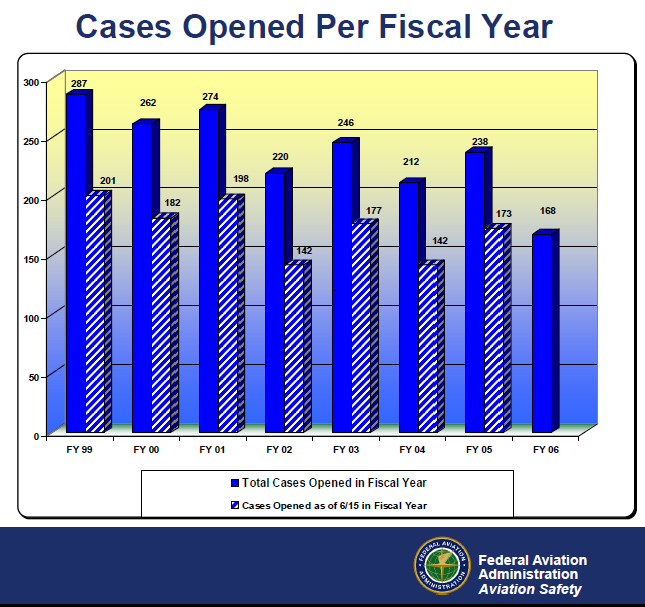 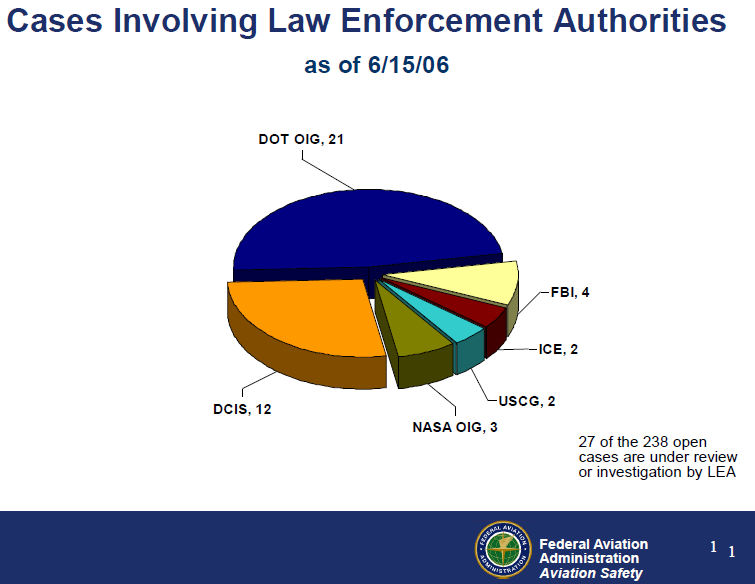 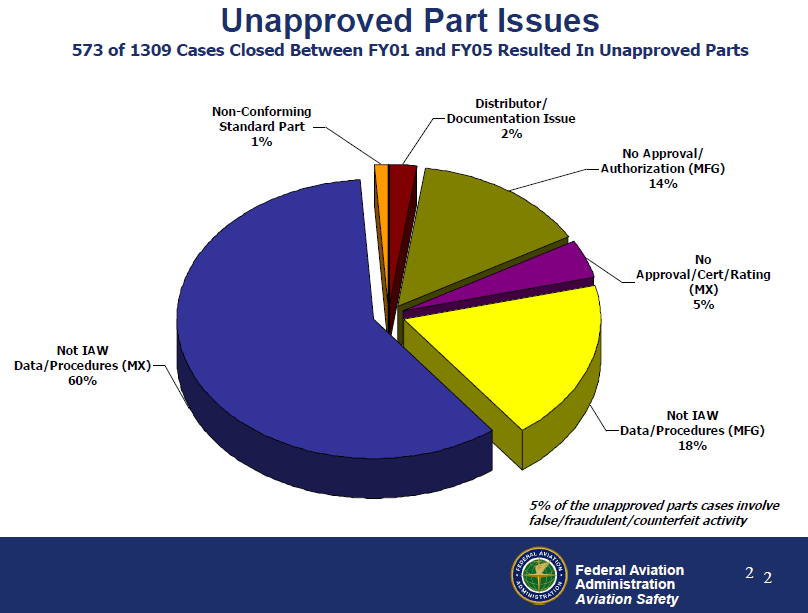 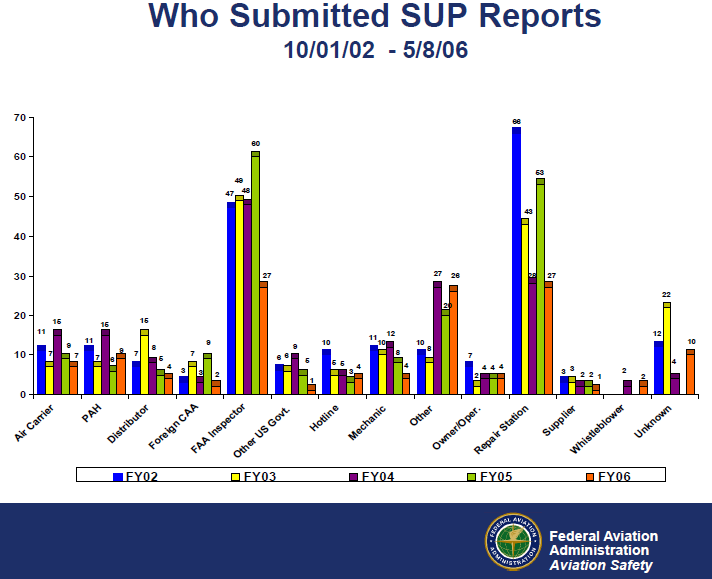 Today it does not appear we have such useful data. An interesting observation regarding the report is that it seemed to focus exclusively on Hotline reports (calling in a report). Certainly there are other means of reporting such as use of the FAA Form 8120-11, Suspected Unapproved Parts Report. It would have been interesting to see the same investigative report cover a broader scope of reporting. Also, it would be interesting to see the raw numbers for all types of reporting; are they on the decline? Keep in mind that although we see UPNs, we in the public don't know how many reports are being submitted. In my opinion this is an important indicator of program effectiveness. Also, in the same way I encouraged those in the DOD market to sign up for GIDEP reporting, I encourage anyone in Quality and Logistics in the civilian sector to access FAA Unapproved Parts Notices (UPN) and sign up for distribution of all new notices. Go to the FAA UPN website4, pick a year, and click on the email icon. You don't need a pw.
CONCLUSION: Both reports should be welcomed by our industry community in that they identified areas which could be improved upon, with the DOD and FAA both largely acknowledging the report's recommendations. Advancements are thus forthcoming. Finally, we are tempted to wonder if the DOD and FAA collaborate on investigations; intelligence sharing for example? There is some recent evidence to indicate yes, thankfully. In 2016 the FAA issued a UPN on counterfeit parts. Based on background information not reflected in that UPN, it is almost certain the FAA UPN was based on DOD reports and investigations. One thing is for sure, counterfeit parts and other types of unapproved parts are not going away. Let's hope the industry has indeed instituted effective countermeasures into our routines to properly mitigate this activity. Bravo to the FAA and DOD for leading the way. Over 'n out Roy 'Royboy' Resto www.AimSolutionsConsulting.com 1COUNTERFEIT PARTS: DOD Needs to Improve Reporting and Oversight to Reduce Supply Chain Risk; Report Number GAO-16-236; Date Issued: February 2016; Government Accounting Office 2ENHANCEMENTS ARE NEEDED TO FAA'S OVERSIGHT OF THE SUSPECTED UNAPPROVED PARTS PROGRAM; Federal Aviation Administration; Report Number: AV2017049; Date Issued: May 30, 2017 3 http://www.gidep.org/about/about.htm 4 https://www.faa.gov/aircraft/safety/programs/sups/upn/ THE VALUE OF TEAR-DOWN REPORTSPosted By Roy Resto | June 06, 2017
Some documents, as Rodney Dangerfield might say, ‘’’…get no
respect.” That is of course, until the mud hits the fan. So it is with the supposedly
lowly tear-down report. Day in and day out we routinely check for the presence
of these documents, checkoff a box on our receiving checklist, then add them to
the scan/file pile. Done. There are situations however, when those reports are
going to demand a lot of attention, which is the focus of this blog. Tear-down reports may go by many names such as ‘Work Shop
Reports’, ‘Shop Findings’, and ‘Work Order’, among others. Essentially they are
a summary of the work performed, parts replaced, the reason those parts were
replaced, and other pertinent data. Generally the regulations of the respective
country’s Civil Aviation Authority require such information be recorded when
aircraft components are being repaired and overhauled. The tear-down report
accompanies the Airworthiness Release Certificate such as an EASA Form 1 or FAA
8130-3. Many times preliminary tear-down reports are created in
order to facilitate the customer quoting process. For example, a maintenance
shop receives a component for overhaul but first the customer wants a quote of
what the price will be before authorizing the commencement of work. In this blog we’ll review the following: 1) Reliability: Identifying trends
in failed parts 2) Establishing warranty claims 3) Does the stated work and parts
replaced align with the price charged? Sidebar Fun Fact: Rodney Dangerfield, whose name at birth
was Jacob Cohen, took on his stage name based on a cowboy character in a Jack
Benny radio show. Reliability:
Identifying trends in failed parts I recently attended the AMC/AEEC (Avionics Maintenance
Conference/Airlines Electronic Engineering Committee) Conference; more on them
later1. The AMC for many
years has been a platform for airlines to collectively express their concerns
with certain Avionics systems and components. Their questions and concerns are
submitted ahead of the conference so as to give the respective OEM and/or
airframer the opportunity to respond during the conference. The entire process
is quite orderly and organized, and typically well researched. I estimated there
were about 600 attendees from around the world made up mostly of Avionics
Engineers, Customer Support Representatives, and Avionics Maintenance Managers,
among others. What follows is a classic use of tear-down reports which
were analyzed in order to address reliability problems. This is a redacted
posting from one of the discussion items: “An
analysis of 124 landing light assemblies’ teardown
reports was accomplished over the period xx/xx/xx to xx/xx/xx with the top
issues reported as lens cracked/broken (77%), wire harness cracked/broken
(77%), and lamp harness open (61%). (Airline) xxx and (OEM) xxx reviewed a
corrective action plan to improve the lamp harness with a service loop
(bulletin). (Airline) xxx has just implemented this so it’s too early see if
this action will correct the harness issues.” When component
removal rates within an ATA chapter exceed a specified threshold, alerts are generated
and issued to the airline maintenance organization. Investigative actions
typically include analysis of tear-down reports as just illustrated. Establishing warranty claims Warranties
for components that have undergone maintenance typically extend to the work
performed and the parts replaced at the last visit. When there is a premature
removal from the aircraft, the question arises by the operator if the part is
under warranty, and if so, to return the part for a warranty claim to the
maintenance shop. The maintenance shop will have to analyze two questions to establish
whether they will honor a warranty claim:
Enter
the Tear-down report. A simple example: The part was removed from the aircraft
after 2 months since the last shop visit. At the last shop visit the failure was confirmed by the removal and
replacement of transistor Q1. The unit passed all subsequent tests and was
returned to service. This time however,
the failure is confirmed by the removal and replacement of transistor Q2, which
was not touched the last time since it was working just fine. Will the warranty
be honored? To be clear, I don’t wish to get into a side discussion about
warranties, but it should be evident that referring to the details contained in
tear-down reports help establish grounds for warranty claims. Does the stated work and parts
replaced align with the price charged? You
just charged your customer a hefty price for an overhaul. You can expect that tear-down
report to receive quite a bit of attention. Hopefully the work performed and parts
replaced align with the price you charged or you can expect an ear-full. Irresistible
sidebar: Rodney Dangerfield famous one-liners:
1AMC/AEEC background: From their
respective ARINC website: · About AMC: The AMC is an air transport industry activity organized by ARINC Industry Activities. The objectives of AMC are to promote reliability and reduced operating cost in air transport avionics by improving maintenance and support techniques through the exchange of technical information. AMC consists of representatives from the technical leadership of the air transport avionics maintenance community. The voting membership of AMC consists of the representatives of commercial air transport operators. · About
AEEC: The Airlines Electronic Engineering Committee (AEEC) creates value for
airlines and the aviation industry by developing engineering standards and
technical solutions for avionics, networks, and cabin systems that foster
increased efficiency and reduced life cycle costs for the aviation community. It’s
been my experience that these groups over the years have quietly, continuously,
and collaboratively made significant contributions to increased reliability,
standardization, and safety. Over ‘n
out Roy
‘Royboy’ Resto AFTERMARKET TAGS: Overhauled vs Repaired vs 2 YearsPosted By Roy Resto | April 04, 2017
Time to stir the pot again I continue to hear moans about the issues we’re about to discuss, so I dusted off and updated this classic prose which will address the purchasing of aftermarket spares (other than new condition). Many of you have shared privately with me that you forwarded links to the older blog to your customers, and this too prompted this update. In this blog we’ll review the following:
OVERHAULED vs. REPAIRED or INSPECTED. I’m perplexed that so many purchasers continue to demand that parts, other than new, on the aftermarket must be in “Overhauled” (OH) condition. That’s for every part. Everyone knows that you will be charged more for OH condition than for Repaired or Inspected parts. When I question the practitioners of such requirements, the first answer I get is “It’s our policy.” OK, what’s that policy based on? If the person wears glasses, they’re seen to slide the spectacles down to the tip of their nose, and lower their head; the better to give your direct eye contact while they give you the lecture you deserve. “Why, don’t you know (you silly boy) that Overhauled parts last longer on the airplane? This translates to requiring fewer spares.” And there it is, the reason for the policy. Here are some thoughts to challenge that:
Let’s forget about statistics for a moment. First jot down a few parts you’d like to test and research. Start with your engineering department. Ask if any of the following programs address the parts you’re researching: MRB (Maintenance Review Board), MPD (Maintenance Planning Documents), and the MSG (Maintenance Steering Group) programs for your aircraft. A discussion of these programs is beyond the brevity of this blog, but your reliability engineer will assist. Suffice it to say that these programs form the basis for your Maintenance Operations. Do any of these address your components? Does it say anywhere that the part must be overhauled upon removal or replacement? There may be a few, but these are in the minority; it’s likely you will not find any such requirements for the majority of parts on your list. OK, let's assume you can’t substantiate the 100% Overhaul Policy through any of those documents. Talk to your reliability engineer and ask if there has been any past “history” forming the basis of the overhaul policy. If not, talk to the engineer and apprise them that you are switching your policy to accept Repaired or Inspected parts. The engineer will monitor the MTBF (Mean Time Between Failure) trends. If there is a correlation between MTBF negative trends and the use of Repaired and Inspected parts vs. Overhauled parts, then your policy would be vindicated. I’m here to prophesy to you that you’ll likely not see any such negative trends. Such data would form the statistical basis for your policy if it existed. If you don’t have it, why continue doing business the same expensive way? Read on please.
Most Component Maintenance Manuals (CMM) do not literally contain “overhaul” instructions. If this is true how can repair stations accommodate your request to have parts overhauled? Let’s look at an example. Let’s assume you have an avionics computer of some sort. Its CMM does not contain any ‘overhaul’ instructions (just the typical inspection, check, and repair instructions), but you insist that it be in overhaul condition. They’ll be happy to accommodate you, and the expected higher fees they’ll charge, by following the FAA’s definition of ‘Overhaul’ found in FAR 43.2. It states that no person may describe a part as being overhauled unless “Using methods, techniques, and practices acceptable to the Administrator, it has been disassembled, cleaned, inspected, repaired as necessary, and reassembled; and it has been tested in accordance with…”. So, the CMM would not have required a disassembly and cleaning unless there was a failure of some sort, but because you insist on an Overhaul, they’ll do it anyway so as to meet the requirements of the FAA’s definition of Overhaul, and to be able to list its condition as such in block 11 of the 8130-3. Keep in mind this was a simplistic example, but it is quite realistic.
One more thing, a subject for profound thought and fluttering of the eyebrows: there is a great body of folks in our industry whom believe that parts should not be disassembled unless specifically called for in a CMM because this act in itself greatly increases the risks that an error, bug, or mechanical deficiency could be introduced when reassembled; such is the reality when human factors are involved, so keep in mind that your insistence for fulfilling the requirement for an overhaul may introduce the very reliability problems you thought you’d avoid with the overhaul policy.
I’d like to conclude the discussion on the OH requirement by addressing a veiled apprehension: You may be concerned about the parts you buy on the aftermarket, and thus have those concerns assuaged by having all the parts Overhauled. I may not be able to argue you out of that position, but I do suggest the following: Send it to the MRO of your choice, and ask them to inspect and repair the part as necessary. In addition, specifically ask for a hidden damage inspection on your Repair Order. They’ll look at it closer, and you’ll likely get charged less that a full overhaul. Cool idea huh? Oh, and one more thing (I feel the urge to pontificate): If you feel proud of the fact that you supposedly have a higher standard requiring the overhaul policy, I’m here to tell you that you’re selling yourself short. A higher standard than overhaul is the condition of “Rebuilt” (ref FAR 43.2). Yes this is an acceptable term for block 11 of an 8130-3. Your part will meet all the testing requirements of a new part with the exception that it did not just roll off the assembly line. Price that with the OEM! TWO YEAR TAGS: Another black and white policy that continues to make me shake my head in amazement is some operator’s policy that any parts purchased must have tags no older than two years. When I ask why, the glasses are seen to slide to the front of the nose again. “Don’t you know (you silly boy) that parts can deteriorate or degrade just sitting on the shelf?” Oh brother…, What are the historical arguments for this policy?
First, what ever happened to following manufacturer’s recommendations for shelf life as may be contained in a CMM if applicable? Typically, if there is a shelf or storage life, the CMM will contain it in its Storage section, or equivalent, of the manual. If it does not exist, why pay for the additional expense of having it sent back to a shop for a fresh tag? Alternatively, this is only defensible if you have supporting statistical or reliability issues as previously discussed. Do you?
Questions about SB’s, AD’s, or software changes that may have taken place while on the shelf represent the best concerns for the 2 year tag defense. Let’s not overlook the obvious, however: if this is indeed your concern, those issues could have manifested themselves in the two year time frame for the parts you’d accept with tags less than two years, right? So how do you currently address that possibility? The person is seen to retract the glasses to its proper position on the nose bridge. A probable response is that you know the product you are assigned to purchase, and thus would likely know about AD, SB, or software issues. Your Purchase Order (PO) should always include special instructions to your supplier that you require the part delivered with SB’s, AD’s or software installations accomplished when applicable. After all, there are many SB’s, AD’s and Software installations whose implementation method and requirements depend on the operator’s management of those issues. Finally, we are fortunate that many SB’s, AD’s, and Software installations change the part number, so if you get the part number you’ve ordered you’ve likely got the AD, SB, or software level required. If still worried, put the required level on the PO. Over ‘n out. Roy ‘Royboy’ Resto AimSolutionsConsulting.com PACKAGING OF AIRCRAFT PARTSPosted By Roy Resto | February 01, 2017
Would you like me to
gift-wrap this for you? We wish that packaging of aircraft parts was as
easy as adding a satin bow and ribbons to make it look pretty. The fact is that
proper packing and preparation for shipment of aircraft parts requires a degree
of know-how, and in some cases knowledge of some fairly specialized processes
or procedures. Consider some of these topics, applicable as required:
That's a lot, and to get it right every time means you have a good crew in the shipping department, so don't forget to thank these unsung employees for their efforts. In aviation there is a standard for just about everything, and there is no exception for packaging aircraft parts. My experience is that deliveries destined for Government or Defense customers tend to have the most burdensome requirements. Globally, for both the Civilian and Government/Defense markets, consider the following available standards:
Why do I need the ATA Spec 300? For all of you who are Accredited to the ASA-100, you are
required to have this on-hand and available per the standard. The first release of this specification went
back to the 90's, when many airlines had the requirement in their T&C's to
assure the parts purchased were packaged in accordance with the spec. Many
firms today still state this T&C on their Purchase Orders. In fact it was
not just the ASA-100 that required use of the spec. CASE and ATA Spec 106 also
called for it. Many are under the assumption that the spec exists only to
designate how those hard-shelled shipping cases are designed, such as this
well-worn example: 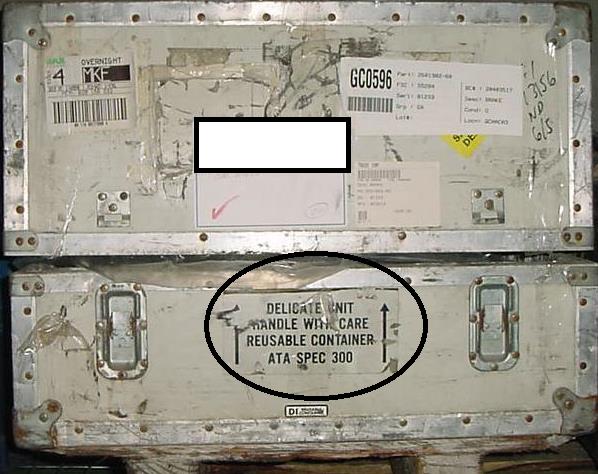 Note the ATA Spec 300 designation within the circle. There are, according to ATA Spec 300, three categories of
packaging:
The picture above is
of a Category I box. It's going to survive at
least 100 round trips. Unless you're an engineer, you're unlikely to set
about designing a Category I box. The Spec has all the engineering requirements
for construction and testing of the box to assure conformity. There are firms
that specialize in building these in case you're ever asked to provide these
for your customer. Needless to say,
they're expensive, and are typically used to protect costly rotables. If you're a repair station and your customer
sends you product in these, you had better send it back in the same box lest
they charge for a replacement; trust me. Many repair stations don't account
for these during the receiving process and subsequently ship the part back
without it; you're going to hear about it. In fact many of you are already, likely shipping parts in
packaging that is Category III compliant, and you may not be aware of it.
Here's a picture of some category II packaging: 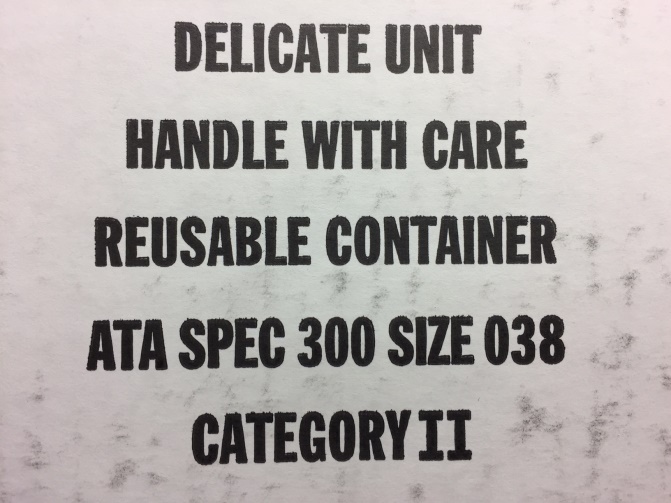 What else about the
Spec 300?
By the way, regarding the use of ‘peanuts’ as
interior cushioning, the spec states “Miscellaneous wadding such as newspaper
or rags, and loose fill packing materials such as plastic 'chips' or 'peanuts'
shall not be used as dunnage or cushioning material.” MIL-STD-2073-1: ATA Spec 300, all 36 pages, may seem complicated in some
aspects. If so, MIL-STD-2073-1 is a heavyweight at 208 pages. If you're
consulting this Military Standard, it's only because you have been required to so
by a government solicitation award contract. Some shippers of these parts find
the Standard complicated and beyond their core skill sets. Because of this,
there are firms that have specialties in packaging meant to meet the Standard. In
some cases a government Inspector must inspect the parts and packaging before
it's shipped to the government. These Inspectors typically represent the DCMA
(Defense Contract Management Agency). Whereas ATA Spec 300 recognizes and defines the three aforementioned categories, the
Mil-Std generally recognizes over 18, which are called ‘Methods’. For example: Method 10 -
Physical protection Method 20 - Physical protection with preservative (with greaseproof wrap, as required) Method 30 -
Waterproof or waterproof-greaseproof protection with preservative Method 31 -
Waterproof bag, heat sealed Method 32 -
Container, waterproof bag, heat sealed Method 33 -
Greaseproof-waterproof bag, heat sealed Method 40 - Water vaporproof protection with preservative as required Method 41 - Water vaporproof bag, heat sealed Method 42 -
Container, water vaporproof bag, heat sealed, container Method 43 -
Floating water vaporproof bag, heat sealed Method 44 -
Rigid container (other than metal), sealed Method 45 -
Rigid metal container, sealed Method 50 - Water vaporproof protection with desiccant Method 51 - Water vaporproof bag with desiccant, heat sealed Method 52 -
Container, water vaporproof bag with desiccant, heat sealed, container Method 53 -
Floating watervaporproof bag with desiccant, heat sealed Method 54 -
Rigid container (other than metal) with desiccant, sealed Method 55 -
Rigid metal container with desiccant, sealed And... as those cheesy $19.95 TV
commercials always state: But wait!
There's more! The standard includes references to these other nifty specifications: QQ-A-1876 -
Aluminum Foil. PPP-B-1672 -
Box, Shipping, Reusable with Cushioning. A-A-3174 -
Plastic Sheet, Polyolefin. MIL-DTL-117
- Bags, Heat-Sealable. MIL-PRF-121
- Barrier Materials, Greaseproof, Waterproof, Flexible, Heat-Sealable. MIL-PRF-131
- Barrier Materials, Watervaporproof, Greaseproof, Flexible, Heat-Sealable. MIL-PRF-3420
- Packaging Materials, Volatile Corrosion Inhibitor, Treated, Opaque. MIL-D-3464 -
Desiccants, Activated, Bagged, Packaging Use and Static Dehumidification. MIL-DTL-6060
- Bags, Watervaporproof, Heat-Sealable, Complex. MIL-I-8574 -
Inhibitors, Corrosion, Volatile, Utilization of. MIL-PRF-16173
- Corrosion Preventive Compound, Solvent Cutback, Cold-Application. MIL-PRF-22019
- Barrier Materials, Transparent, Flexible, Sealable, Volatile Corrosion
Inhibitor Treated. MIL-DTL-22020
- Bags, Transparent, Flexible, Sealable, Volatile Corrosion Inhibitor Treated. MIL-PRF-22191
- Barrier Materials, Transparent, Flexible, Heat-Sealable. MIL-PRF-81705
- Barrier Materials, Flexible, Electrostatic Protective, Heat-Sealable. MIL-STD-129
- Military Marking for Shipment and Storage. MIL-STD-3010
- Test Procedures for Packaging Materials. MS20003 -
Indicator, Humidity, Card, Three Spot, Impregnated Areas (Cobaltous Chloride). Hmm…that
$600 hammer (of dubious fake news fame) has
to be packaged in MIL-STD-2073-1 compliant material, I’m sure… Over ‘n out
Roy ‘Royboy’
Resto AimSolutionsConsulting.com AIRCRAFT BIG DATA, ANALYTICS, AND THE AFTERMARKETPosted By Roy Resto | December 01, 2016
When I hear popular culture terms, I tend to borrow the
lingo so I don’t seem remote and out of touch. A term I’ve heard bandied-about
is ‘TMI’, or Too Much Information. ‘TMI’ might be uttered by you following a
conversation with an acquaintance who shared information that was socially
awkward, over-the-top, or just plain overwhelming. But this is the age of
information, which reportedly is the new gold standard. If so, when is
information too much? Having information or data does not necessarily make you smart;
any more than having a big collection of books in your home or office library
makes you well-read. Data becomes gold
when we put it to work for us. And so it is with the big data being
generated by today’s aircraft. So Royboy, TMI? What
TMI? Consider the following: “An A320 generates information from about 20,000 data sources, Airbus
says, compared to 200,000 for an A380 and more than 400,000 for an A350.” 1 How about: “Take an average jet engine from a commercial airliner, which can be
equipped with over 5,000 individual sensors, as an example. According to SAP
business software, these engines can generate around 20 terabytes of data per hour.”2 And there you have it; that
is big data! Let’s develop this; there are many dots to connect.
Here are the topics to be discussed:
SOURCES OF THE DATA: In order to gain a proper perspective on the evolution and
typical sources of aircraft data, I encourage you to read a previous blog: “AUTONOMIC
LOGISTICS”, here’s the link: http://www.aviationsuppliers.org/index.asp?bid=222&BlogEntryID=76&FormID=300 IMMEDIATE USES: Various OEMs are going to call these uses by any number of
names, but generically we can refer to the following: · Aircraft/Engine/Helicopter Health Monitoring:
Simply, the data being generated is telling us something has failed. · Predictive Maintenance: Based on trending data,
something, if left unaddressed, may fail in the near future. · Analytics: This emerging field is software based
and designed to sift through the reams of data and perform the required
analysis. The desired result is that, in the parlance of the CIA and NSA, you
get ‘actionable intelligence’. COLLATERAL USES: Here are the existing and developing uses of all this data:
http://www.aviationsuppliers.org/CHRONIC-OR-ROGUE-PARTS
WHO WILL MINE THE
DATA? Right now the big airframers offer fee-based programs for
operators. The engine OEMs are very strong in similar programs, and perhaps
history will write that they indeed pioneered the evolving techniques.
Following the airframe and engine OEMs are the OEMs of the systems and LRUs,
particularly since the aforementioned issues of reliability and warranty are in
play; they are highly motivated to mine the data for those reasons, and to perform
what I call ‘Targeted Analytics’. How about MROs? Many airlines outsource a significant
portion of their maintenance programs to MROs. This ranges from line
maintenance, to component maintenance, to full airframe and engine overhauls. Will
the airline give big data access to the MRO? Will the airline accept the MRO fees
for acting on ‘actionable intelligence’ derived from management and analysis of
the data? POSSIBLE EFFECTS UPON
THE AFTERMARKET: Currently, other than the aforementioned OEM use of the
data, there does not appear to be direct aftermarket use of the data; indeed
its use is still evolving. In the near future however, there will be a
trickle-down effect upon the accuracy of the following:
ALIS is going to be the harbinger
and standard-setting system by which such big data integrates into logistics
and aftermarket support systems. What works and doesn’t work is going to have a
major trickle-down effect on nascent civilian programs. FUTURE ENHANCEMENTS:
o
Assist operators and manufacturers to attain and
maintain higher reliability through trend monitoring o
Evaluate if certain problem areas are unique to
an operator or observable throughout the industry o
Monitor which modification has a better payback
by comparing removal and failure rates of operators who have incorporated
various service bulletins/modifications o
Determine utilization rates through aircraft
flight hours, flight lengths and number of landing cycles o
Assist operators and manufacturers in
determining the effectiveness of aircraft maintenance programs There is no doubt that the new big
data will progressively become the source of such information sharing systems. BROAD ACCEPTANCE HAS
BEEN SLOW
Finally, it seems that broad acceptance and implementation
of the benefits of aircraft big data has been slower than anticipated1.
This is curious since OEMs continue to market their data-driven support systems
as producing maintenance savings of approximately 10-15%. How about: “…with 10 times return on investment for aviation companies and a
potential 70 to 75 percent reduction in airplane breakdowns, there is a clear
case for automated predictive maintenance in the aviation industry.”2
Sounds convincing,
but reluctance may be driven by the following:
We’ll see… Over ‘n out Roy ‘Royboy”
Resto AimSolutionsConsulting.com 1 Surely,
but Slowly; Aviation Week & Space Technology; April 11-24, 2016; Page
36
2 http://www.aviationpros.com/article/12236185/man-versus-machine-aviations-predictive-maintenance-challenge |