Posted By Roy Resto | January 29, 2026
I’m writing this article because of the great variation seen in the distribution community regarding the inspection staff who are typically the receiving and shipping inspectors. I encounter many inspectors that I would be proud to have on my own staff in the aircraft operations world or MROs, yet others who frankly may be better suited to sales, purchasing, or administration functions. We’ll come back to this occurrence towards the end and solicit your opinion.
It’s interesting that in many quality systems both in aviation and otherwise, there is the concept of certified inspectors. “Certified” in the broadest sense meaning that these inspectors are formally designated, approved, or literally certificated. Here are some interesting ones:
- CQI: Certified Quality Inspector (CQI). According to the ASQ1: “The Certified Quality Inspector is an inspector who, in support of and under the direction of quality engineers, supervisors, or technicians, can use the proven techniques included in the body of knowledge. Under professional direction, the quality inspector evaluates hardware documentation, performs laboratory procedures, inspects products, measures process performance, records data and prepares formal reports.”
The training for this is quite broad and rigorous and of course is subject to testing. The training involves many topics familiar to Quality Engineers.
- IDEA-ICE-3000 Professional Inspector Certification. For firms which manufacture or distribute electronic products for the defense, consumer, and aerospace markets, the prevention of counterfeit electronic components from entering the supply chain is the focus of new quality standards and mitigation measures. For more information on this phenomenon, read my article on Counterfeit Electronic Parts; https://www.aviationsuppliers.org/counterfeit-electronic-parts
According to one supplier of such parts2:
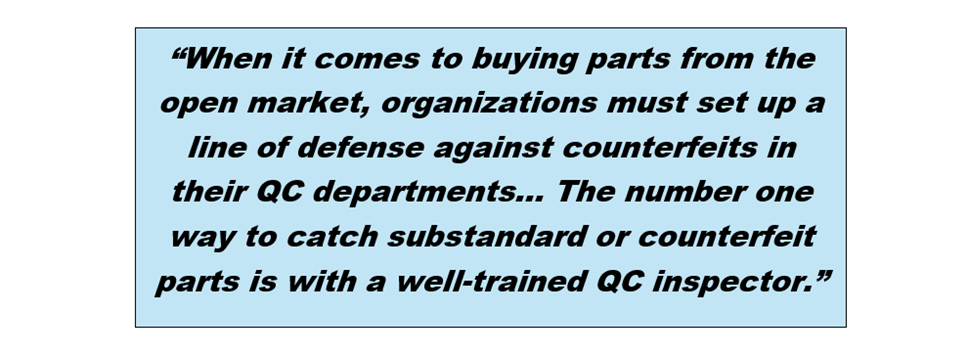
The certification of inspectors for this purpose is administered by IDEA and is based on a standard called IDEA-STD-1010: Acceptability of Electronic Components Distributed in the Open Market. Companies requiring their inspectors to be certified to this standard must follow the process described in the program IDEA-ICE-3000 Professional Inspector Certification Exam3. The program involves training and testing.
- RII Inspectors: Required Inspection Items are generally defined as tasks where improper maintenance or improper parts could result in a failure, malfunction, or defect endangering the aircraft's safe operation. The task is considered critical for safety and therefor its performance must be countersigned (a ‘second set of eyes’) by a designated inspector authorized for RII specifically. Typical RII tasks include engine changes, work on the flight control system, and work on the pitot-static system among others.
- NDT/NDI Inspectors: In aerospace these Non-Destructive Testing/Non-Destructive Inspection employees are highly trained and use specialized equipment to evaluate materials, components, or systems for defects without causing damage, ensuring safety and reliability. These methods, including ultrasonic, radiographic (X-ray), magnetic particle, eddy current, and liquid penetrant tests, detect internal or surface flaws like cracks, voids, or corrosion, saving money and preventing failures. For each method there are levels of qualification, testing (written and practical), and recurrent training.
- Return to Service Inspectors: These are highly trained and licensed/certificated employees who are authorized by their firms to sign for products or articles following MRO (Maintenance, Repair, or Overhaul) activity as being airworthy and therefor are being returned to service (RTS). Typically, the RTS is attested for either on EASA Form 1, FAA 8130-3, or aircraft logbook entries, among others.
- For EASA, the employee typically must have Certifying Staff (B1/B2/C) License
- For the FAA, an Airframe and/or Powerplant, or Repairman Certificate
- Both must be authorized as such on the firm’s Roster (FAA) or Register (EASA).
As expected, in addition to the noted basic certifications or licenses, these inspectors are highly trained and authorized.
- FAA Inspection Authorization, IA: According to the FAA’s Inspection Authorization Information Guide4, .’… an IA may inspect and approve for return to service any aircraft or related part or appliance after a major repair or major alteration. Also, the holder of an IA may perform an annual inspection, and he or she may supervise or perform a progressive inspection.’
IA’s are typically very experienced A&Ps who must undergo testing, and initial and recurrent training.
- Designated Manufacturing Inspection Representatives, DMIR: A DMIR conducts conformity inspections during the manufacturing process. DMIRs also issue certificates such as airworthiness certificates for aircraft, export certificates for aircraft and parts, and special flight permits. A DMIR must possess aeronautical knowledge and experience, be employed by a Production Approval Holder (PAH), or a PAH's approved supplier, and meet the qualification requirements of FAA Order 8000.95, Designee Management Policy5.
There are other examples including DARs and ODA staff, but the point is made that the idea of certified inspectors is not new and in fact they play a key role in contributing to safety and quality.
Why the variation in inspector skill levels in the distributor community? Let’s talk.
- Excellent performance: Here the key is that they are looked upon with respect and have the authority to perform their duties. Here are some possible indicators:
- Low turnover.
- Regarding the method to document all discrepancies found during the receiving process: Consistent entries.
- Training exceeds the requirements of the manual and there is recurrent training. The inspectors are not just trained, they are competent. For more on this read an article I wrote titled "TRAINING VS COMPETENCY” at:
- https://www.aviationsuppliers.org/training-vs-competency
- Subpar performance: I have seen companies where the inspectors are looked upon as low-level hourly employees and treated as warehouse workers whose main purpose is to receive and ship products as quickly as possible so the salespeople can meet their quotas and commissions. There, I said it and I meant it. Here are some possible indicators:
- Higher than normal turnover.
- Regarding the method to document all discrepancies found during the receiving process: Very low amounts of entries.
- Documented training only meets the minimum requirements of the manual. There is no investment in raising the skill levels or additional training beyond the manual requirement. There is no recurrent training.
- The equivalent of the Quarantine or QA Hold area is empty or consists solely of parts to be scrapped or has a single part for window dressing for an audit (whew…yup).
- If the inspector doesn’t sign the C of C, a salesperson on the roster will.
Paralleling these ideas is an informative article about the importance of being an inspection roster. Here is the link: https://www.aviationsuppliers.org/the-importance-of-being-on-a-roster
The ASA has tinkered with the idea of having a program to certify distribution inspectors. If you have made it this far in article, you are greatly encouraged to leave your thoughts about this in the comments section below.
Make it happen, over ‘n out
Roy ‘Royboy’ Resto
www.AimSolutionsConsulting.com
Crafted without the use of AI.
1 - https://www.asq.org/cert/quality-inspector
2 - https://www.aeri.com/idea-ice3000-inspection-qualifications/
3 - https://idofea.org/inspector-certification/
4 - https://www.faa.gov/training_testing/testing/ia_info_guide.pdf
5 - https://www.faa.gov/other_visit/aviation_industry/designees_delegations/individual_designees/manufacturing